Every renter knows the sound: a shower caddy letting go at 6 a.m., bottles bouncing off the tub, shampoo pooling around the drain. It is tempting to blame the caddy, but most failures have nothing to do with build quality. They happen because the fixing was wrong for the surface, the load was heavier than the rating, or nobody waited for the adhesive to cure. This guide to no drill shower storage works through each method the way a shower actually treats it — steam, soap film, textured tile, and bottles that get heavier as they fill with water — then ranks the options honestly, with install steps and deposit-safe removal for each one. It sits inside the wider plan in our renter-friendly bathroom storage ideas for tiny bathrooms, and the same no-drill logic applies above the toilet in storage above a rental bathroom toilet without drilling. The Spruce’s small-bathroom storage ideas show more ways to use the same vertical space.
One test before you spend anything: clean a flat patch of tile with rubbing alcohol, press on a cheap suction cup, and hang a full shampoo bottle from it overnight. If it is on the floor by morning, your tile has ruled out suction and probably adhesive too, and you can skip straight to the tension pole section. If it holds, you have more options. Either way, measure your shower first: floor to ceiling height for a pole, the width of flat tile between grout lines for adhesive, and the thickness of your glass screen if you have one. Those three numbers decide everything that follows.
Why Shower Storage Falls: Steam, Soap Film, Texture and Wet Weight
A shower is the worst room in the home for anything stuck, hooked, or wedged, and it helps to know exactly what you are fighting.
Steam and heat. A hot shower raises the temperature and humidity around the fixing every single day. Suction seals soften and creep as the air behind the cup warms and expands. Adhesive strips rated for bathrooms tolerate this better, but bargain strips soften noticeably. Temperature cycling — hot shower, cold room, hot shower — works fixings loose the way bending a wire back and forth fatigues it.
Soap film. Tile in a working shower is coated with an invisible layer of soap scum and conditioner residue. Both suction and adhesive bond to that film instead of the tile, and the film itself is slippery and weak. This is why a caddy can hold for a week and then let go all at once: the bond was never to the wall. A scrub with a degreasing cleaner, then a wipe with rubbing alcohol, is not optional prep — it is the difference between the two outcomes.
Texture and grout. Suction needs a continuous seal. Matte, tumbled, embossed, or natural-stone tile leaks air under the cup from the first minute. A grout line crossing under a cup or an adhesive pad does the same thing more slowly. Many rental showers are tiled in exactly these finishes, which is why “it worked at my last place” proves nothing.
Wet weight. Bottles get heavier in use, not lighter: they fill with water under the cap, a pump bottle of conditioner weighs roughly 1 lb (450 g) on its own, and a family-size shampoo can reach 2 lb (900 g). A caddy holding four large bottles may be carrying 5–7 lb (2.3–3.2 kg) before anyone touches it — and then someone presses down on a pump, adding a sharp downward load. Package ratings assume a static, evenly spread load on a perfect surface. Your shower offers neither, so treat every rating in this guide as a ceiling to stay well under, not a target.
Tension-Pole Corner Caddies: The Benchmark for No-Drill Shower Storage
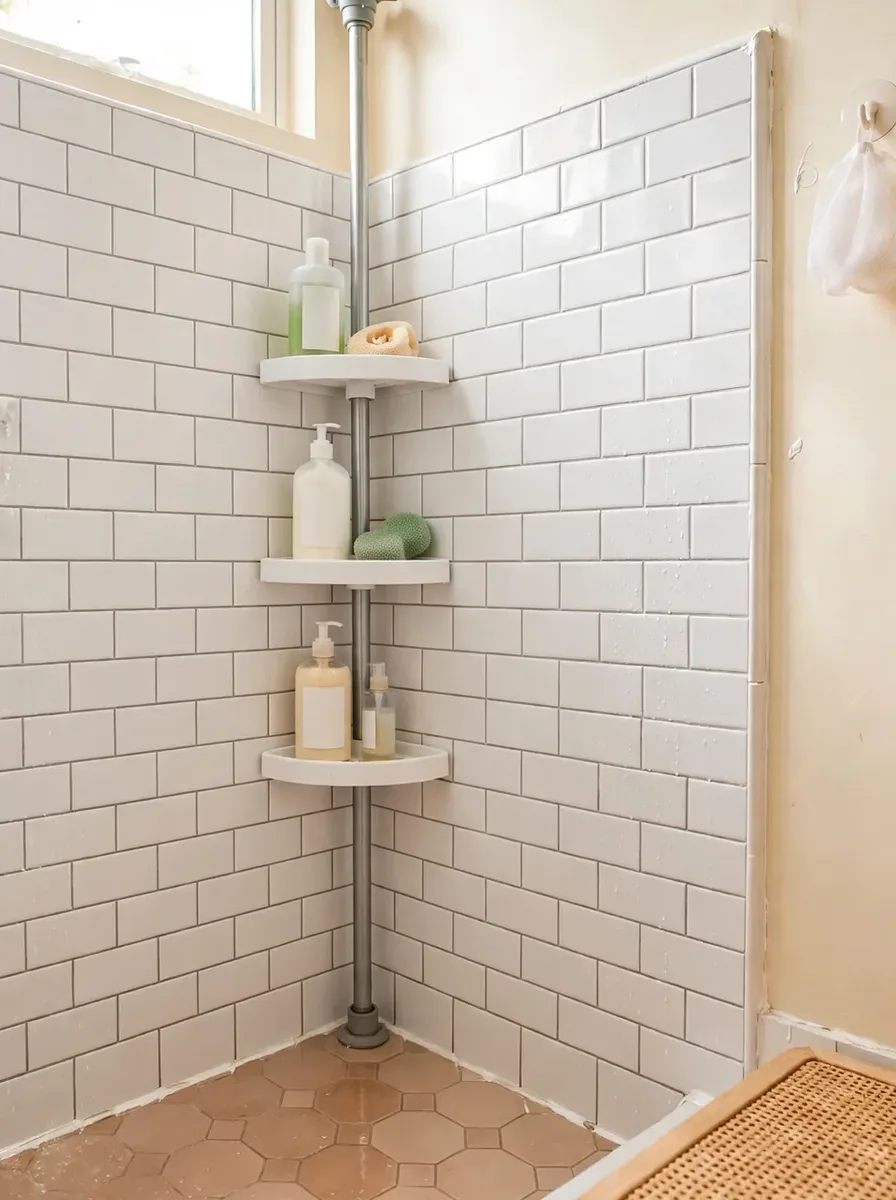
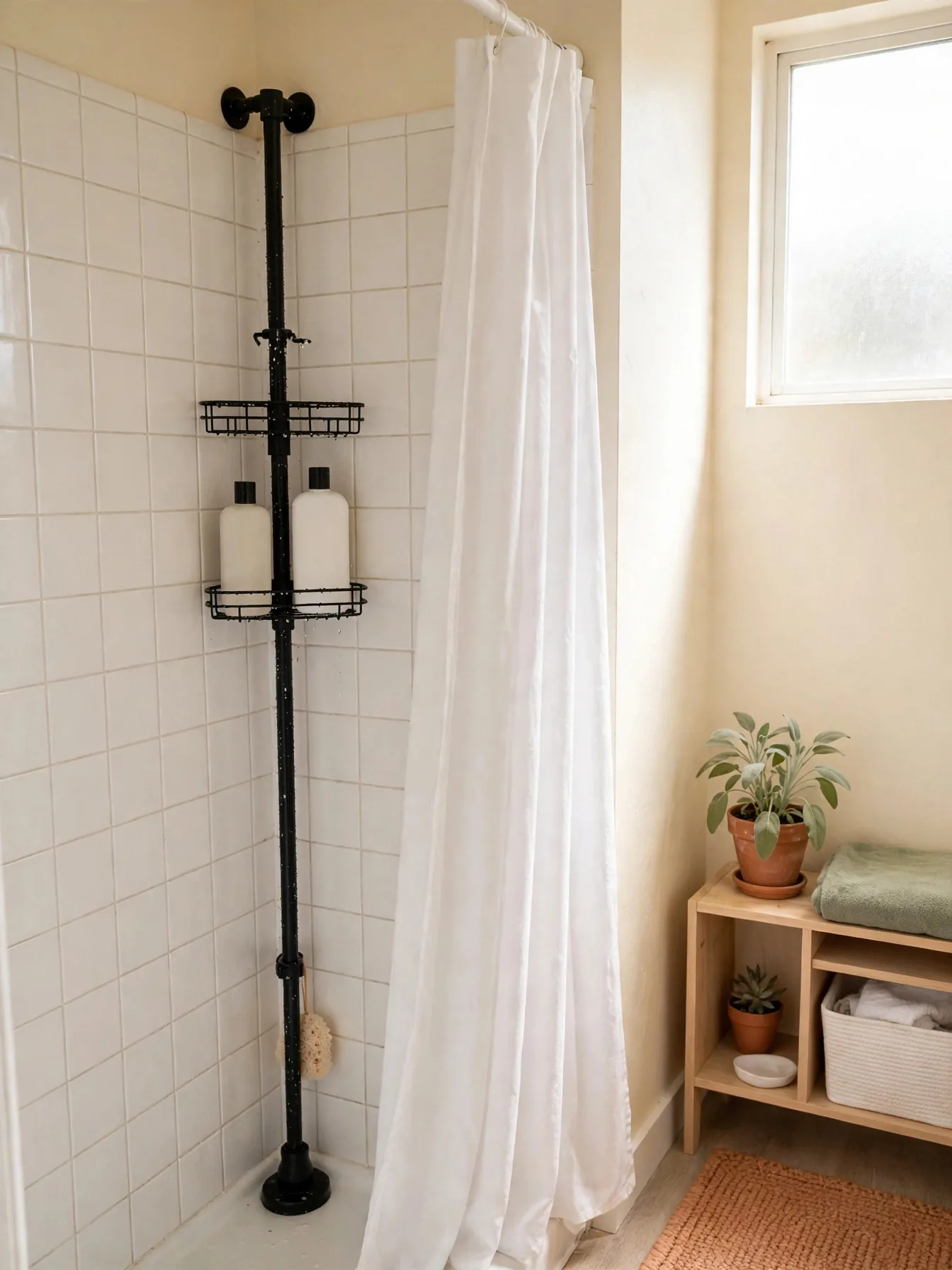
The tension pole is the most reliable no-drill option because it ignores your tile completely. A spring-loaded or screw-tightened pole wedges between the tub floor (or shower tray) and the ceiling, and the baskets hang from the pole, not the wall. Steam, texture, and soap film are simply not part of the equation.
Measure first. Poles typically extend across a range such as 60–108 in (152–274 cm) or 70–120 in (178–305 cm), so measure your floor-to-ceiling height at the exact corner where the pole will stand — ceilings slope, and the measurement over the tub is often an inch or two (2.5–5 cm) less than at the room’s centre. Choose a pole whose range has your height comfortably in the middle, not at either extreme. Baskets are usually 9–12 in (23–30 cm) wide and project about 5–7 in (13–18 cm) from the corner, so check the corner is genuinely spare space.
Install. Assemble the pole at roughly your measured height, stand it in the corner, then extend or twist until the top cap presses firmly against the ceiling and the base does not slide when pushed sideways. Fit the baskets before the final tightening — they are awkward to thread on afterwards. Put a thin rubber pad or a folded silicone mat under the top cap on a painted ceiling, and under the base on a smooth tray. Load the heaviest bottles on the lowest basket, and re-check the tension after the first week and then monthly; a quarter-turn is usually all it needs.
Honest limits. Most poles carry package ratings around 15–30 lb (7–14 kg) total across all baskets — plenty for one or two people’s bottles, not for a shelf of family-size everything. The pole also needs a solid ceiling: a suspended or very soft ceiling can flex or mark, and a sloped ceiling over a tub may not give the top cap a flat seat. On removal, release the tension slowly, lift the pole out, and wipe the two contact points — there should be nothing else to repair, which is exactly the point.
Cost. Roughly $25–$60 for stainless or better aluminium poles; the cheapest chrome-plated poles sit nearer $20 and are the ones that rust (see the materials section below).
Required space: A genuinely spare corner from tub floor or shower tray to ceiling, with baskets 9–12 in (23–30 cm) wide projecting about 5–7 in (13–18 cm) from the corner.
Installation: Measure the floor-to-ceiling height at the exact corner where the pole will stand, assemble the pole at roughly that height, extend or twist until the top cap presses firmly and the base does not slide sideways, fit the baskets before the final tightening, and re-check the tension after the first week and then monthly.
Approximate dimensions: Poles typically extend across a range such as 60–108 in (152–274 cm) or 70–120 in (178–305 cm), and baskets are usually 9–12 in (23–30 cm) wide.
Rental-friendly limits: Most poles carry package ratings around 15–30 lb (7–14 kg) total across all baskets, and the pole needs a solid ceiling — a suspended or very soft ceiling can flex or mark, and a sloped ceiling over a tub may not give the top cap a flat seat.
Pros: The most reliable no-drill option because it ignores your tile completely, so steam, texture and soap film are simply not part of the equation.
Cons: Plenty for one or two people’s bottles, but not for a shelf of family-size everything, and it needs a solid, flat ceiling.
Suitable products: Stainless steel or better aluminium tension-pole corner caddy ($25–$60), with a thin rubber pad or folded silicone mat under the top cap and the base.
Hanging Showerhead Caddies: Convenient, With Real Limits
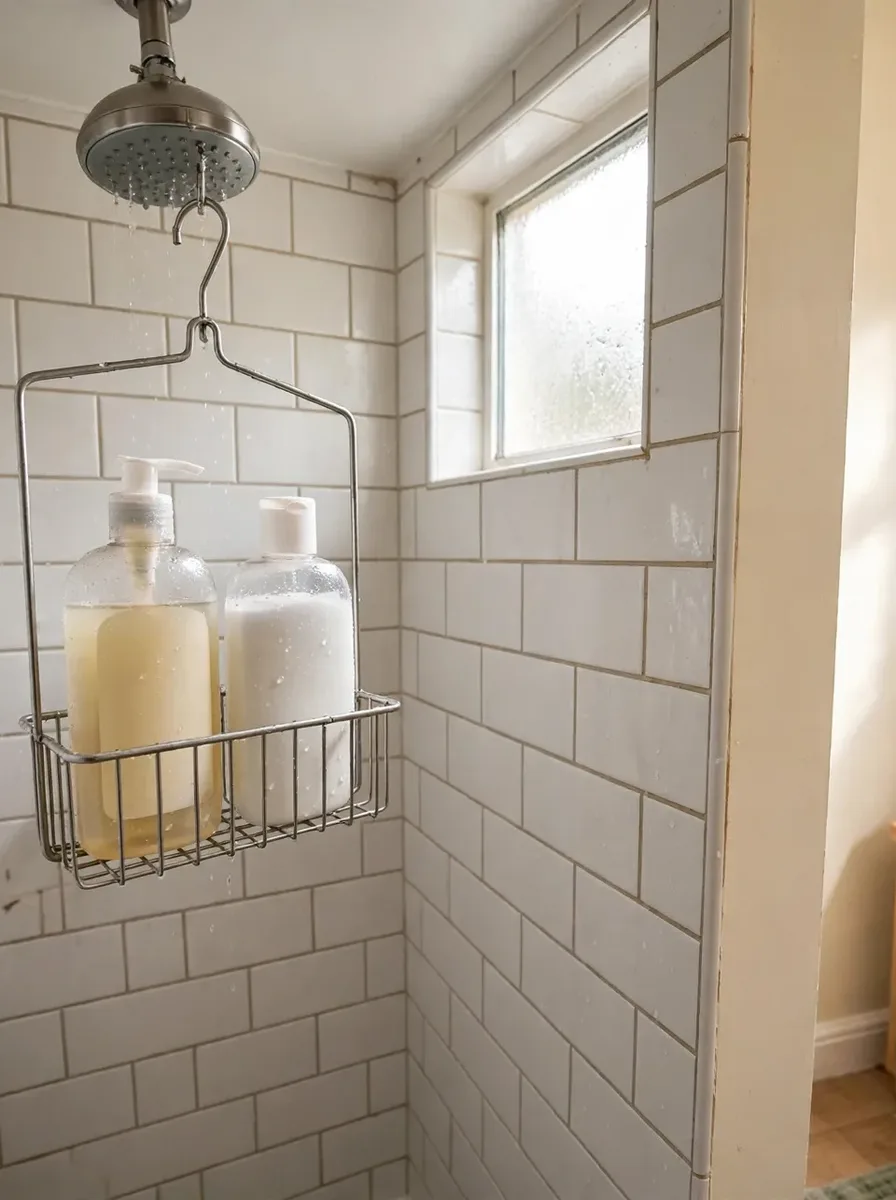
The caddy that hooks over the showerhead pipe is the cheapest and fastest option — about $10–$25 — and the one with the most misunderstood limits. Everything it holds hangs from a single point, so the whole unit wants to tilt, swing, and slide down the pipe.
Why they tilt. The hook sits above the centre of the load. Put a heavy bottle at the front and the caddy tips forward; load one side and it lists. Most designs include one or two small suction cups at the bottom to pin the caddy flat against the tile — which means the “no suction” caddy quietly depends on suction after all, on exactly the tile that may not hold it. If your tile fails the overnight suction test, expect a hanging caddy to swing.
Install it properly. Hang the hook over the pipe and tighten the rubber collar or clamp if one is supplied — this stops the slow slide down the pipe. Press the stabilising cups onto clean, flat tile. Load heaviest at the back, nearest the wall, and keep glass bottles out entirely: a tilted caddy plus a glass bottle plus a hard tub is a breakage and a deposit conversation. Keep total weight well under the package rating of 5–10 lb (2.3–4.5 kg) — in practice, two or three standard bottles and a razor is a sensible load.
Removal is the one area where this method wins outright: lift it off, rinse it, done. For a short tenancy or a guest bathroom, that convenience can outweigh the wobble. Just go in knowing it is the second-least stable method here, ahead of suction alone only because the hook carries the weight and the cups merely steady it.
Required space: A showerhead pipe to hook over, plus clean, flat tile for the small suction cups at the bottom that pin the caddy flat.
Installation: Hang the hook over the pipe and tighten the rubber collar or clamp if one is supplied, press the stabilising cups onto clean, flat tile, and load heaviest at the back, nearest the wall.
Approximate dimensions: No fixed size is given — measure your showerhead pipe and the tile before buying, since the caddy hangs from a single point above the centre of the load.
Rental-friendly limits: Keep total weight well under the package rating of 5–10 lb (2.3–4.5 kg) — in practice, two or three standard bottles and a razor is a sensible load — and keep glass bottles out entirely.
Pros: The cheapest and fastest option at about $10–$25, and removal is lift-off, rinse and done.
Cons: The second-least stable method here, because everything hangs from one point so the unit wants to tilt, swing and slide down the pipe, and it quietly depends on suction after all.
Suitable products: Hanging showerhead caddy ($10–$25) with a rubber collar or clamp and suction stabilisers.
Suction Cups: Glass-Smooth Surfaces Only
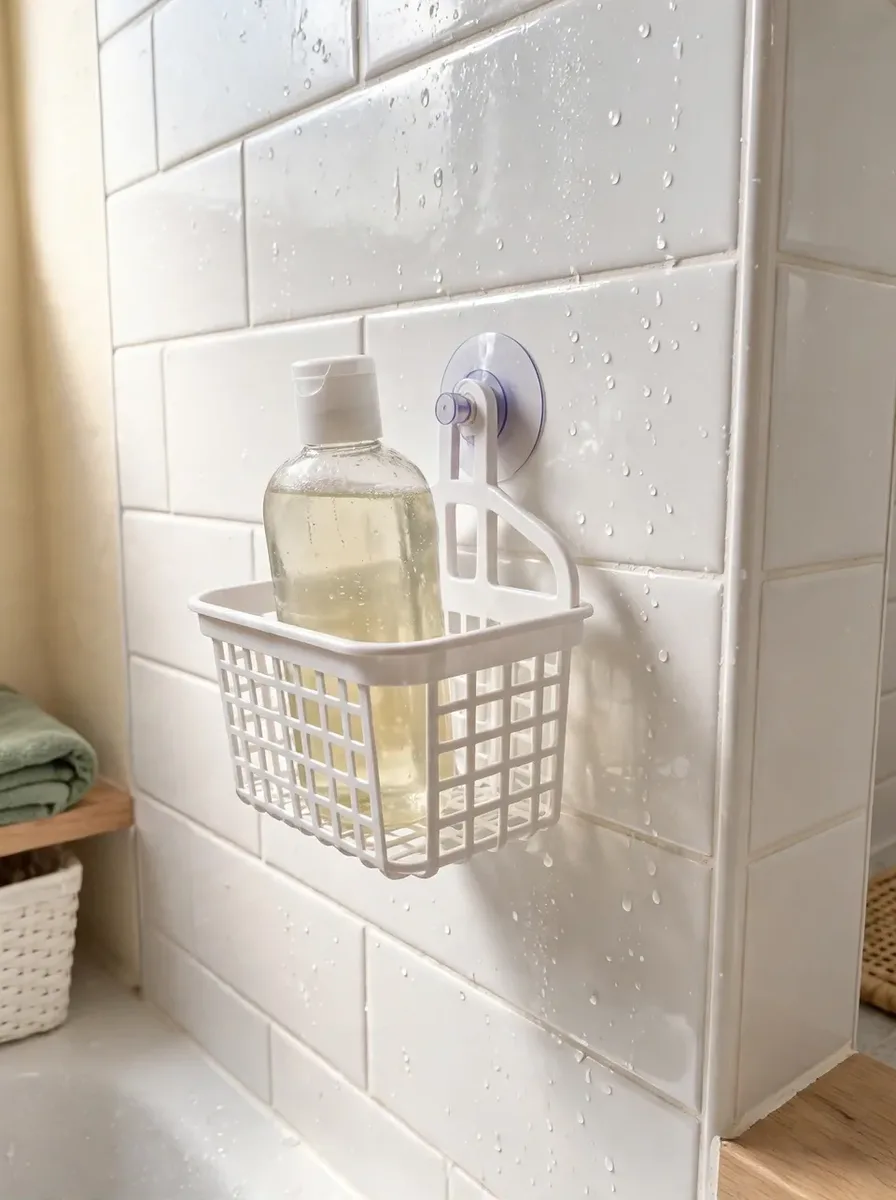
Suction is the most oversold fixing in the bathroom aisle. It works beautifully on exactly one kind of surface — flat, glossy, non-porous, with no grout line anywhere under the cup — and fails predictably everywhere else. Smooth glazed ceramic tile, glass screens, and glossy fibreglass surrounds qualify. Matte or textured tile, stone, small mosaic tiles (where every line is a grout line), and painted walls do not, whatever the packaging claims.
Get the most out of it. Wash the tile, wipe with rubbing alcohol, and let it dry fully. Warm the cup in your hands, press it hard against the tile to push the air out, then engage the lever or twist mechanism if it has one. Better suction baskets use a lever or a screw-down cup that actively pulls a vacuum; plain press-on cups are the weakest of all. Wait an hour before loading, and load light: treat 2–3 lb (0.9–1.4 kg) per cup as a working ceiling even when the package rating says more, and reserve suction for a razor, a small bottle, or a soap dish — never the family shampoo.
Know the failure pattern. Suction rarely fails on day one. It creeps over days as air leaks in through microscopic texture, then lets go at night when the bathroom cools. Press each cup firmly once a week when you clean the shower; if one feels soft, re-seat it. And place suction storage where a fall is harmless — over the tub, not above a glass shelf or your toes.
Removal is trivial and genuinely damage-free: slide a fingernail or an old bank card under the cup’s edge to break the seal. Suction’s problem was never removal; it is staying up in the first place.
Required space: A flat, glossy, non-porous patch — smooth glazed ceramic tile, a glass screen or a glossy fibreglass surround — with no grout line anywhere under the cup.
Installation: Wash the tile, wipe with rubbing alcohol and let it dry fully, warm the cup in your hands, press it hard to push the air out, engage the lever or twist mechanism if it has one, wait an hour before loading, and press each cup firmly once a week.
Approximate dimensions: No fixed shelf size is given — the cup must sit fully on one flat tile, with no grout line under it, and the load is a razor, a small bottle or a soap dish, never the family shampoo.
Rental-friendly limits: Treat 2–3 lb (0.9–1.4 kg) per cup as a working ceiling even when the package rating says more, and do not use suction on matte or textured tile, stone, small mosaic tiles or painted walls.
Pros: Removal is trivial and genuinely damage-free — slide a fingernail or an old bank card under the cup’s edge to break the seal.
Cons: The least reliable method here, because suction rarely fails on day one but creeps over days as air leaks in, then lets go at night when the bathroom cools.
Suitable products: Lever or screw-down suction basket, which actively pulls a vacuum; plain press-on cups are the weakest of all.
Adhesive Shelves: Dry Tile, Full Cure, Honest Loads
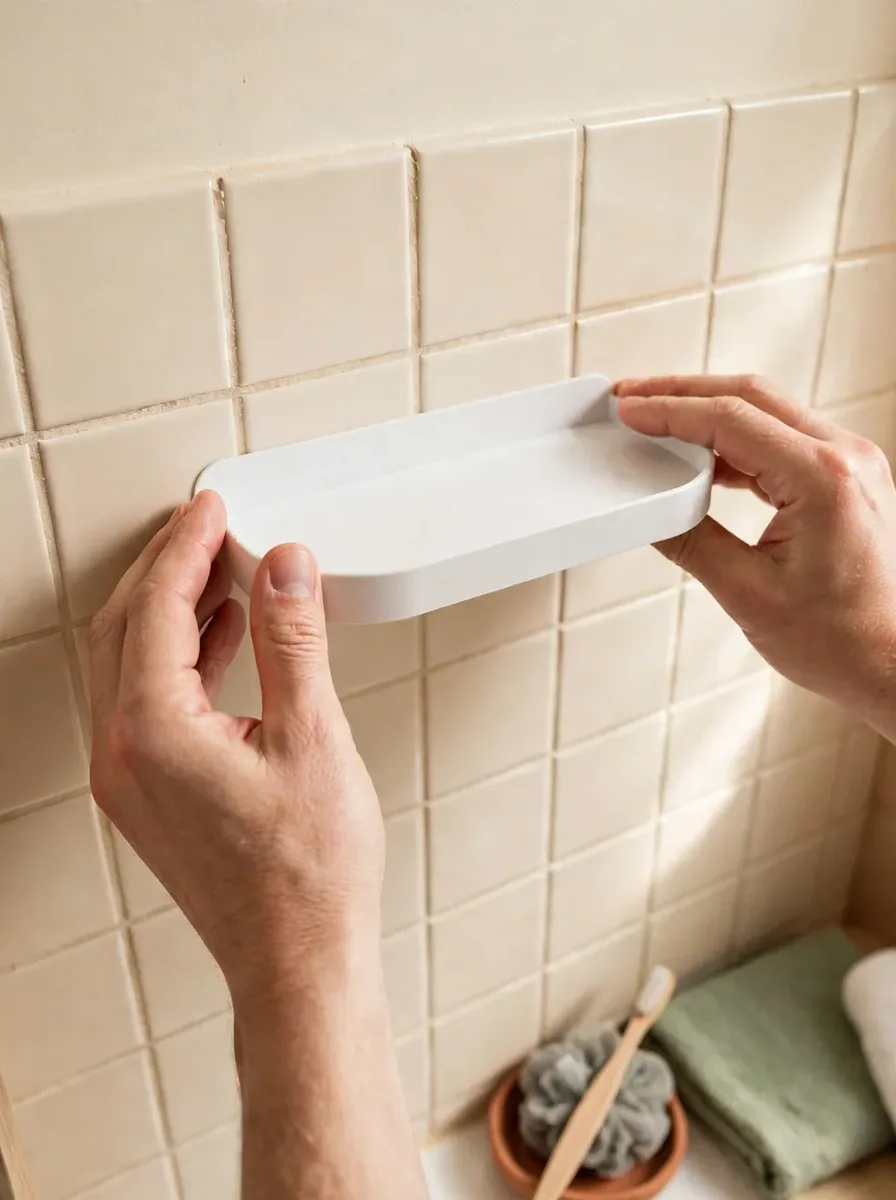
Adhesive is the middle path: stronger than suction on the right tile, less bulky than a pole, and flat against the wall where space is tight. It is also the method most often ruined by impatience, because the two rules — bone-dry surface, full cure time — are the two rules everyone skips.
Surface rules. Adhesive pads need the same surface as suction: smooth, glazed, non-porous, and big enough that no grout line crosses under the pad. A typical shelf uses two pads, each roughly 3 × 4 in (8 × 10 cm), so you need a flat tile area at least that size, twice, at the same height. On textured or matte tile, do not “try it anyway” — a slow peel under load is worse than no shelf, and the pad can take a weak tile glaze with it when it goes.
Install, in order. Clean with a degreaser, wipe with rubbing alcohol, and let the wall dry completely — install after the shower has been unused for several hours, ideally in the morning before anyone showers. Position with a level, press each pad firmly for 30 seconds, working air out from the centre. Then wait. Bathroom-rated adhesive strips typically ask for 24 hours before loading; some specify 12. The shower stays usable for washing during the cure only if the shelf is out of the spray — otherwise this is a job for the night before a day out. Load to half the package rating at most: shelves are commonly rated at 10–20 lb (4.5–9 kg) per pair of pads on ideal tile, and a working load of 5–8 lb (2.3–3.6 kg) of bottles is realistic and safe.
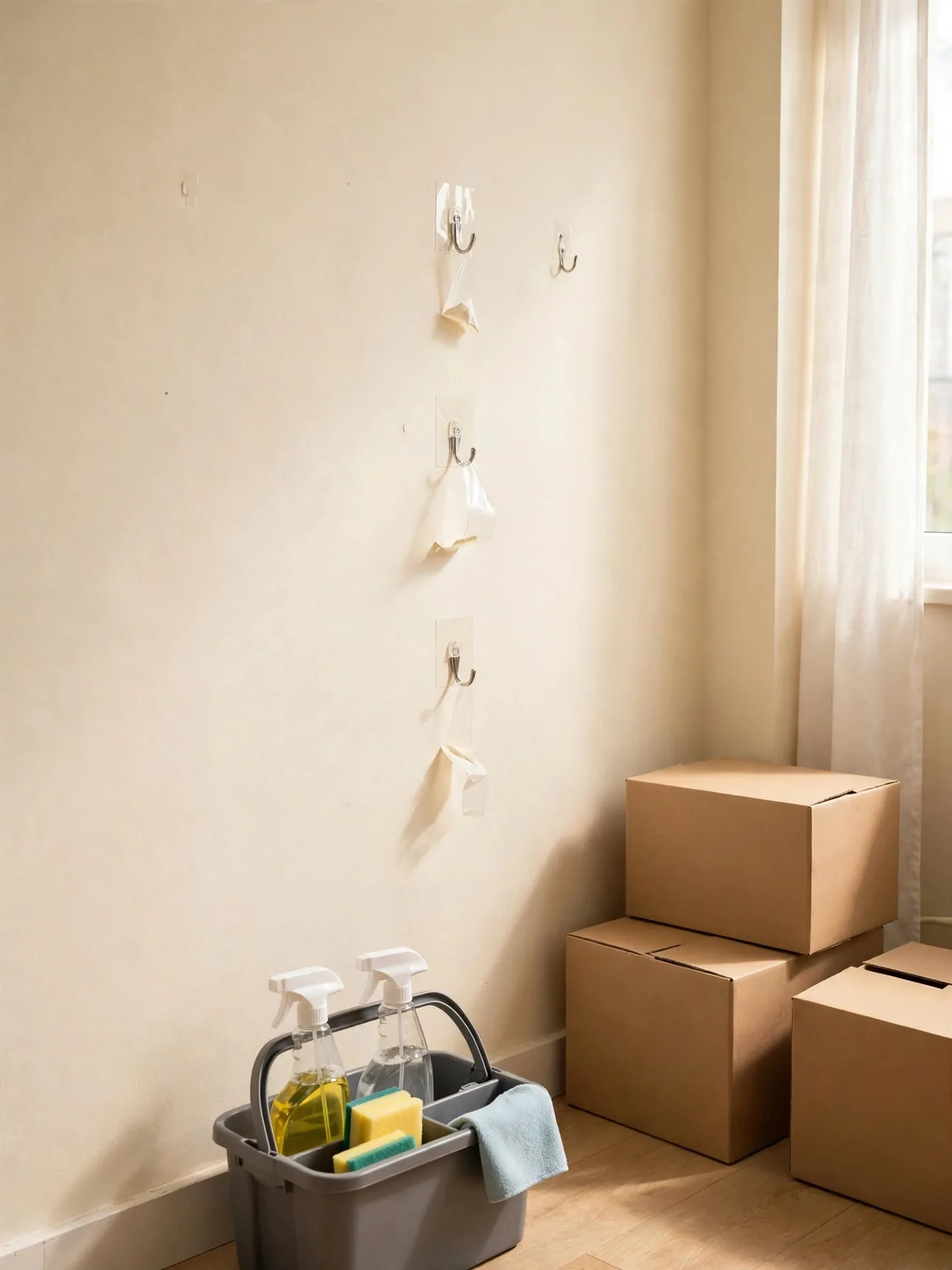
Removal without damage. Warm the pad gently with a hairdryer for 30 seconds. If the system has pull-tabs, stretch each tab slowly along the wall — parallel to it, never outwards — and the pad releases cleanly. For generic pads, work dental floss or fishing line behind the pad in a slow sawing motion, then roll the residue off with your thumb and clean with alcohol. Never lever a pad off with a screwdriver: that is how tile glaze chips and deposits disappear.
Cost. Adhesive shelves and baskets run about $12–$30 each, plus a few dollars for replacement pads when you move.
Required space: A flat tile area at least as large as the two pads, each roughly 3 × 4 in (8 × 10 cm), at the same height, with no grout line crossing under either pad.
Installation: Clean with a degreaser, wipe with rubbing alcohol and let the wall dry completely — install after the shower has been unused for several hours — position with a level, press each pad firmly for 30 seconds working air out from the centre, then wait 24 hours before loading (some strips specify 12).
Approximate dimensions: A typical shelf uses two pads, each roughly 3 × 4 in (8 × 10 cm).
Rental-friendly limits: Shelves are commonly rated at 10–20 lb (4.5–9 kg) per pair of pads on ideal tile, so a working load of 5–8 lb (2.3–3.6 kg) of bottles is realistic and safe, and on textured or matte tile do not try it anyway.
Pros: Stronger than suction on the right tile, less bulky than a pole, and flat against the wall where space is tight.
Cons: The method most often ruined by impatience, because the two rules — bone-dry surface and full cure time — are the two rules everyone skips.
Suitable products: Adhesive shelf or basket ($12–$30 each) with bathroom-rated adhesive strips, plus replacement pads for a few dollars when you move.
Over-the-Glass-Door Caddies: The Frameless-Shower Option
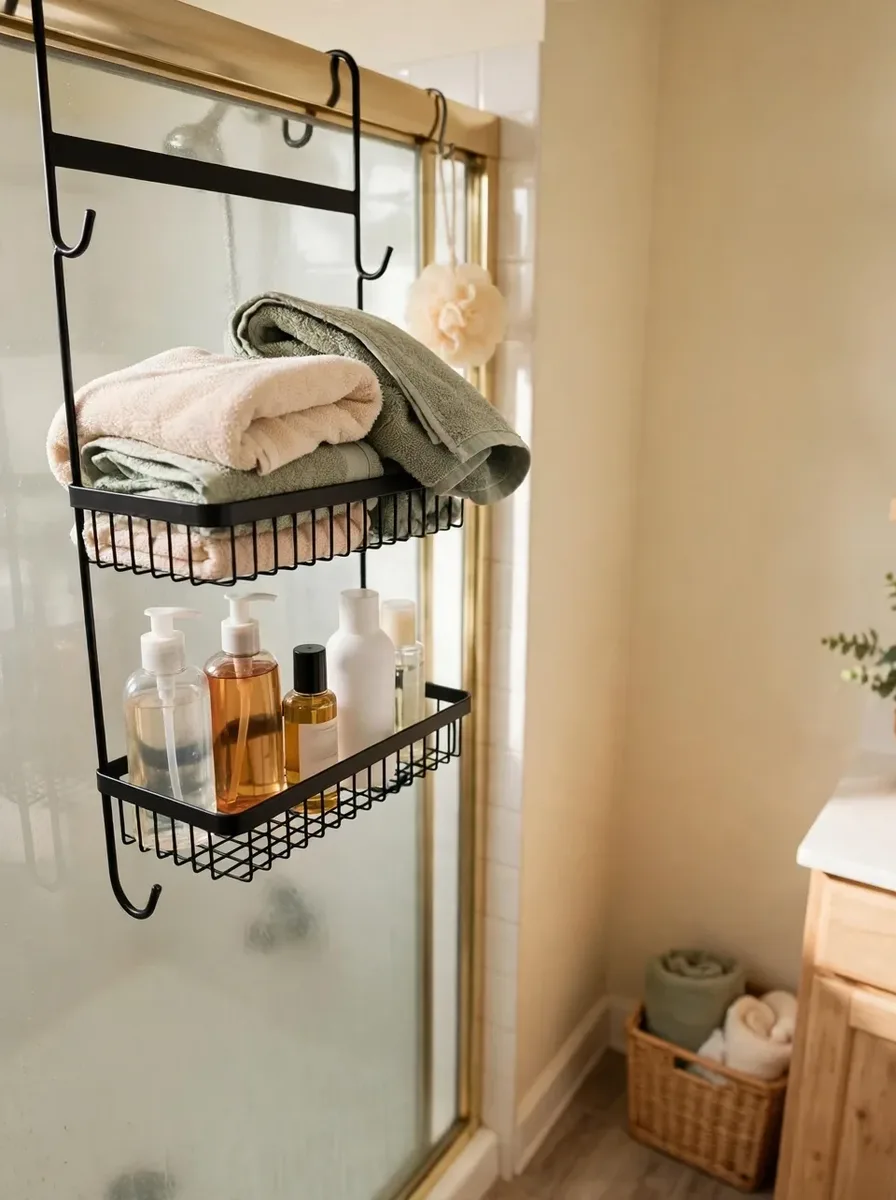
If your rental has a frameless glass shower screen, a caddy that hooks over the top of the glass is worth considering — it is essentially the showerhead caddy’s stronger cousin, because the hooks bear on a rigid panel instead of a pipe. The same design often works over a shower door or the side of a tub screen.
Check the fit. Hooks are made for specific glass thicknesses, commonly around 3/8 in (10 mm), so measure your screen before ordering. The hooks should sit fully on the glass with the rubber padding in contact; a hook that only catches the edge will rock and can chip the glass corner — the one genuinely expensive accident in this guide. The caddy also reduces the door’s clearance: make sure the door still opens and closes without the loaded caddy swinging into the tile or the showerhead.
Load and behaviour. Ratings are usually similar to showerhead caddies, around 5–10 lb (2.3–4.5 kg) on the package, and the unit will still sway when the door moves. Keep bottles low and toward the back, and consider this format for the lighter overflow — razors, a spare bottle, a squeegee — rather than the full set. On sliding screens it is a poor fit; the caddy fouls the track and the panels.
Removal is lift-off, like the showerhead caddy, with the same zero-trace result. Combined with an adhesive shelf inside the shower, an over-glass caddy outside it makes a tidy two-part system for about $15–$30.
Required space: A frameless glass shower screen of matching thickness, with enough clearance for the door to still open and close without the loaded caddy swinging into the tile or the showerhead.
Installation: Measure your screen before ordering, seat the hooks fully on the glass with the rubber padding in contact, and check that the door still opens and closes with the caddy loaded.
Approximate dimensions: Hooks are made for specific glass thicknesses, commonly around 3/8 in (10 mm).
Rental-friendly limits: Ratings are usually around 5–10 lb (2.3–4.5 kg) on the package, so keep bottles low and toward the back and use this for the lighter overflow, and on sliding screens it is a poor fit because the caddy fouls the track.
Pros: The showerhead caddy’s stronger cousin, because the hooks bear on a rigid panel instead of a pipe, and removal is lift-off with a zero-trace result.
Cons: The unit still sways when the door moves, and a hook that only catches the edge will rock and can chip the glass corner.
Suitable products: Over-glass-door caddy ($15–$30), paired with an adhesive shelf inside the shower as a two-part system.
No-Drill Shower Storage Methods, Compared
| Method | Typical cost | Package rating | Best surface | Real-world reliability | Removal |
|---|---|---|---|---|---|
| Tension pole corner caddy | $25–$60 | 15–30 lb (7–14 kg) total | Any — ignores the tile | Highest; check tension monthly | Release tension, wipe two contact points |
| Adhesive shelf | $12–$30 | 10–20 lb (4.5–9 kg) per pair of pads | Smooth glazed tile, no grout under pads | High if cured fully and loaded to half rating | Warm, pull tabs along the wall or floss behind pad |
| Over-glass-door caddy | $15–$30 | 5–10 lb (2.3–4.5 kg) | Glass screen of matching thickness | Medium; sways when the door moves | Lift off |
| Hanging showerhead caddy | $10–$25 | 5–10 lb (2.3–4.5 kg) | Any pipe; stabiliser cups need smooth tile | Medium-low; tilts under uneven loads | Lift off |
| Suction basket | $8–$20 | 2–5 lb (0.9–2.3 kg) per cup | Glass-smooth tile, glass, glossy fibreglass only | Lowest; creeps and drops without warning | Break the seal at the cup’s edge |
Read the table the way we test products — the process is set out on our how we test page: the rating column is what the box promises on a perfect surface, and the reliability column is what the shower does to that promise over a month of steam. When two methods tie, choose the one whose failure mode is gentler. A pole that loosens slides an inch and rattles; an adhesive shelf that lets go drops everything at once.
Rust and Materials: What Actually Survives a Wet Shower
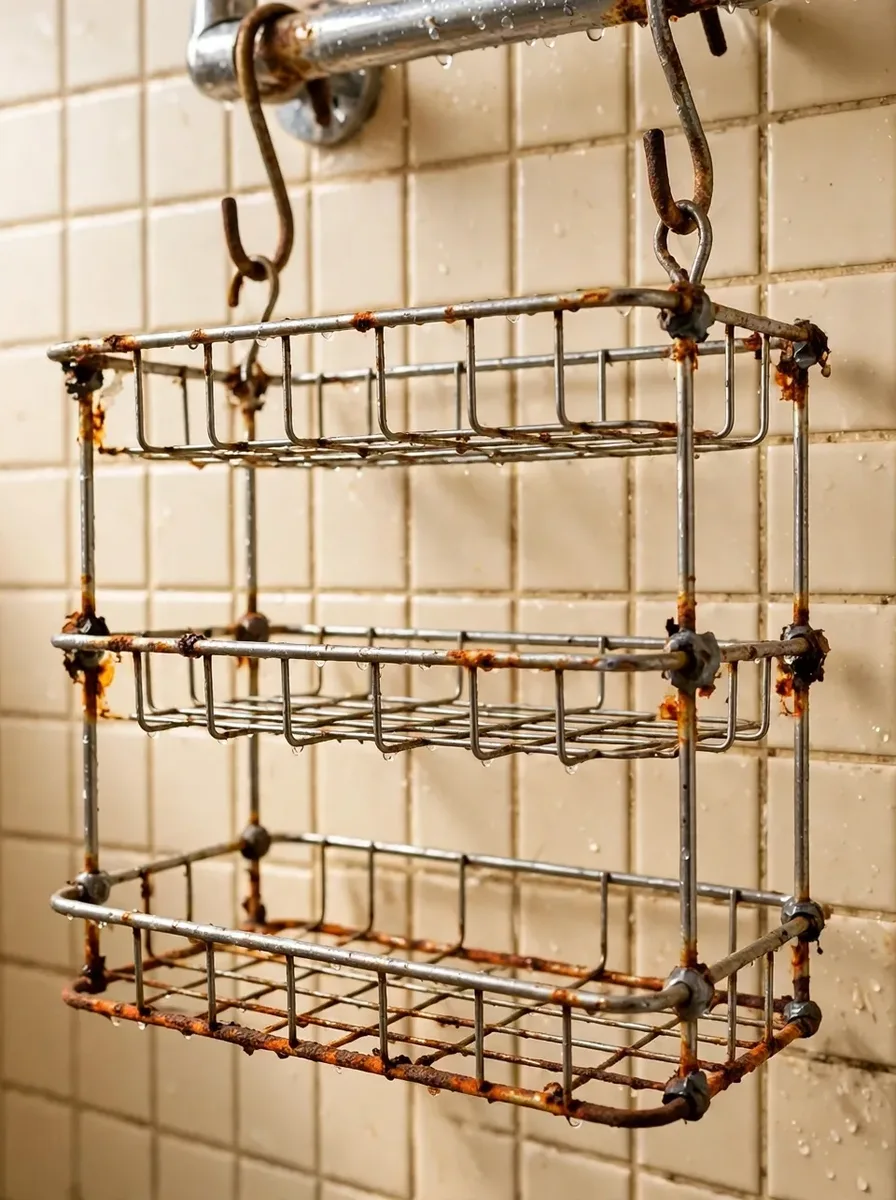
A caddy can stay up perfectly and still fail you by rusting — and rust is a deposit issue, not just an ugly one, because it stains tubs, grout, and tile in orange marks that are hard to remove. The material matters more than the brand.
Chrome-plated steel is the default at the cheap end and the worst choice. The chrome layer is thin; it scratches at welds and basket joints, water reaches the steel underneath, and rust spots appear within months in a daily-use shower. Once a basket rusts it also weakens, so a rusty caddy is a falling caddy in waiting.
Stainless steel is the safe buy — look for grade 304 in the listing if it is stated. It can develop light surface discolouration from shampoo residue, which wipes off, but it does not rust through. Aluminium never rusts and is noticeably lighter, which suits hanging caddies; it can dent and its finish can pit over years, but in a rental timeframe it holds up well. Solid plastic and resin caddies have improved a lot: no rust at all, easy to clean, though the cheapest thin plastic flexes under full bottles and can crack at the hooks. Powder-coated steel sits in the middle — fine until the coating chips, then it rusts from the chip outward.
Whatever you buy, rinse the baskets when you clean the shower and let them dry between uses where you can. And retire any caddy at the first rust spot rather than the tenth: the replacement costs $15; the stain removal argument with a landlord costs more. If your budget is tight overall, the small bathroom organization ideas for renters on a budget guide shows where a cheap caddy is a false economy and where it is not.
Cut the Load: The Cheapest Fix Is Fewer, Lighter Bottles
Every method in this guide gets more reliable as the load drops, and most showers are carrying far more than they need. A honest audit usually finds two shampoos, two conditioners, a body wash, a scrub, a face wash, and several nearly-empty bottles kept “just in case” — 8–10 lb (3.6–4.5 kg) of product asking a suction cup for mercy.
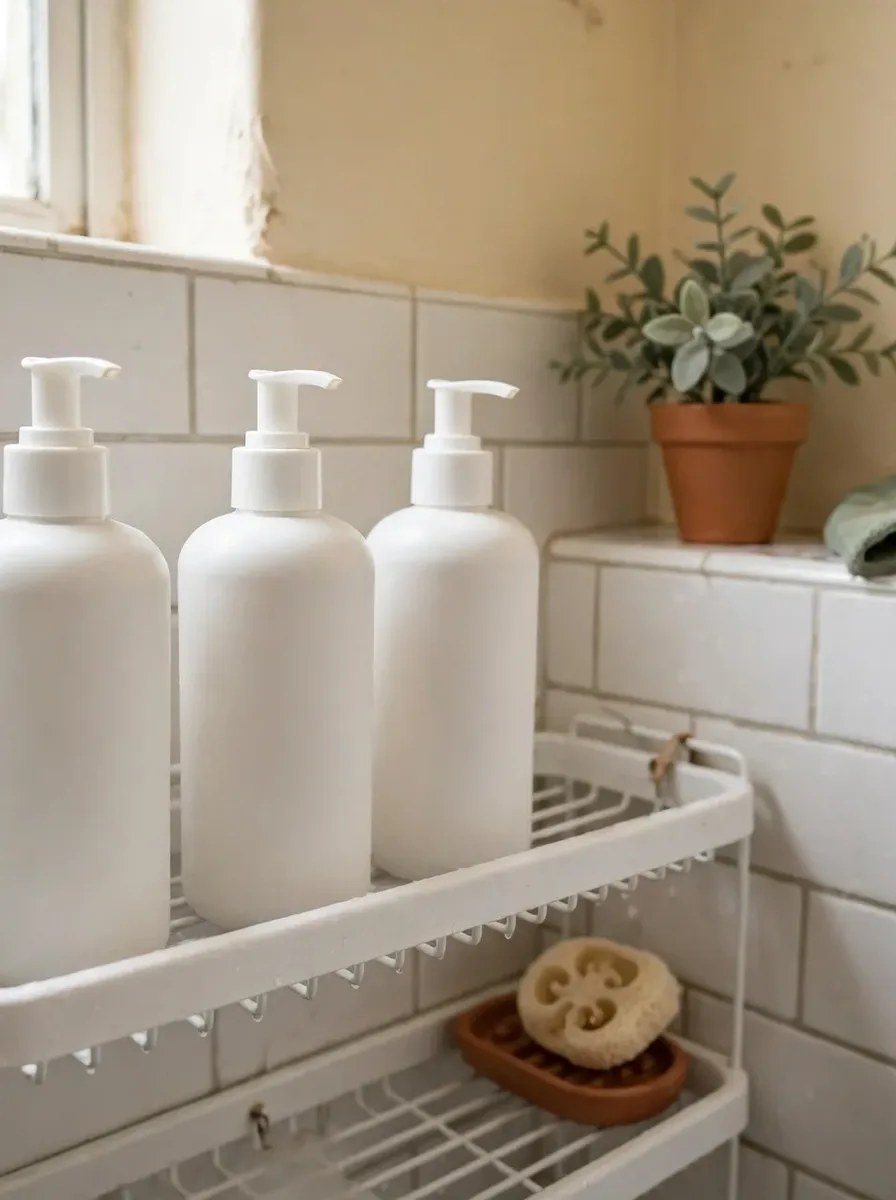
Decant the daily three — shampoo, conditioner, body wash — into matching pump bottles of about 8–10 fl oz (240–300 ml). Pumps also solve a hidden load problem: pressing a pump pushes down with far less sideways force than squeezing and shaking a big bottle, so caddies tilt and creep less. Refill from the big bottles stored outside the shower, under the sink or in a cupboard, where weight does not matter. Products used weekly — scrubs, treatments, the second shampoo — live outside the shower too and come in when needed.
What stays in the shower then fits on almost anything: three pump bottles, a razor, a soap dish or a hook for a washcloth. At that point even a modest adhesive shelf or a small hanging caddy is working at a fraction of its rating — which is precisely why it stays up. Storage problems in small bathrooms are usually inventory problems wearing a disguise; the rest of the room is covered in the bathroom storage hub.
Mistakes That Cost Renters Money
Mounting straight after a shower. Adhesive and suction both fail on damp tile. The wall must be dry to the touch and, for adhesive, left for the full cure time printed on the packet — 24 hours is common, and “overnight is probably fine” is how shelves end up in the tub.
Bonding over soap film. Skipping the degrease-and-alcohol clean because the tile “looks clean”. It is not; the film is invisible and it is the layer your fixing actually sticks to.
Crossing a grout line. A cup or pad that straddles tile and grout has a built-in air leak or a weak edge. Move the fixing an inch (2.5 cm) in any direction and the same product suddenly works.
Loading to the package rating. Ratings assume a perfect surface, a static load, and ideal installation. Work at half the rating or less, keep the heaviest bottles lowest and nearest the wall, and remember a full bottle weighs more than the empty one you held in the shop.
Storing glass bottles on hanging storage. Anything that hangs can swing or tilt. Glass belongs on a pole basket’s lowest shelf or out of the shower entirely.
Ignoring the first wobble. A caddy that has started to tilt, a pole that has lost tension, a suction cup that feels soft — these are warnings with days of notice. Re-seat, re-tighten, or re-mount at the first sign, and the 6 a.m. crash never happens.
Buying chrome for a wet room. The cheapest caddy is the one you buy once. Stainless, aluminium, or solid plastic costs a little more and does not leave rust rings on a tub you do not own.
Get the method matched to your surface, the surface properly clean, and the load honest, and no-drill shower storage stops being a gamble. For most renters that means a tension pole if the ceiling allows it, a cured adhesive shelf if the tile is smooth, and suction demoted to the light, harmless jobs it is actually good at.