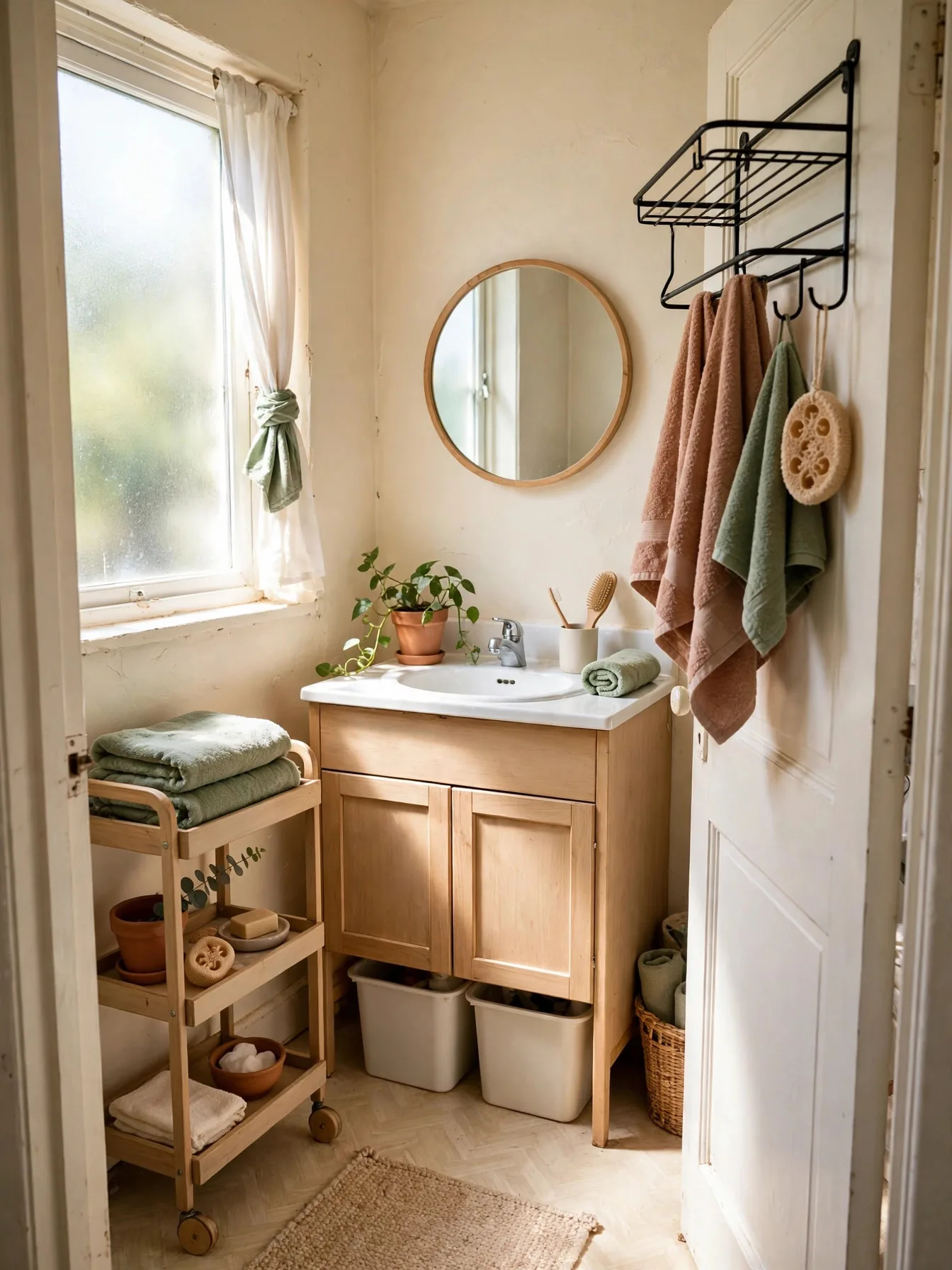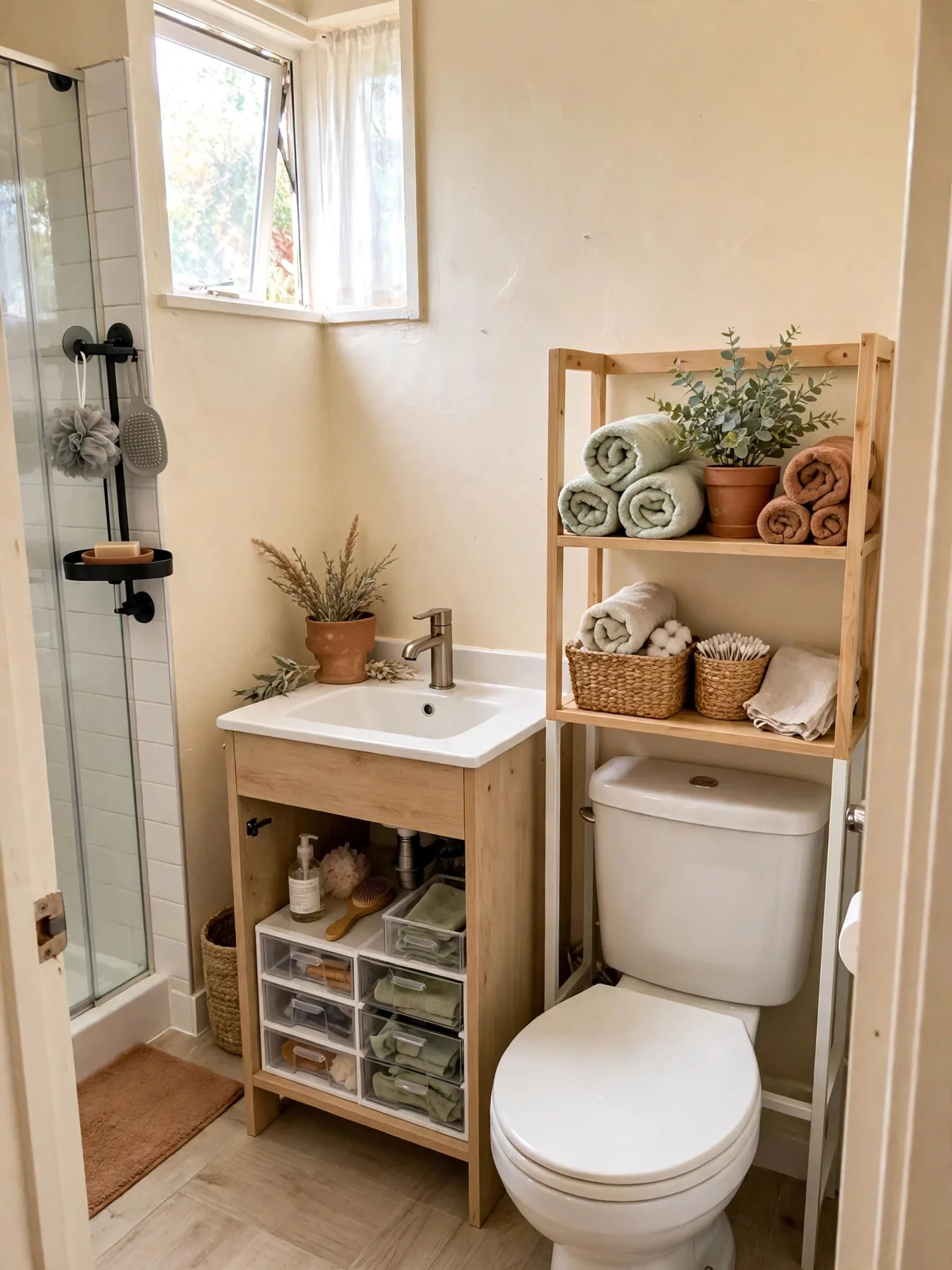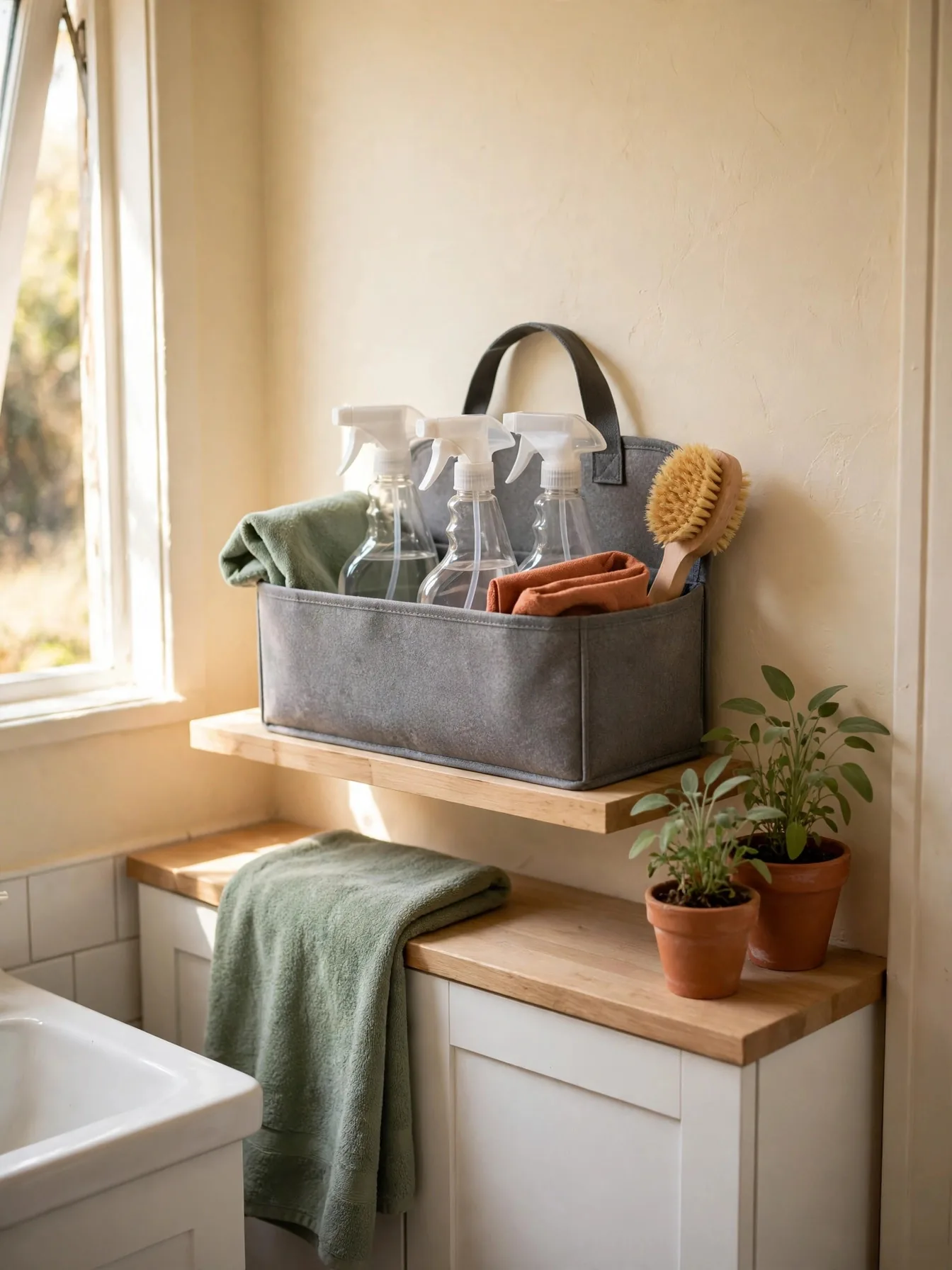
Cleaning supplies are the worst citizens of a tiny rental bathroom. They are bulky, they are chemical, they drip, and unlike the towels and toiletries that live there politely, you only actually need them once a week, in a burst. That is exactly what a small room handles worst, which is why the bottles end up on the toilet tank, on the shower floor, or in a damp heap under the sink. Good small apartment cleaning supply storage is not about finding more room. It is about ranking the few spots you already have, honestly, and giving a deliberately small kit one dry, upright, reachable home. This guide is part of our wider plan for renter-friendly bathroom storage ideas for tiny bathrooms, and it applies the same tests we use site-wide, set out in how we test and rate storage methods: does it stay dry, does it stay upright, and can a child reach it? More small-bathroom storage inspiration is at Better Homes & Gardens.
Start by Shrinking the Kit
No storage spot in a tiny bathroom survives contact with a twelve-product cleaning collection, so the first move is an edit, not a purchase. The working kit for one small bathroom is four products: a bathroom or all-purpose spray, a toilet cleaner, a glass cleaner, and one scrubbing product — a paste, powder, or a second brush. Add the tools: a scrub brush, a squeegee, three or four microfiber cloths, and a pair of rubber gloves. That is the entire daily army.
Everything else — the oven cleaner, the drain opener you bought once, the specialty stone spray for a countertop you do not own — is warehouse stock, and warehouse stock does not belong in the smallest room in the apartment. It goes to the hallway closet spot covered later, or out of the apartment entirely. This matters more than any organizer: a four-product kit fits inside a single caddy roughly 11 inches (28 cm) long. A twelve-product kit fits nowhere, and every spot ranked below quietly assumes you did the edit first.
The Five Tests Every Spot Has to Pass
Before the verdicts, the criteria. A spot earns a yes only if it passes all five:
- Dry. Bathroom air is humid even outside the shower. A spot that stays damp will rust caps, peel labels, and turn cloths musty.
- Ventilated. Cleaning products should never be sealed into an airtight box. An open caddy or a louvered cabinet beats a sealed plastic tub every time.
- Upright. Spray bottles leak from the trigger and the cap when they lie on their sides. Any spot that forces bottles to lie down fails.
- Out of reach. Anything chemical sits above 60 inches (152 cm), behind a latch, or both — more on this in the safety section.
- Weekly-reachable. A spot that needs a step stool, a crouch-and-dig, or moving three other things will be abandoned by week three, and the bottles will migrate back to the tank.
One more rule applies everywhere: nothing sits directly on a cabinet floor under plumbing. A leak tray goes down first, always — the first sign of a slow drip should be a tray you can slide out and inspect, not a soaked product box.
Under the Sink: The Default Spot, With Conditions
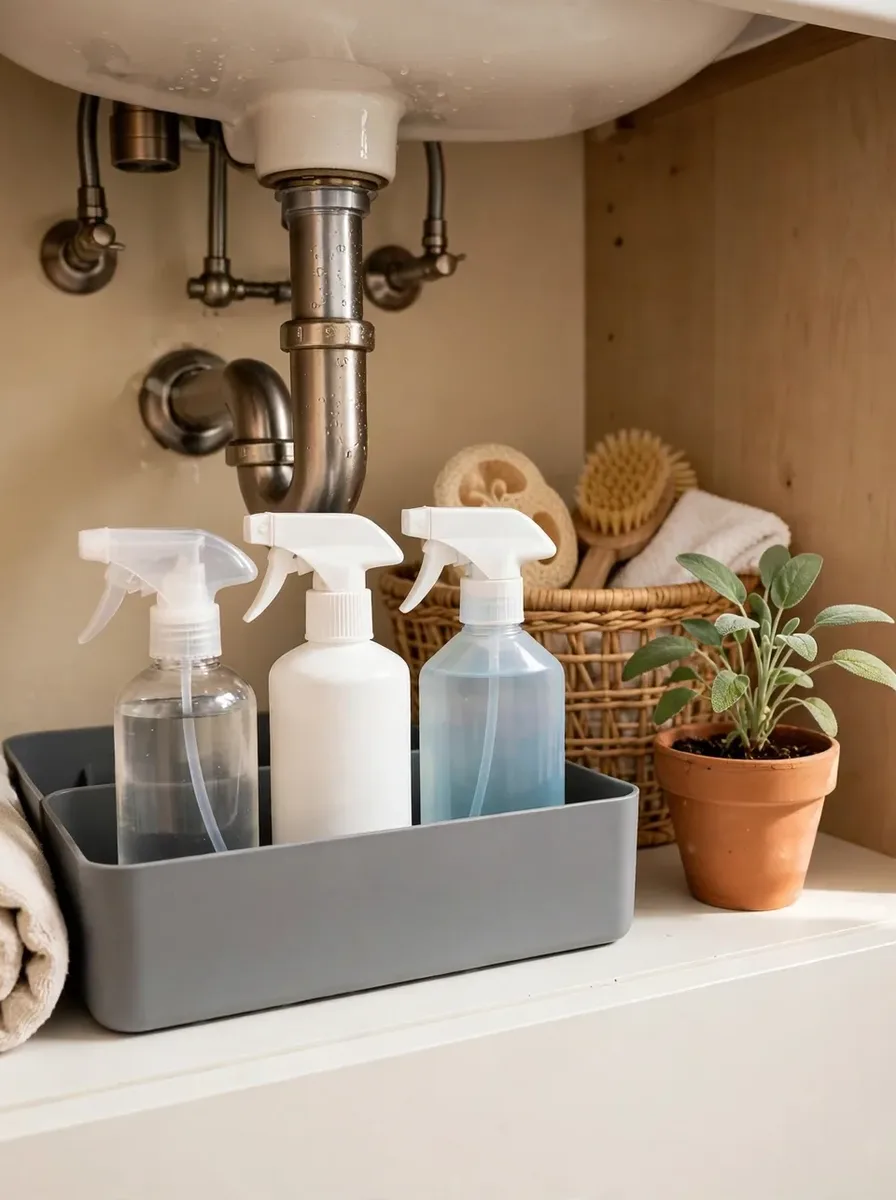
Verdict: yes — the best default, if you respect the pipes.
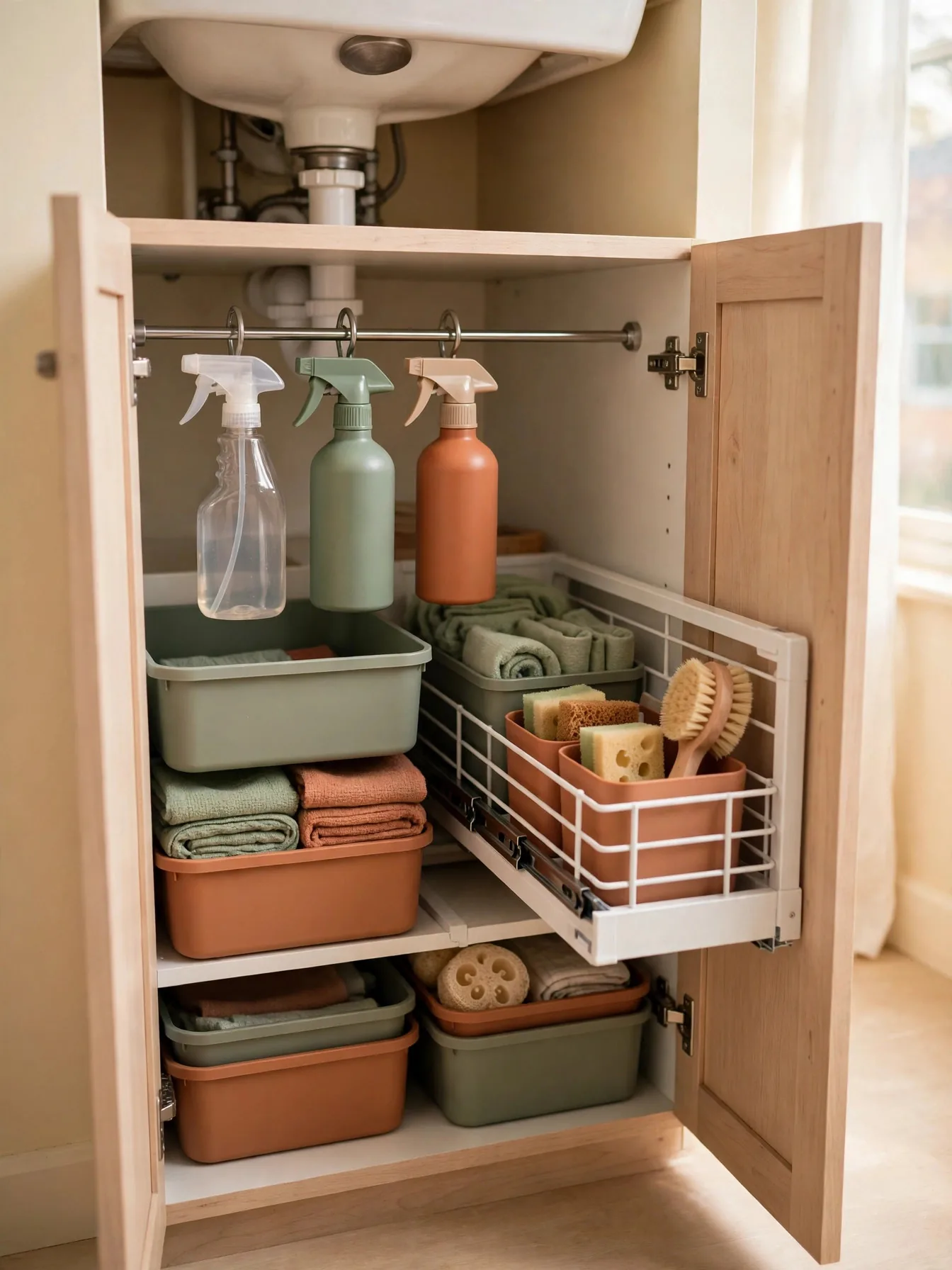
The under-sink cabinet is where cleaning supplies want to live: hidden, close to everything they clean, and behind a door you can latch. A typical rental vanity cabinet is 24–30 inches (61–76 cm) wide, and the trap and supply lines claim the middle 8–10 inches (20–25 cm) of it. What you actually own is two side pockets, each roughly 8–10 inches (20–25 cm) wide and 15–17 inches (38–43 cm) deep, with about 12–14 inches (30–36 cm) of height before the basin cuts in.
Work one side only. Slide in a leak tray — typically 12–14 inches (30–36 cm) long and 8–10 inches (20–25 cm) wide, around $8–$14 — and set a handled caddy on it. A standard caddy is 10–12 inches (25–30 cm) long, 6–8 inches (15–20 cm) wide, and 6–8 inches (15–20 cm) tall, which swallows the four-product kit with the brush standing in the corner. Bottles up to about 11 inches (28 cm) tall fit upright; anything taller goes in the hallway, not on its side.
The conditions are real. Keep every product off the hot water line — a bottle resting against a hot pipe ages fast and can warp. Keep bleach physically apart from the acidic toilet cleaner, in a separate corner of the tray or a separate small bin, so a double leak can never mix them. And do the monthly leak check: slide the tray out, look at it, feel the cabinet floor. Thirty seconds, once a month. The full cabinet method — tension rods, stackable bins, and pipe mapping — is in our guide to under-sink bathroom storage for small rental apartments.
Cost: caddy plus tray, roughly $16–$28. Watch out for: pedestal sinks, which have no cabinet at all — if that is your bathroom, skip to the over-door and cart verdicts.
Required space: Needs one side pocket of a typical rental vanity cabinet, 24–30 in (61–76 cm) wide overall, with each side pocket roughly 8–10 in (20–25 cm) wide and 15–17 in (38–43 cm) deep, and about 12–14 in (30–36 cm) of height before the basin cuts in.
Installation: Work one side only: slide in a leak tray, set a handled caddy on it, and keep bottles upright, with a monthly leak check by sliding the tray out, looking at it, and feeling the cabinet floor.
Approximate dimensions: A leak tray is typically 12–14 in (30–36 cm) long and 8–10 in (20–25 cm) wide, a standard caddy is 10–12 in (25–30 cm) long, 6–8 in (15–20 cm) wide, and 6–8 in (15–20 cm) tall, and bottles up to about 11 in (28 cm) tall fit upright.
Rental-friendly limits: The caddy and tray lift out with nothing fixed to the cabinet. Keep every product off the hot water line, keep bleach physically apart from the acidic toilet cleaner, and skip this spot entirely if you have a pedestal sink with no cabinet.
Pros: It is the best default spot, hidden, close to everything it cleans, and behind a door you can latch.
Cons: The trap and supply lines claim the middle 8–10 in (20–25 cm) of the cabinet, so only one side pocket is really usable for the kit.
Suitable products: Handled caddies and leak trays.
Over the Door: High, Dry, and Out of Reach
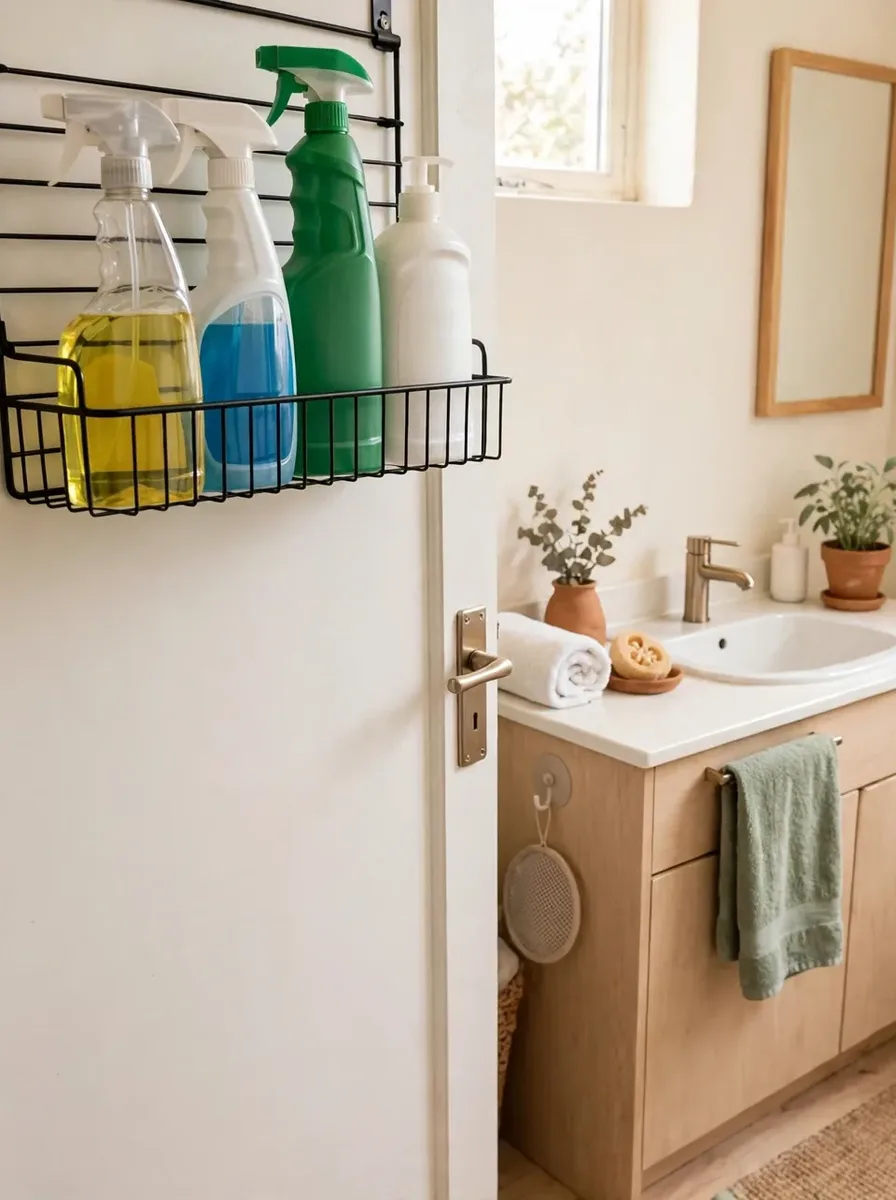
Verdict: yes — the strongest spot in homes with small children.
The back of the bathroom door is the one surface in a tiny bathroom that is high, dry, ventilated, and already yours. A basket-style over-door rack puts supplies at 60–72 inches (152–183 cm) — adult eye level, toddler impossible — and the steam from the shower largely passes underneath it rather than through it.
Fit is the whole game. Most interior doors are 1⅜ inches (3.5 cm) thick, and the rack’s hooks need about ¼ inch (0.6 cm) of clearance above the door so they do not scrape the frame on every swing. Hang the rack, close the door slowly, and check two things: that it still latches, and that the rack does not bang the wall behind. If either fails, the rack is the wrong model.
Load it with discipline. Manufacturers rate these racks at roughly 10–20 lb (4.5–9 kg) total, and that figure assumes the weight hangs close to the door. Treat it as optimistic: keep the total nearer 10 lb (4.5 kg), put the two heaviest spray bottles in the top basket where they cannot tip, and never hang a full gallon refill jug from a hook. Tools — brush, squeegee, gloves, a folded cloth — can fill the lower hooks, because a swinging door punishes weight, not bulk.
Cost: roughly $15–$25. Watch out for: hollow-core doors flex under load, so if the door visibly bows when you hang the rack, move the bottles back under the sink and keep the rack for tools only.
Required space: Needs the back of the bathroom door, putting supplies at 60–72 in (152–183 cm), adult eye level and toddler impossible, with the steam from the shower largely passing underneath.
Installation: Hang the rack over the door, with hooks needing about 1/4 in (0.6 cm) of clearance above the door so they do not scrape the frame. Close the door slowly and check that it still latches and that the rack does not bang the wall behind.
Approximate dimensions: Supplies sit at 60–72 in (152–183 cm), most interior doors are 1⅜ in (3.5 cm) thick, and manufacturers rate these racks at roughly 10–20 lb (4.5–9 kg) total.
Rental-friendly limits: Nothing is screwed in, and the rack lifts off the door. Hollow-core doors flex under load, so if the door visibly bows when you hang the rack, move the bottles back under the sink and keep the rack for tools only.
Pros: It is the strongest spot in homes with small children, since it is high, dry, ventilated, and already yours.
Cons: A swinging door punishes weight, so keep the total nearer 10 lb (4.5 kg), put the two heaviest spray bottles in the top basket, and never hang a full gallon refill jug from a hook.
Suitable products: Basket-style over-door racks.
The Slim Gap Cart: Found Space Beside the Toilet
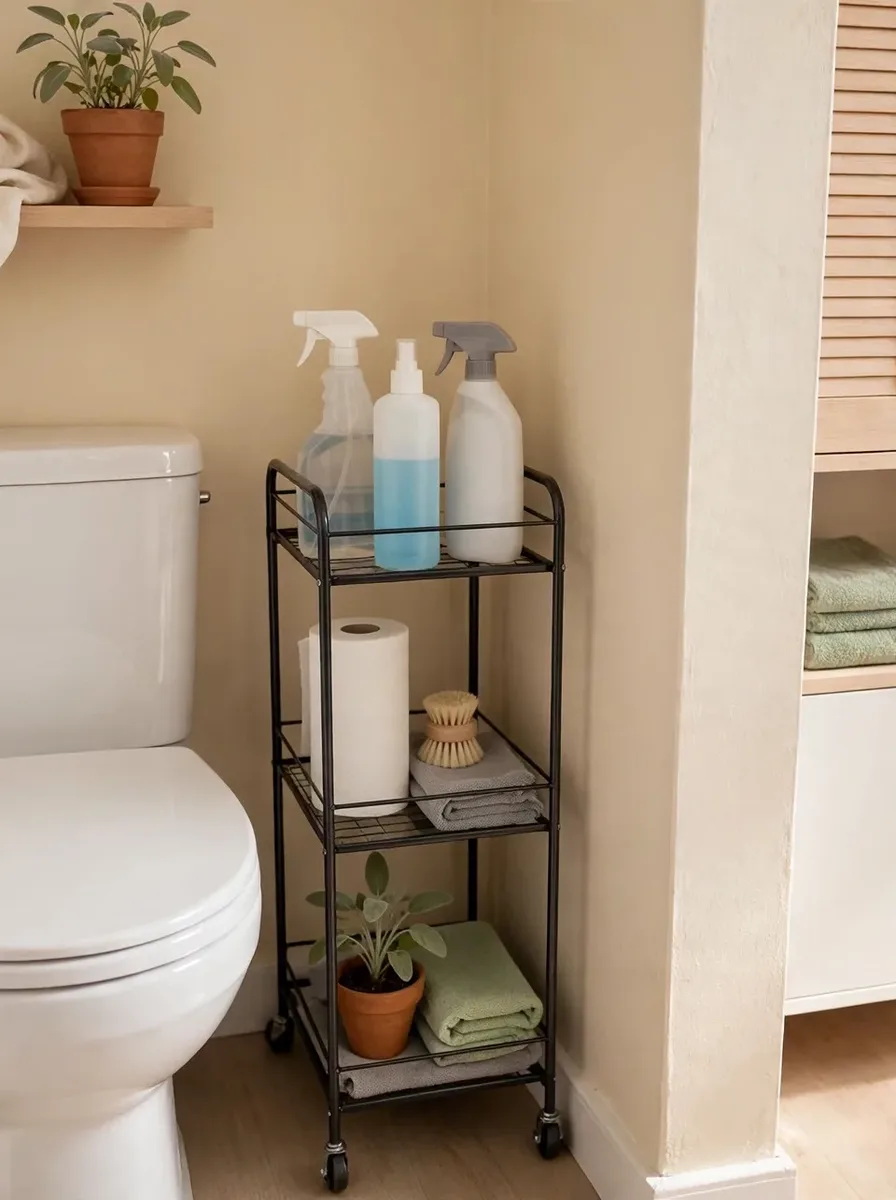
Verdict: yes, if the gap is real — measure before you buy.
Most tiny bathrooms have a dead slot between the toilet and the wall or the vanity, and a slim rolling cart is built for exactly that slot. Typical carts run 6–8 inches (15–20 cm) wide, 15–18 inches (38–46 cm) deep, and 30–35 inches (76–89 cm) tall over three or four tiers. Cleaning supplies suit the cart well: sprays on the middle tier, cloths and the brush on top, a spare roll and the scrubbing paste below.
The measurement that matters is at floor level, not eye level. Baseboards steal about ½–1 inch (1.3–2.5 cm), and a gap that reads 8 inches (20 cm) at counter height may be 7 inches (18 cm) at the floor — too tight for an 8-inch cart. Measure low, and leave at least ½ inch (1.3 cm) of total slack or the cart will scrape every time you pull it out. Load the heaviest bottles on the bottom tier so it rolls straight instead of tipping, and keep it clear of the toilet shut-off valve: the day you need that valve is not the day to discover a cart parked on it.
Cost: roughly $20–$35. Watch out for: the cart is open and at grab height, so in a home with toddlers it holds tools and cloths only — chemicals stay high or latched, per the safety rules below.
Required space: Needs a dead slot between the toilet and the wall or the vanity, measured at floor level rather than eye level, with at least 1/2 in (1.3 cm) of total slack so the cart does not scrape every time it is pulled out.
Installation: Roll the cart into the measured gap, load the heaviest bottles on the bottom tier so it rolls straight instead of tipping, and keep it clear of the toilet shut-off valve.
Approximate dimensions: Typical carts run 6–8 in (15–20 cm) wide, 15–18 in (38–46 cm) deep, and 30–35 in (76–89 cm) tall over three or four tiers.
Rental-friendly limits: The cart is freestanding and rolls out, with nothing fixed to the room. Baseboards steal about 1/2–1 in (1.3–2.5 cm), so a gap that reads 8 in (20 cm) at counter height may be 7 in (18 cm) at the floor.
Pros: It turns a dead slot into three or four tiers, with sprays on the middle tier, cloths and the brush on top, and a spare roll and scrubbing paste below.
Cons: The cart is open and at grab height, so in a home with toddlers it holds tools and cloths only, while chemicals stay high or latched.
Suitable products: Slim rolling gap carts.
Inside the Cabinet Door: Hooks for Tools, Not Bottles
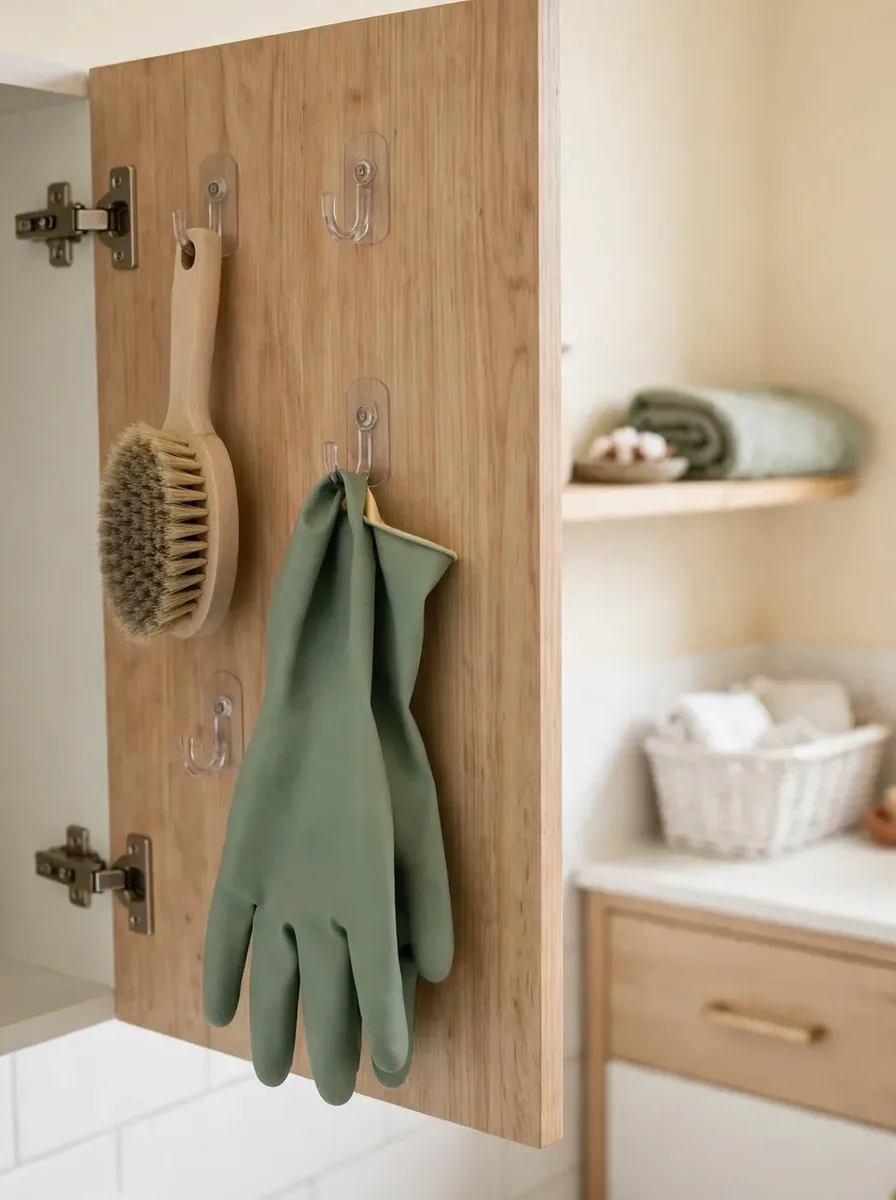
Verdict: yes for tools, no for bottles.
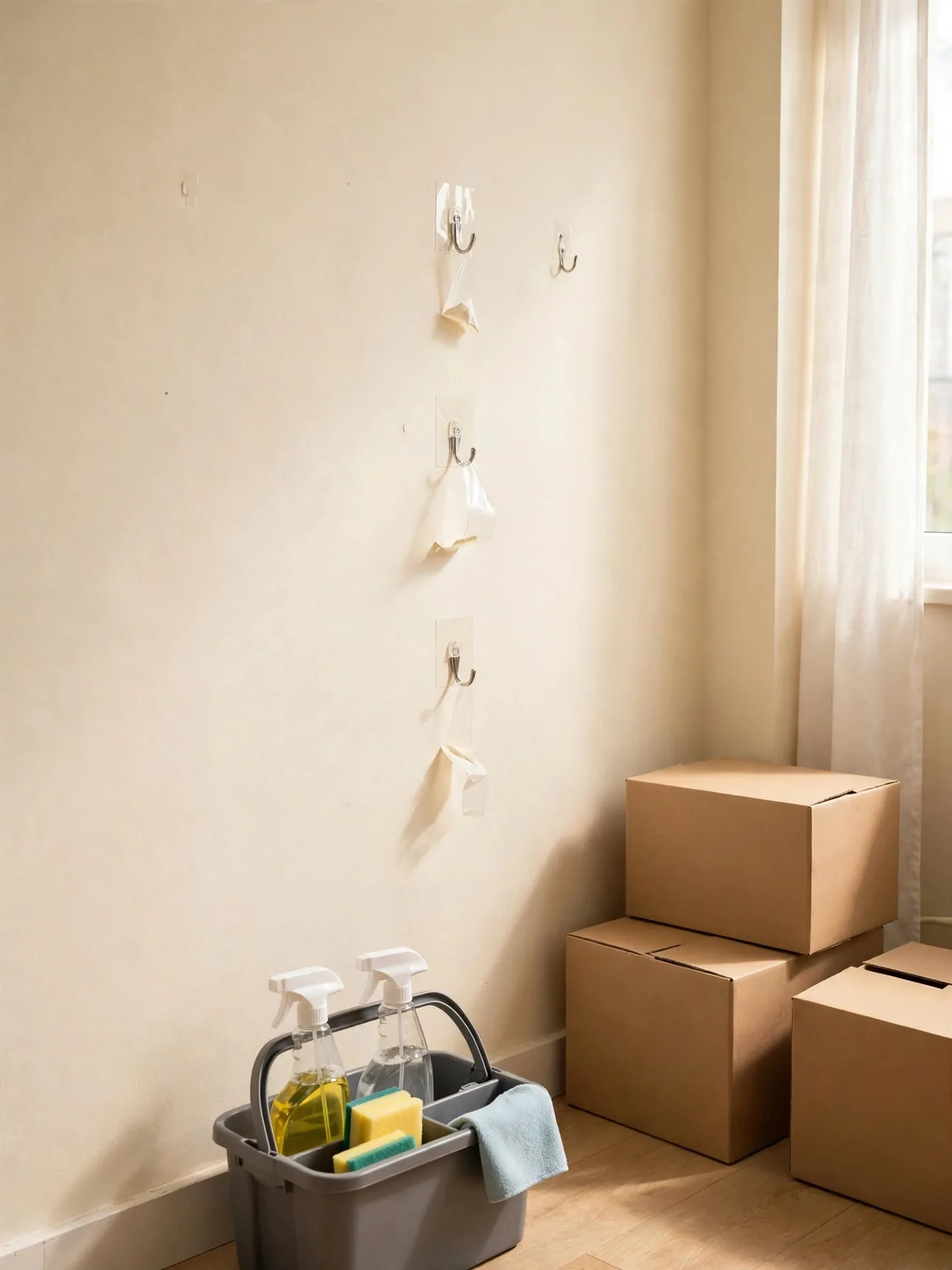
The inside face of the under-sink cabinet door offers about 1–2 inches (2.5–5 cm) of usable depth before anything mounted there collides with the shelf edge or the trap. That is enough for the flat, light things: a scrub brush, rubber gloves, a squeegee, a dustpan brush. Adhesive hooks rated around 1–2 lb (0.5–1 kg) each handle all of it for roughly $8–$12 a pack, and they peel off cleanly at move-out.
Bottles fail here twice over. A spray bottle is 3–4 inches (8–10 cm) deep, so it either blocks the door or gets clipped by the cabinet frame on every close — and a bottle knocked sideways inside a closed cabinet leaks in the dark. The swinging weight also works adhesive loose in humid air faster than a static load does. Hang the tools on the door; keep the bottles in the tray below it.
Cost: roughly $8–$12 for hooks. Watch out for: steam. Adhesive inside a bathroom cabinet lives in humid air, so press hooks on for a full 30 seconds, wait the curing time on the packet before loading them, and expect to re-seat one occasionally.
Required space: Needs the inside face of the under-sink cabinet door, offering about 1–2 in (2.5–5 cm) of usable depth before anything mounted there collides with the shelf edge or the trap.
Installation: Press adhesive hooks on for a full 30 seconds, wait the curing time on the packet before loading them, and expect to re-seat one occasionally, since adhesive inside a bathroom cabinet lives in humid air.
Approximate dimensions: Adhesive hooks are rated around 1–2 lb (0.5–1 kg) each, while a spray bottle is 3–4 in (8–10 cm) deep, too deep for this spot.
Rental-friendly limits: Adhesive hooks peel off cleanly at move-out, with nothing screwed in. Bottles fail here twice over, so hang the tools on the door and keep the bottles in the tray below it.
Pros: It uses a flat, light space for the tools that otherwise have no home, a scrub brush, rubber gloves, a squeegee, and a dustpan brush.
Cons: A bottle either blocks the door or gets clipped by the cabinet frame on every close, and the swinging weight works adhesive loose in humid air faster than a static load does.
Suitable products: Adhesive hooks, scrub brushes, rubber gloves, and squeegees.
Shower-Adjacent Storage: The Honest No
Verdict: no for chemicals. Two tools may live nearby — nothing else.
Every tiny-bathroom photo online shows bottles lined up on the tub ledge or a caddy hanging in the shower, and for shampoo that is fine. For cleaning chemicals it fails nearly every test in this guide. The ledge is wet daily, so labels peel and caps rust. Bottles get knocked into the bath — including, eventually, into bathwater with a child in it. Steam cycling makes trigger mechanisms weep. And a spray bottle stored at tub height is at exact grabbing height for a toddler standing in the bath, the one moment your hands are wet and busy.
The narrow exception is the two tools you use during a shower routine: a squeegee and a scrub brush, on a hook on the wall just outside the spray zone, so a 30-second wipe-down happens without a trip across the room. No chemicals, no bottles, nothing with a cap that can leak. If a shower-only product must live there — a daily shower spray — decant a small amount into the small-bottle system below and keep that one bottle in a ledge corner, out of the direct spray. Everything else in the kit lives dry.
Borrow the Hallway Closet: The Overflow Shelf
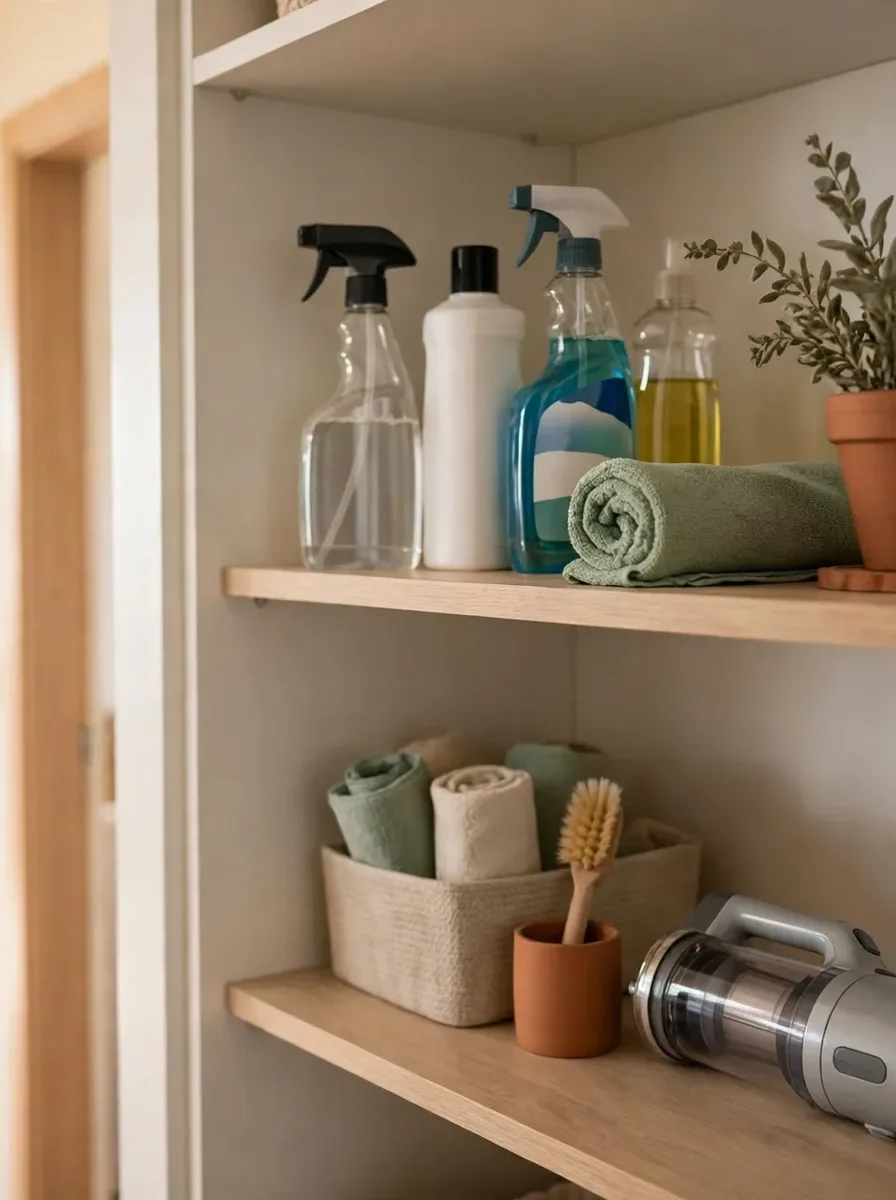
Verdict: yes — every tiny bathroom needs an outside annex.
Some things should never have been in the bathroom at all: the gallon refill jug, the mop, the broom, the spare cloths, the drain opener, the products for rooms that are not the bathroom. A single hallway closet shelf — 18–24 inches (46–61 cm) wide and 10–12 inches (25–30 cm) deep — holds all of it, dry, ventilated, and behind a door. If the closet has no spare shelf, a caddy or bin on the closet floor under the coats does the same job for roughly $10–$20.
Think of it as a warehouse-and-workshop split. The bathroom holds the working kit — four products, used weekly, in the caddy. The closet holds the warehouse: refills, backups, and the long tools. The mop and broom lean in the closet corner or hang on hooks on the back of the closet door, where their 48–54 inches (122–137 cm) of handle length is a non-issue.
The honest trade-off is discipline. The system works only if the caddy goes back to the bathroom and the refill jug stays in the closet. The failure mode — bottles slowly migrating until both spots are cluttered — is a habit problem, not a storage problem, and the fix is the weekly reset: the kit returns to its tray before anything else happens.
Cost: $0 if a shelf exists, roughly $10–$20 for a bin or caddy. Watch out for: keep the closet spot dry and off the floor if the closet shares a wall with the shower — and never annex a shelf above food storage in a kitchen cupboard instead; cleaning chemicals and food never share a cabinet.
Laundry supplies spilling over as well? Our small apartment laundry storage solutions guide gives them the same honest treatment.
Required space: Needs a single hallway closet shelf, 18–24 in (46–61 cm) wide and 10–12 in (25–30 cm) deep, or a caddy or bin on the closet floor under the coats if no spare shelf exists.
Installation: There is no installation — place a caddy or bin on the shelf or closet floor, and lean the mop and broom in the closet corner or hang them on hooks on the back of the closet door.
Approximate dimensions: The shelf is 18–24 in (46–61 cm) wide and 10–12 in (25–30 cm) deep, and mop and broom handles are 48–54 in (122–137 cm) long.
Rental-friendly limits: Nothing is fixed in the bathroom, and the overflow lives dry and ventilated behind a closet door. Keep the closet spot dry and off the floor if it shares a wall with the shower, and never annex a shelf above food storage.
Pros: It holds everything bulky that should never have been in the bathroom, the gallon refill jug, the mop, the broom, spare cloths, and the drain opener, dry and behind a door.
Cons: The system works only if the caddy goes back to the bathroom and the refill jug stays in the closet, so it needs a weekly reset to stop bottles slowly migrating between the two spots.
Suitable products: Caddies, bins, and closet hooks.
Decant Down: The Small-Bottle System
Half the bulk problem is packaging. A standard spray bottle is 28–32 oz (830–950 ml), but a weekly bathroom clean uses a few ounces. The decanting system splits every product into two lives: the bulk container lives in the hallway closet, and a small working bottle — 8–16 oz (240–475 ml), about 7–9 inches (18–23 cm) tall — lives in the bathroom caddy. The working kit gets roughly half as tall and noticeably lighter, which is what makes the under-sink pocket and the gap cart genuinely roomy.
Three rules keep decanting safe rather than stupid:
- Label everything, immediately. Product name, what it cleans, and the date, on a waterproof label or tape-and-marker. An unlabelled clear bottle of clear liquid is an accident on a timer.
- Never decant into a food or drink container. Not a soda bottle, not a juice jug, not “just for a week.” This is the single most common poisoning setup in small homes, and no space saving justifies it. A set of plain refill bottles costs roughly $6–$12.
- Keep bleach in its original bottle. Bleach degrades in clear containers, attacks some plastics, and is the product where a labelling mistake hurts most. It is the one product that never gets decanted — it lives in the closet in its factory bottle and visits the bathroom in the caddy.
Work with concentrates where you can: a small bottle of concentrate in the closet replaces several bulk refills, and you mix the working bottle at the sink. Keep one spare trigger sprayer in the closet too — triggers are the part that fails, and a dead trigger on cleaning day is how bottles end up stored open.
Required space: Needs no fixed new space — a small working bottle lives in the bathroom caddy, while the bulk container lives in the hallway closet.
Installation: Label everything immediately, with product name, what it cleans, and the date, on a waterproof label or tape-and-marker. Never decant into a food or drink container, and keep bleach in its original bottle, visiting the bathroom only in the caddy.
Approximate dimensions: A standard spray bottle is 28–32 oz (830–950 ml), while a small working bottle is 8–16 oz (240–475 ml), about 7–9 in (18–23 cm) tall.
Rental-friendly limits: Nothing is fixed to the room, and plain refill bottles cost roughly 6–12 dollars. Keep one spare trigger sprayer in the closet, since triggers are the part that fails.
Pros: The working kit gets roughly half as tall and noticeably lighter, which is what makes the under-sink pocket and the gap cart genuinely roomy.
Cons: An unlabelled clear bottle of clear liquid is an accident on a timer, and bleach degrades in clear containers and attacks some plastics, so it is the one product that never gets decanted.
Suitable products: Small plain refill bottles, waterproof labels, and concentrates.
The Tool Kit: Cloths, Brushes, and Things That Fold Flat
Tools have one great virtue chemicals lack: they can be stored flat, hung up, and slightly damp without hurting anyone. Exploit it. Microfiber cloths fold to almost nothing — four cloths stack about 1 inch (2.5 cm) tall — and live in the top of the caddy or a small bin on the door. A collapsible bucket, roughly $10–$15, flattens to about 2 inches (5 cm) and hangs on a hook, replacing the rigid bucket that eats 12 inches (30 cm) of cabinet in most rentals. The scrub brush and squeegee hang on the cabinet-door hooks to dry instead of stewing in the caddy.
The one rule for tools is the damp rule: a cloth goes away dry, or it goes away hanging. A damp cloth sealed into a bin in a humid bathroom is musty by the weekend and quietly mildewed by the end of the month. Hang cloths over the caddy handle or a hook overnight, and they fold away clean the next morning.
Required space: Needs only the top of the caddy or a small bin on the door for cloths, plus a hook for a collapsible bucket, since tools can be stored flat, hung up, and slightly damp.
Installation: Hang cloths over the caddy handle or a hook overnight to dry, then fold them away clean the next morning. Hang the scrub brush and squeegee on the cabinet-door hooks to dry instead of stewing in the caddy.
Approximate dimensions: Four microfiber cloths stack about 1 in (2.5 cm) tall, and a collapsible bucket flattens to about 2 in (5 cm), replacing a rigid bucket that eats 12 in (30 cm) of cabinet.
Rental-friendly limits: Nothing is fixed to the room, and tools can be stored flat or hung without hurting anyone. A cloth goes away dry, or it goes away hanging, never sealed damp into a bin.
Pros: Tools exploit flat and hung storage, cloths fold to almost nothing, and a collapsible bucket saves the space a rigid bucket would eat.
Cons: A damp cloth sealed into a bin in a humid bathroom is musty by the weekend and quietly mildewed by the end of the month.
Suitable products: Microfiber cloths, collapsible buckets, scrub brushes, and squeegees.
Safety: Children, Pets, Ventilation, and Leaks
Storage advice for chemicals is safety advice whether it says so or not, so here are the rules that outrank every verdict above.
Height or a latch — and know which one you actually have. Above 60 inches (152 cm) defeats toddlers. It does not defeat a climbing four-year-old, a cat that treats shelves as a staircase, or a dog that chews through thin plastic bottles. The reliable answer for any home with children under six or a chewing pet is a physical barrier: a childproof cabinet latch (roughly $5–$8, adhesive-mounted, removable) or a latched storage box, typically 12–14 inches (30–36 cm) long, that holds the full kit and clicks shut. Choose based on your household, not on the tidier photo.
Ventilation is a storage feature. Products give off mild fumes continuously, which is why this guide keeps steering you to open caddies, door racks, and louvered cabinets instead of sealed tubs. Never store cleaning products in an airtight container or a sealed box with damp cloths, and run the bathroom fan or crack the window while you clean.
Never mix, and store like you mean it. Bleach mixed with ammonia or with acidic cleaners — including most toilet cleaners — produces dangerous gas. Storage is where mixing accidents are set up: keep bleach in its own corner of the tray or its own bin, apart from the toilet cleaner, and use one product at a time. If two bottles ever leak into the same tray, that is a ventilate-and-call-the-landlord moment, not a wipe-it-up moment.
Leaks are a when, not an if. Triggers weep, caps crack, bottles get knocked. That is why every spot in this guide puts a tray under the bottles, why the monthly tray slide-out check matters, and why a leak gets reported to the landlord promptly — a cabinet floor rotted by a drip you hid is a deposit conversation you will lose. Full kits for every budget level, including the trays and latches above, are broken down in our guide to small bathroom organization ideas for renters on a budget.
Every Spot, Ranked Side by Side
| Spot | Best for | Fits | Child & pet safety | Typical cost | Verdict |
|---|---|---|---|---|---|
| Under-sink caddy in a tray | The daily four-product kit | 4–5 bottles upright | Good with a cabinet latch | $16–$28 | Best default |
| Over-door rack | Bottles high, tools on hooks | 3–4 bottles + tools | Best — above 60 in (152 cm) | $15–$25 | Best with toddlers |
| Slim gap cart | Full kit in a dead gap | 4–6 small bottles | Poor — open and low | $20–$35 | Great if the gap fits |
| Cabinet-door hooks | Brush, gloves, squeegee | Tools only | Neutral | $8–$12 | Tools only, never bottles |
| Shower ledge / in-shower caddy | Nothing chemical | — | Worst — tub grabbing height | — | No |
| Hallway closet shelf | Refills, mop, broom, backups | Everything bulky | Good behind a door | $0–$20 | Essential overflow |
Where Renters Usually Go Wrong
Storing bottles on the toilet tank or the tub ledge. The tank lid is a curved, vibrating surface above open water, and the ledge is wet, knock-prone, and at toddler-in-the-bath grabbing height. Both are where bottles fall from, and both are banned by the five tests for good reason.
Keeping every product you have ever bought. Eight sprays cannot be stored well in a tiny bathroom; four can. The edit at the top of this guide is not a warm-up exercise — it is the step that makes every other step possible.
Decanting into a drinks bottle. It saves nothing, it risks everything, and it is the one mistake in this guide with no safe version. Plain refill bottles cost a few dollars.
Sealing damp cloths and products into an airtight box. You have built a mildew incubator with a chemical scent. Open caddy, ventilated bin, dry cloths — every time.
Skipping the leak check because the cabinet “seems fine.” Slow drips soak silently for weeks. The tray slide-out takes thirty seconds once a month, and it is the difference between wiping a tray and replacing a cabinet floor — on your deposit.
Parking the gap cart over the shut-off valve. The cart belongs in the gap, not on the plumbing. Leave the valve reachable with the cart in place, and check that it is before you load the tiers.
The Setup to Copy
If you do not want to think about this again, here is the default build this guide lands on. Shrink the kit to four products. Put them, decanted small where the rules allow, in a handled caddy on a leak tray under the sink, bleach apart from the toilet cleaner. Hang the brush, gloves, and squeegee on hooks inside the cabinet door. Keep refills, the mop, and the collapsible bucket in the hallway closet. Add a cabinet latch or a latched box if there is a child or a chewing pet in the home — and if there is a toddler, move the bottles to the over-door rack instead and let the caddy carry tools. Total spend lands between $25 and $60, everything lifts out in minutes on moving day, and the bathroom keeps exactly one weekly chore’s worth of chemistry. For the rest of the room, the full bathroom storage hub pulls every zone together.