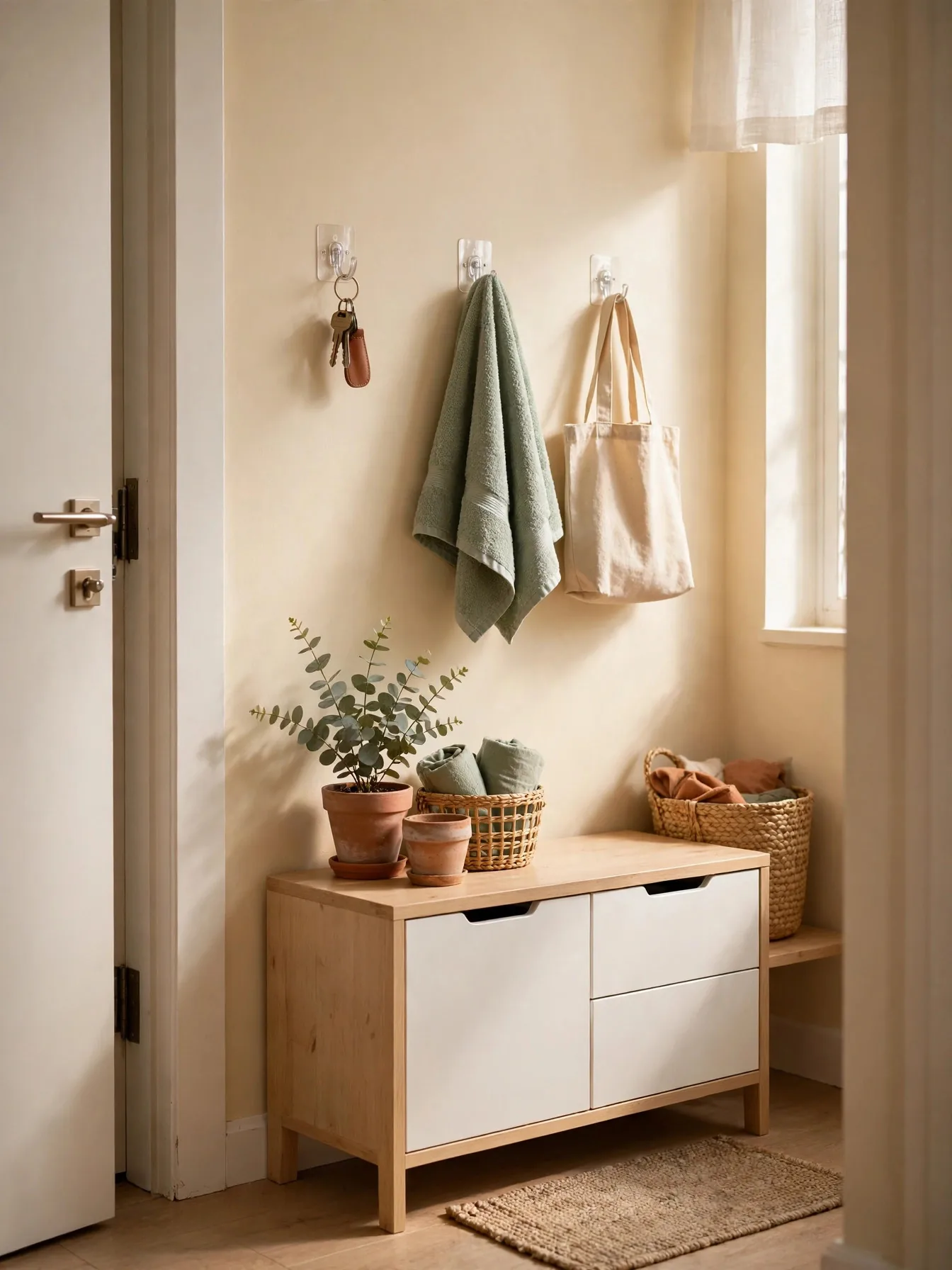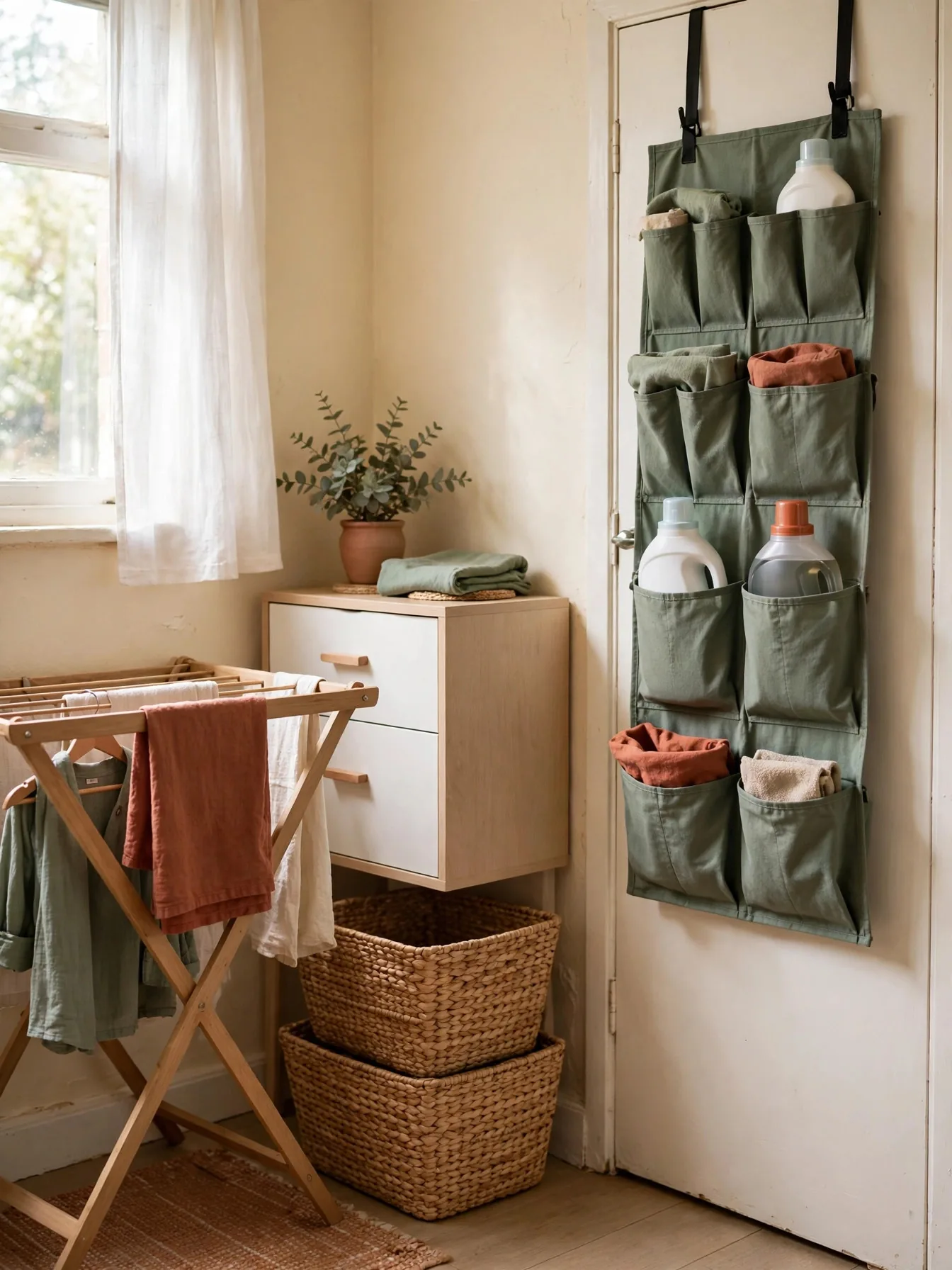
Laundry is the chore that exposes every weakness in a small rental. There is nowhere to sort, nowhere to fold, and the detergent bottle lives on top of the washer because there is literally no shelf. The good news is that small apartment laundry storage solutions do not depend on having a proper laundry room — they depend on matching the system to the setup you actually have. A renter with a machines-in-a-nook layout needs different storage from a renter whose “laundry room” is a closet, and both need something completely different from the renter carrying bags to a shared basement or a laundromat. More laundry-room organization ideas are at The Spruce.
This guide is organised by those three realities rather than by product. Every solution is no-drill and removable: freestanding shelving that stands on the floor, carts that roll into gaps, racks that hang on doors, and kits that pack away. Nothing here needs a screw, and everything can leave with you at move-out. Where a method relies on a no-drill fixing, it follows the same honest weight limits we set out in our comparison of no-drill shelves for apartment walls — and everything here sits inside the wider set of damage-free methods in our renter guides.
First, Work Out Which Laundry Situation You Actually Have
Before buying anything, take four measurements, because they decide which systems are even possible in your home. Measure the width of your machines: a standard washer or dryer is 27 in (69 cm) wide, while compact apartment models are usually 24 in (61 cm). Measure any gap beside or between the machines — a gap of 5 in (13 cm) or more is usable storage space. Check the swing of the washer lid or dryer door so nothing you add blocks it. Finally, measure the space above the machines to the ceiling or the underside of any cabinet; over-machine shelving needs roughly 30 in (76 cm) of clear height above the machines to give you two useful tiers.
Then be honest about which of the three cases below is yours. Renters regularly buy nook solutions for a closet setup, or a beautiful over-machine shelf when they do not own machines at all. The cases overlap — a slim cart works in two of them — but the core system is different in each, and buying for the wrong case is how laundry storage ends up in the returns pile.
One rule applies to all three: keep the total spend modest. Laundry storage is unglamorous infrastructure, and the full system for any case below lands between $20 and $90. If a product costs more than that, it needs to justify itself against a $25 cart that does the same job.
Case One: The In-Unit Laundry Nook
The nook — machines sitting side by side in an alcove, a wide closet with the doors removed, or a section of a kitchen or bathroom — is the best-case rental scenario, because you have floor space and wall-adjacent space to work with. The system has three parts: shelving above the machines, a cart in the gap, and smaller bottles that actually fit both.
Shelving above the machines, without touching the wall
A freestanding over-machine shelving unit is the single highest-value purchase for a nook. It stands on the floor on four legs that straddle the machines, so the wall behind it carries no weight and needs no holes. Units sized for a pair of machines are typically 47–55 in (119–140 cm) wide, 12–16 in (30–41 cm) deep and 60–68 in (152–173 cm) tall, with two or three tiers above the machines; single-machine versions for a top-loader run 27–32 in (69–81 cm) wide. Expect to pay $35–$70 for a steel unit.
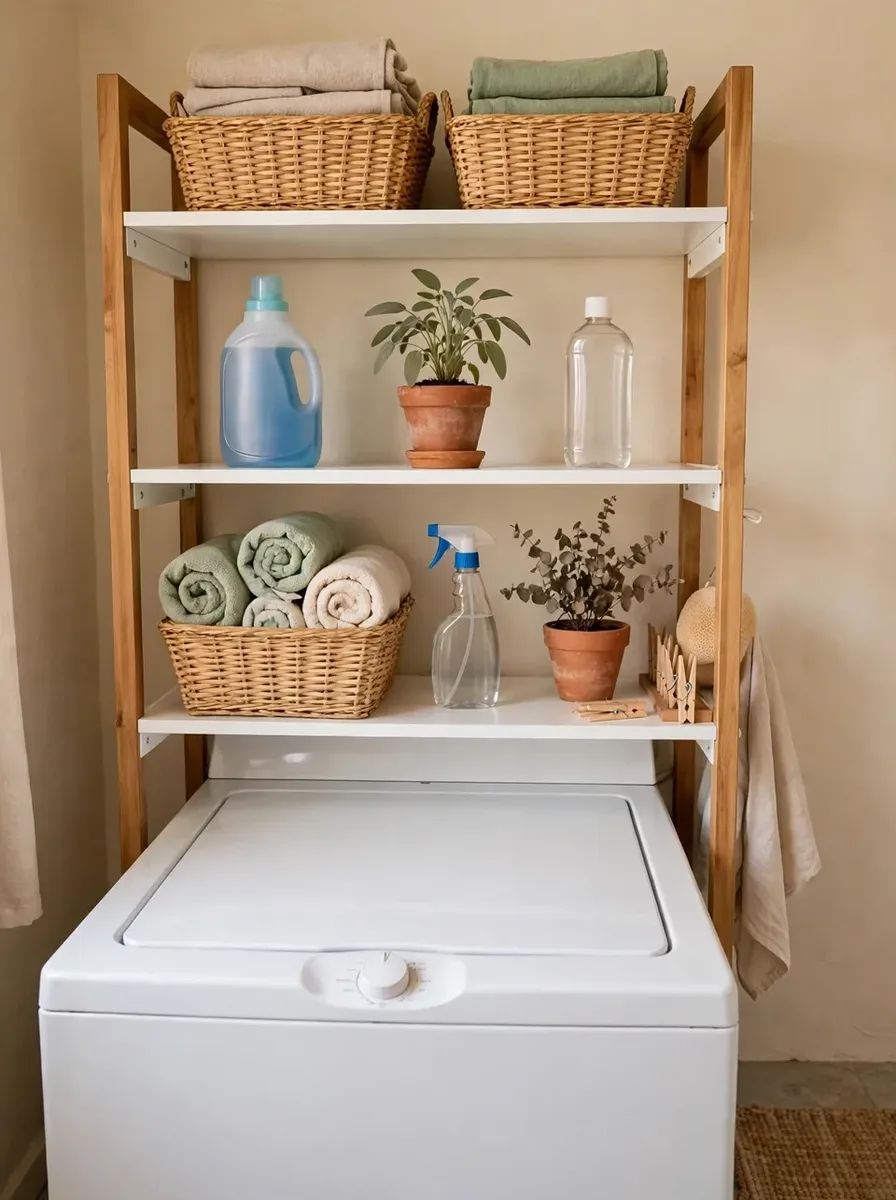
Two honest cautions. First, clearance: a top-load washer lid needs room to open fully, so leave 2–3 in (5–8 cm) between the top of the machine and the lowest shelf, and check the lid’s swing before you load the shelf. Second, vibration. Washers walk and shudder on spin cycles, and smooth plastic bottles creep slowly toward shelf edges. Store detergent and supplies in baskets or bins with a lip rather than loose, keep glass containers off these shelves entirely, and put the heaviest items on the lowest tier.
The gap between the machines is a shelf lying on its side
Most nooks have a 5–8 in (13–20 cm) gap between the machines or beside them, and it is almost always wasted. A slim rolling cart — usually 5–7 in (13–18 cm) wide, about 21 in (53 cm) deep and 30–34 in (76–86 cm) tall, with three or four tiers — turns that gap into the most-used storage in the laundry area. It rolls out when you need something and disappears when you do not. Prices run $20–$40.
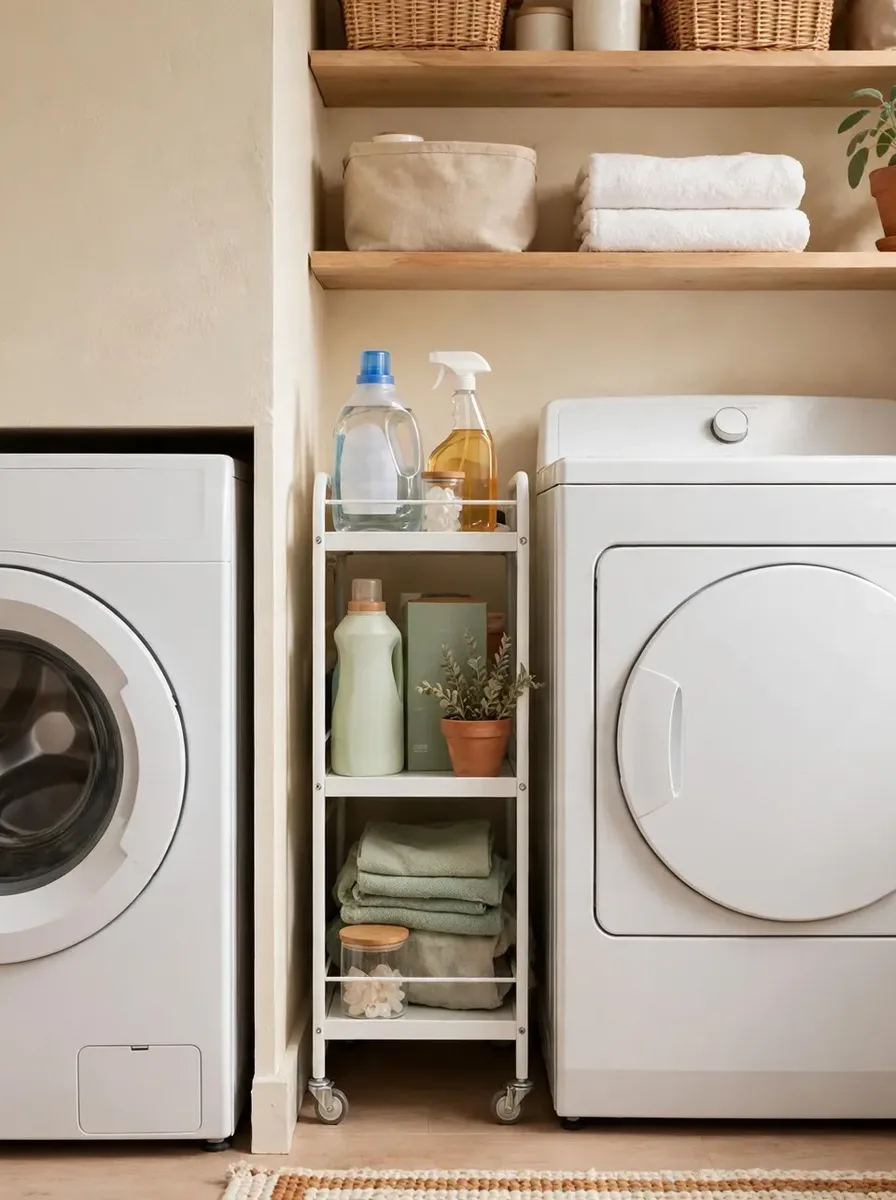
The trade-off is capacity per tier: slim cart shelves are shallow, and standard detergent jugs — often 6 in (15 cm) wide or more — simply do not fit. That is not a flaw in the cart; it is the reason the next part of the system exists.
Decant the detergent, keep the jug elsewhere
Decanting is the unglamorous trick that makes slim storage work. Pour detergent into a 16–32 oz (475–950 ml) bottle that fits your cart or shelf tier, and store the bulk jug in a closet, under the kitchen sink, or wherever bulk storage already lives — the same decant-and-store-bulk-elsewhere logic that works for cleaning supply storage in a tiny bathroom. A set of two or three plain bottles costs $8–$15.
Label what you decant, honestly and clearly, especially if anyone else uses the machines. And one firm safety exception: detergent pods should stay in their original child-resistant packaging, never loose in a pretty jar. If you use pods, keep the original container on the shelf and skip decanting that product entirely.
Where the hamper lives, and where folding happens
A nook system is not finished until dirty laundry has a parking spot and clean laundry has a landing spot. The hamper belongs in the nook if there is a spare 14–16 in (36–41 cm) of floor width — usually at the end of the machine run — because a hamper in the bedroom means clothes pile on the bedroom floor on the way there. If the nook floor is fully taken, a slim hamper on the back of the nearest door or inside the nearest closet beats a wide hamper that blocks the machine doors.
For folding, skip the dedicated table; there is no room, and that is fine. The top of a front-load machine is a perfectly good folding surface once it is not being used as a shelf, and a simple folding board or a flat storage bin lid makes a portable surface for the bed or sofa. The honest point is that in a nook, surfaces are borrowed, not built — the storage system’s job is to keep those borrowed surfaces clear.
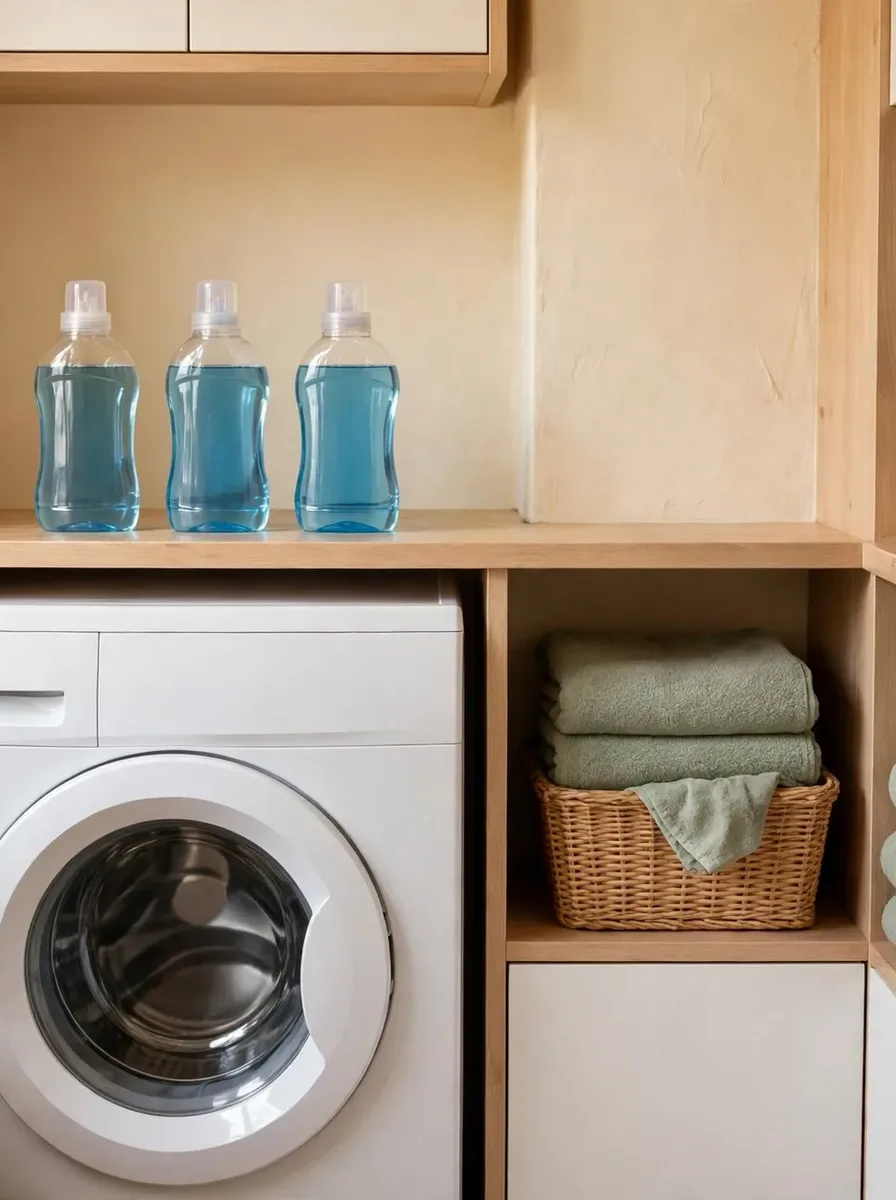
Required space: The nook floor and wall-adjacent space, with roughly 30 in (76 cm) of clear height above the machines for two useful tiers of over-machine shelving, a 5–8 in (13–20 cm) gap between or beside the machines, and a spare 14–16 in (36–41 cm) of floor width for the hamper at the end of the machine run.
Installation: Stand a freestanding over-machine shelving unit on the floor on four legs that straddle the machines, roll a slim cart into the gap, decant detergent into a 16–32 oz (475–950 ml) bottle that fits the cart or shelf tier and store the bulk jug elsewhere, and put the hamper in the nook or a slim hamper on the back of the nearest door or inside the nearest closet.
Approximate dimensions: Units sized for a pair of machines are typically 47–55 in (119–140 cm) wide, 12–16 in (30–41 cm) deep, and 60–68 in (152–173 cm) tall, with single-machine versions at 27–32 in (69–81 cm) wide; a slim rolling cart is usually 5–7 in (13–18 cm) wide, about 21 in (53 cm) deep, and 30–34 in (76–86 cm) tall; leave 2–3 in (5–8 cm) between the top of a top-load washer and the lowest shelf.
Rental-friendly limits: The shelving stands on the floor, so the wall behind it carries no weight and needs no holes; store detergent and supplies in baskets or bins with a lip rather than loose, keep glass containers off these shelves entirely, put the heaviest items on the lowest tier, and keep detergent pods in their original child-resistant packaging, never loose in a pretty jar.
Pros: The over-machine unit is the single highest-value purchase for a nook, the cart turns the wasted gap into the most-used storage in the laundry area, and folding borrows the top of a front-load machine once it is not being used as a shelf.
Cons: Slim cart shelves are shallow, and standard detergent jugs — often 6 in (15 cm) wide or more — simply do not fit, which is why decanting exists; washers walk and shudder on spin cycles, and smooth plastic bottles creep slowly toward shelf edges.
Suitable products: A freestanding over-machine shelving unit, a slim rolling cart, 16–32 oz decanting bottles, baskets or bins with a lip, a slim hamper, and a folding board or flat storage bin lid.
Case Two: Machines Inside a Laundry Closet
A laundry closet — machines behind bifold or hinged doors, often stacked — gives you less floor space than a nook but one asset the nook lacks: doors. In a closet setup, the doors and the vertical strip beside the machines do the work that shelving does in a nook.
The inside of the closet door is free storage
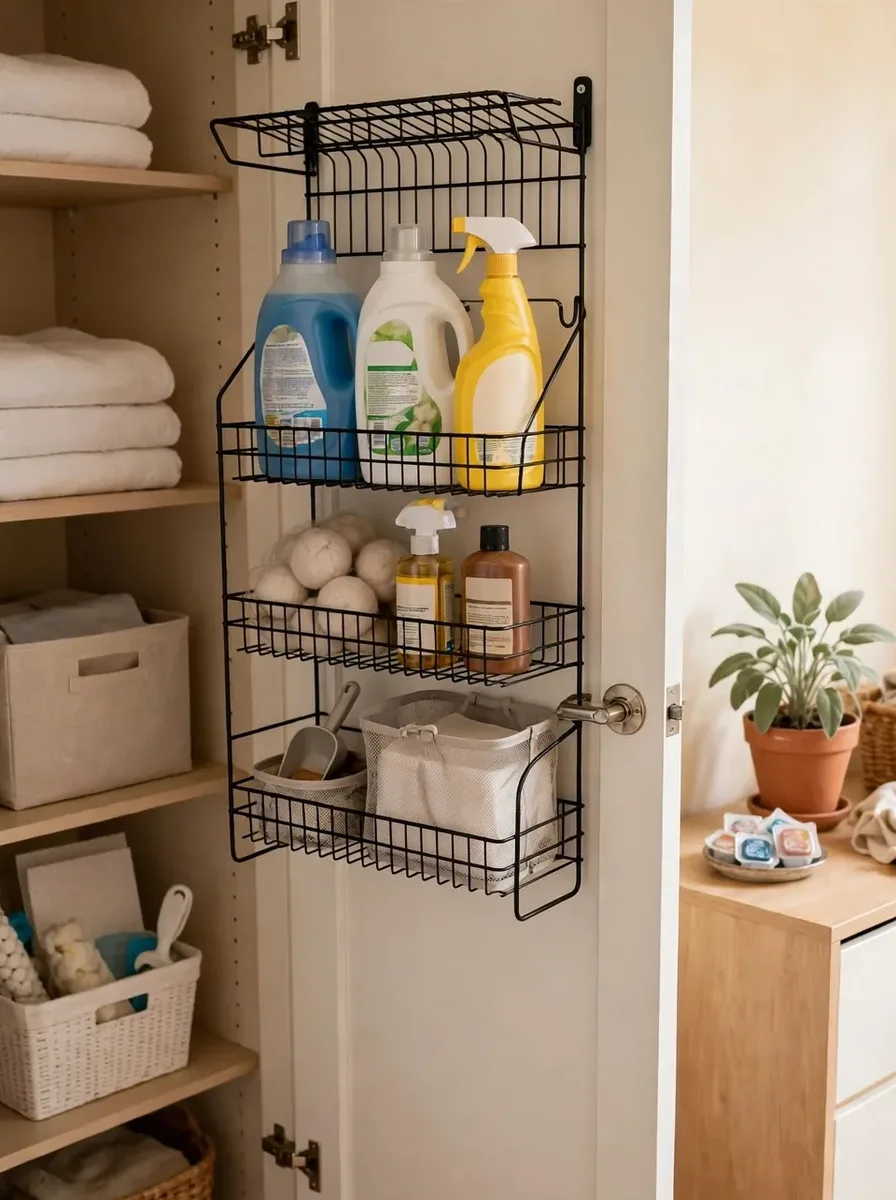
An over-door rack or a clear-pocket over-door organiser on the inside of the closet door holds stain remover, dryer sheets, a lint roller, clothespins and a sewing kit at eye level, in space that is otherwise air. Racks run $12–$25. Check two measurements first: most hooks are sized for a standard 1⅜ in (3.5 cm) interior door, and you need roughly ¼ in (6 mm) of clearance above the door so it still closes without scraping. Add felt pads where metal touches paint, and load it with light supplies only — a door rack sagging under full detergent bottles will eventually bend its hooks and rub the door edge.
Sorting where the machines are
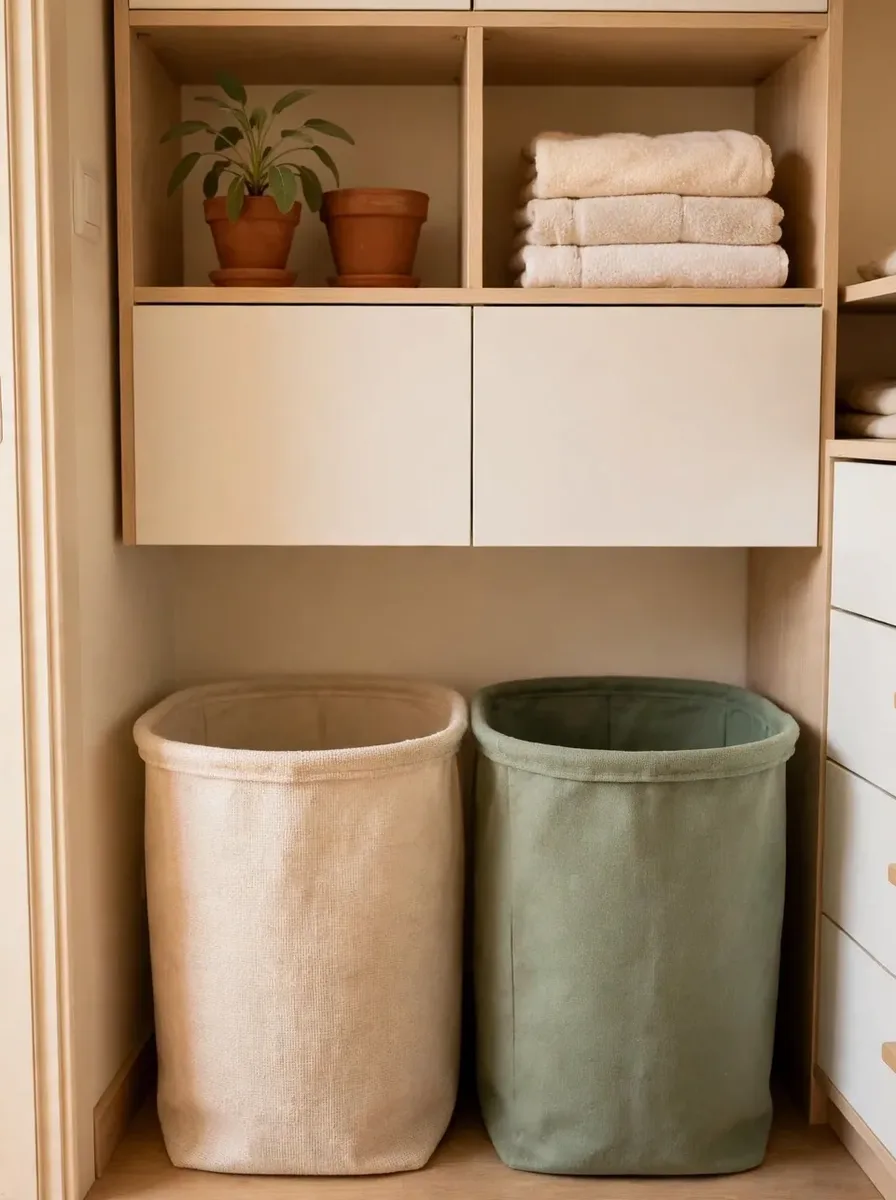
Closet renters often end up sorting laundry on their bed because there is no surface near the machines. A pair of slim, labelled hampers — one for lights, one for darks — that live inside the closet or immediately beside its door fixes the sorting problem at the source. Look for hampers around 14–16 in (36–41 cm) wide with lids, so the closet still looks tidy when the doors are open; a two-hamper setup costs $20–$35. If the closet floor is fully occupied by the machines, a single hamper on wheels that parks in a bedroom closet and rolls to the laundry closet on wash day is the honest compromise.
Heat, moisture and the stacked-machine strip
Bifold doors and other closet quirks
Two closet details catch renters out. Bifold doors fold inward as they open, which eats several inches of the closet’s interior at the sides — an over-door organiser designed for a hinged door may not fit a bifold at all, and a hamper placed at the closet’s edge can block the fold. If your laundry closet has bifolds, move the door-storage idea to the nearest hinged door (a bathroom or hallway closet) and keep the bifold’s swing zone empty. Second, the dryer needs its lint trap and vent path kept clear, and closets tempt you to store things against the machine’s back panel where the vent hose runs. Leave that rear strip empty: it is a heat and lint zone, not a storage zone, and crushing a vent hose with stored items is a genuine fire-safety issue, not just untidiness.
Closets run hot and damp, especially with a dryer venting into a small enclosed space. Store paper goods (dryer sheets, spare lint filters) in a closed box rather than open baskets, and avoid keeping anything heat-sensitive against the dryer side. If your machines are stacked, the narrow vertical strip beside the stack — often 6–10 in (15–25 cm) wide — fits the same slim cart described in Case One. A tension rod mounted inside the closet above the machines also earns its keep here as a drip-dry rail for delicates; it is one of the tension and compression methods covered in the no-drill shelves comparison, and it removes with a twist at move-out.
Required space: The inside of the closet door and the vertical strip beside the machines, often 6–10 in (15–25 cm) wide, plus room for slim hampers around 14–16 in (36–41 cm) wide inside the closet or immediately beside its door.
Installation: Hang an over-door rack or clear-pocket organiser on the inside of the closet door, add felt pads where metal touches paint, and load it with light supplies only; place a pair of slim, labelled hampers — one for lights, one for darks — inside the closet or beside its door; mount a tension rod inside the closet above the machines as a drip-dry rail for delicates.
Approximate dimensions: Most hooks are sized for a standard 1⅜ in (3.5 cm) interior door, and you need roughly ¼ in (6 mm) of clearance above the door so it still closes without scraping; hampers are around 14–16 in (36–41 cm) wide with lids.
Rental-friendly limits: Keep the dryer’s lint trap and vent path clear and leave the rear strip empty, since crushing a vent hose with stored items is a genuine fire-safety issue; bifold doors fold inward as they open, so an over-door organiser designed for a hinged door may not fit a bifold at all, and a hamper at the closet’s edge can block the fold.
Pros: The doors and the vertical strip do the work that shelving does in a nook, and the hampers fix the sorting problem at the source instead of on the bed.
Cons: A laundry closet gives less floor space than a nook, closets run hot and damp, and paper goods must go in a closed box rather than open baskets, with nothing heat-sensitive kept against the dryer side.
Suitable products: An over-door rack or clear-pocket organiser, slim labelled hampers with lids, a slim rolling cart for the strip beside a stacked machine, and a tension rod.
Case Three: No Machines at All — The Laundromat and Shared-Basement System
If your building has a shared laundry room or you use a laundromat, your storage problem is inverted: you do not need storage at the machines, you need a kit at home that grabs and goes, and nothing worth stealing left behind in a shared space. Do not store detergent in a shared laundry room — it walks away, gets borrowed, or gets knocked behind the machines. Everything lives at home, in one place, in one bag’s reach.
Build one portable kit
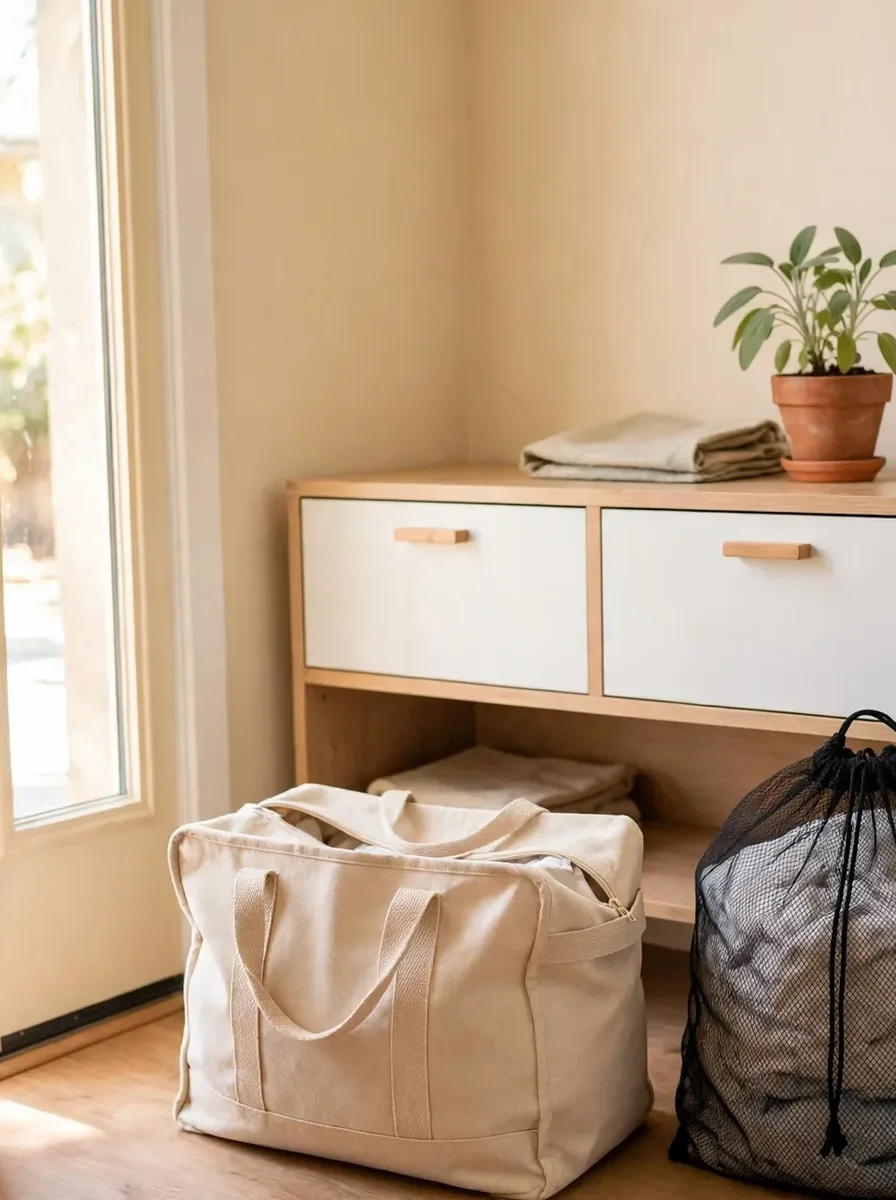
The kit is deliberately boring: a sturdy laundry bag or a backpack-style hamper you can carry on stairs ($15–$25), a small sealed container of pods or a travel-size bottle of detergent, a stain pen, a mesh bag for delicates, and a small pouch for payment. Kept together in a closet or hanging by the door, the whole kit costs $25–$50 and means laundry day is a grab, not a scavenger hunt. A rolling laundry bag or a hamper with wheels ($20–$35) is worth it if your trip involves a elevator-less staircase or a walk of more than a block — dragging 15 lb (7 kg) of wet laundry home is the part nobody budgets for.
Sort at home, fold at home
Shared machines charge by the load and by the minute, so the storage habits that save money happen in your apartment. Sort into two bags at home — a dual-compartment hamper or two cheap mesh bags inside one big bag — so you are not separating colours on a laundromat table. Keep a flat folding surface clear at home (a bed works) and bring a spare bag for clean laundry so folded clothes never go back into the bag that carried dirty ones. If your building’s shared room is in the basement, a slim caddy that carries detergent, pods and stain treatment down in one trip replaces the kit bag’s supply role, and it stores on a closet shelf between trips.
One more habit belongs to this case: splitting the dry. Many renters with no machines run heavy items — towels, jeans, bedding — through a short paid dryer cycle and bring everything else home damp to finish on a rack, because dryer minutes are the expensive part of the trip and light clothes air-dry for free overnight. That only works if the home end is ready: the rack (next section) should be up before you leave, or at least have its storage slot clear, so a bag of damp laundry is not sitting on the floor while you assemble your own system. It also means your kit needs one extra item — a waterproof bag or a plastic-lined tote for the damp load coming home, so it never shares a bag with dry clean clothes.
Required space: One place at home — a closet or by the door — where the whole kit is kept together, and nothing stored in the shared laundry room itself.
Installation: Build one portable kit — a sturdy laundry bag or backpack-style hamper, a small sealed container of pods or a travel-size bottle of detergent, a stain pen, a mesh bag for delicates, and a small pouch for payment — and sort into two bags at home, keeping a flat folding surface clear at home and bringing a spare bag for clean laundry; put the drying rack up before you leave, or at least have its storage slot clear.
Approximate dimensions: No fixed size is given — the kit is one bag and one small supply pouch; a rolling laundry bag or hamper with wheels is worth it if the trip involves an elevator-less staircase or a walk of more than a block, since dragging 15 lb (7 kg) of wet laundry home is the part nobody budgets for.
Rental-friendly limits: Do not store detergent in a shared laundry room — it walks away, gets borrowed, or gets knocked behind the machines — and bring a waterproof bag or plastic-lined tote for the damp load coming home, so it never shares a bag with dry clean clothes.
Pros: Laundry day becomes a grab, not a scavenger hunt, sorting at home saves machine time and money, and splitting the dry — heavy items through a short paid dryer cycle, the rest air-dried at home — saves dryer minutes, the expensive part of the trip.
Cons: The split-dry habit only works if the home end is ready, with the rack up before you leave, and heavy items still need a short paid dryer cycle rather than air-drying for free.
Suitable products: A sturdy laundry bag or backpack-style hamper, a rolling laundry bag or hamper with wheels, a small sealed container of pods or travel-size detergent bottle, a stain pen, a mesh bag for delicates, a dual-compartment hamper or two mesh bags, and a waterproof bag or plastic-lined tote.
The Drying Problem: Racks That Earn Their Space, Then Disappear
Whichever case is yours, drying is where small-apartment laundry systems usually fail, because the rack is the biggest object in the whole setup and it is only needed twice a week. The renter answer is a rack that folds genuinely flat and has a designated storage slot — beside the washer, behind a door, or under a bed — decided before you buy it.
A gullwing or accordion rack opens to roughly 42 × 20 in (107 × 51 cm) of footprint and offers 30–45 linear feet (9–14 m) of drying bars, then folds to about 4 in (10 cm) thick. Prices run $20–$45. That folded slot beside the washer — often the same gap a slim cart uses in a nook, so choose which one your gap hosts — is what separates a rack you use from a rack that lives permanently open in your living room.
How much drying space a load actually needs
Rack capacity is quoted in linear feet of bar, which means little until you map it to a load. A typical mixed load of about 8 lb (3.6 kg) — a week of one person’s everyday clothes — needs roughly 25–35 linear feet (7.5–10.5 m) of bar space if items hang with a finger’s width between them so air can move. That is one full-size gullwing rack, loaded completely. Heavy items change the maths: a pair of wet jeans can weigh 2 lb (0.9 kg) on its own and wants a whole end section of the rack, both for the bar strength and because thick denim dries slowly and blocks airflow to whatever hangs behind it.
If you regularly wash two loads back to back, one rack is not enough, and the honest options are a second folding rack (another $20–$45, and another storage slot to plan) or staggering the loads a day apart so the rack turns over. What does not work is cramming two loads onto one rack with items touching — everything takes twice as long to dry, and the middle items come off smelling musty. Spacing is the drying; the rack is just the frame that holds the spacing up.
Alternatives have honest limits. A tension rod across a shower or tub alcove handles a few hangers of delicates and costs $10–$20, but it is not a full-load solution. Over-door drying racks save floor space but concentrate a wet load’s weight on door hinges — fine for light items, a poor idea for a load of wet jeans. Retractable clotheslines that mount with adhesive or suction sound ideal and, in our judgement, are the weakest option here: a line under the tension of wet laundry is exactly the load case where adhesive and suction fail, and a line that comes down mid-load takes paint with it. Whatever you choose, dry clothes in moving air — near an open window, or with a small fan or the bathroom exhaust fan running — and never in a closed closet, where trapped moisture is how mildew smell gets into both the clothes and the room. How we judge load claims and removability for products like these is set out in how we test.
Required space: A designated storage slot for the folded rack — beside the washer, behind a door, or under a bed — decided before buying, since the rack opens to roughly 42 × 20 in (107 × 51 cm) and folds to about 4 in (10 cm) thick.
Installation: Open the gullwing or accordion rack in the room with the best airflow, near a window or with the bathroom fan on, and hang items with a finger’s width between them so air can move; a tension rod across a shower or tub alcove handles a few hangers of delicates.
Approximate dimensions: A gullwing or accordion rack opens to roughly 42 × 20 in (107 × 51 cm) and offers 30–45 linear feet (9–14 m) of drying bars, then folds to about 4 in (10 cm) thick; a typical mixed load of about 8 lb (3.6 kg) needs roughly 25–35 linear feet (7.5–10.5 m) of bar space, and a pair of wet jeans can weigh 2 lb (0.9 kg) on its own and wants a whole end section of the rack.
Rental-friendly limits: Never dry clothes in a closed closet, where trapped moisture causes mildew smells, and retractable clotheslines that mount with adhesive or suction are the weakest option here — a line under the tension of wet laundry is exactly the load case where adhesive and suction fail, and a line that comes down mid-load takes paint with it.
Pros: A rack that folds genuinely flat and has a designated storage slot is a rack you actually use, and spacing is the drying — the rack is just the frame that holds the spacing up.
Cons: One rack is not enough for two loads back to back, and cramming two loads onto one rack with items touching makes everything take twice as long to dry, with the middle items coming off smelling musty; over-door drying racks concentrate a wet load’s weight on door hinges, so they are fine for light items and a poor idea for a load of wet jeans.
Suitable products: A folding gullwing or accordion rack, a tension rod for delicates, an over-door drying rack for light items, and a small fan.
Small Apartment Laundry Storage Options, Side by Side
| System | Best for | Typical size | Typical cost | Watch out for |
|---|---|---|---|---|
| Freestanding over-machine shelving | Nook with side-by-side machines | 47–55 in (119–140 cm) wide, 2–3 tiers | $35–$70 | Washer lid clearance; vibration creep — use baskets |
| Slim rolling cart | Gaps beside or between machines, any setup | 5–7 in (13–18 cm) wide, 3–4 tiers | $20–$40 | Full-size detergent jugs do not fit |
| Over-door rack or organiser | Laundry closet doors | Fits 1⅜ in (3.5 cm) doors | $12–$25 | Needs top clearance; light loads only |
| Decanted bottle set | Making slim storage usable | 16–32 oz (475–950 ml) bottles | $8–$15 | Label clearly; never decant pods out of safety packaging |
| Portable laundromat kit | No machines / shared laundry room | One bag, one small supply pouch | $25–$50 | Nothing stored in the shared room itself |
| Folding drying rack | All three cases | Opens ~42 × 20 in (107 × 51 cm), folds ~4 in (10 cm) thick | $20–$45 | Needs a planned storage slot or it never gets put away |
Where Good Storage Goes Wrong
Blocking the machine’s own moving parts. Shelves that stop a top-load lid opening fully, carts wedged against a dryer door swing, hampers in front of the detergent drawer — measure the swings before placing anything.
Storing bottles loose on top of the machines. It looks like free storage until the spin cycle walks a detergent bottle off the edge. The top of the washer is a work surface for folding and sorting, not a shelf.
Trusting adhesive shelves with full detergent jugs. A gallon of detergent weighs about 8 lb (3.6 kg) before you add anything else, and adhesive ratings are package claims for ideal conditions. Adhesive belongs under light, dry items — never under the heaviest liquid in the room, above machines you do not own.
Leaving supplies in a shared laundry room. Anything stored in a communal space should be treated as already gone. Carry supplies down, carry them back.
Drying clothes in a closed space. A rack inside a shut closet or a windowless room with no fan running keeps moisture in the fabric and the walls. Airflow is not optional; it is the difference between drying and slow mildewing.
Buying the rack before choosing its storage slot. A drying rack without a planned home becomes permanent furniture. Decide where the folded rack lives — beside the washer, behind a door, under the bed — and check the folded thickness against that slot before you buy.
Skipping the lid on the hamper. In a small apartment the hamper is visible from living space. An open hamper of waiting laundry makes the whole room read as untidy; a lid or a closet door fixes the visual problem for a few dollars.
The Short Version
Small apartment laundry storage is not one product — it is a match between your housing case and a small set of removable pieces. Nook renters: freestanding shelving above the machines, a slim cart in the gap, detergent decanted to fit. Closet renters: the door becomes the storage, hampers handle sorting, and heat shapes what you keep inside. No-machine renters: one portable kit at home, nothing left in shared spaces. Everyone: a folding rack with a planned storage slot and moving air to dry in. Set up once, in an hour or two, for well under $90 — and every piece of it leaves with you when the lease ends.