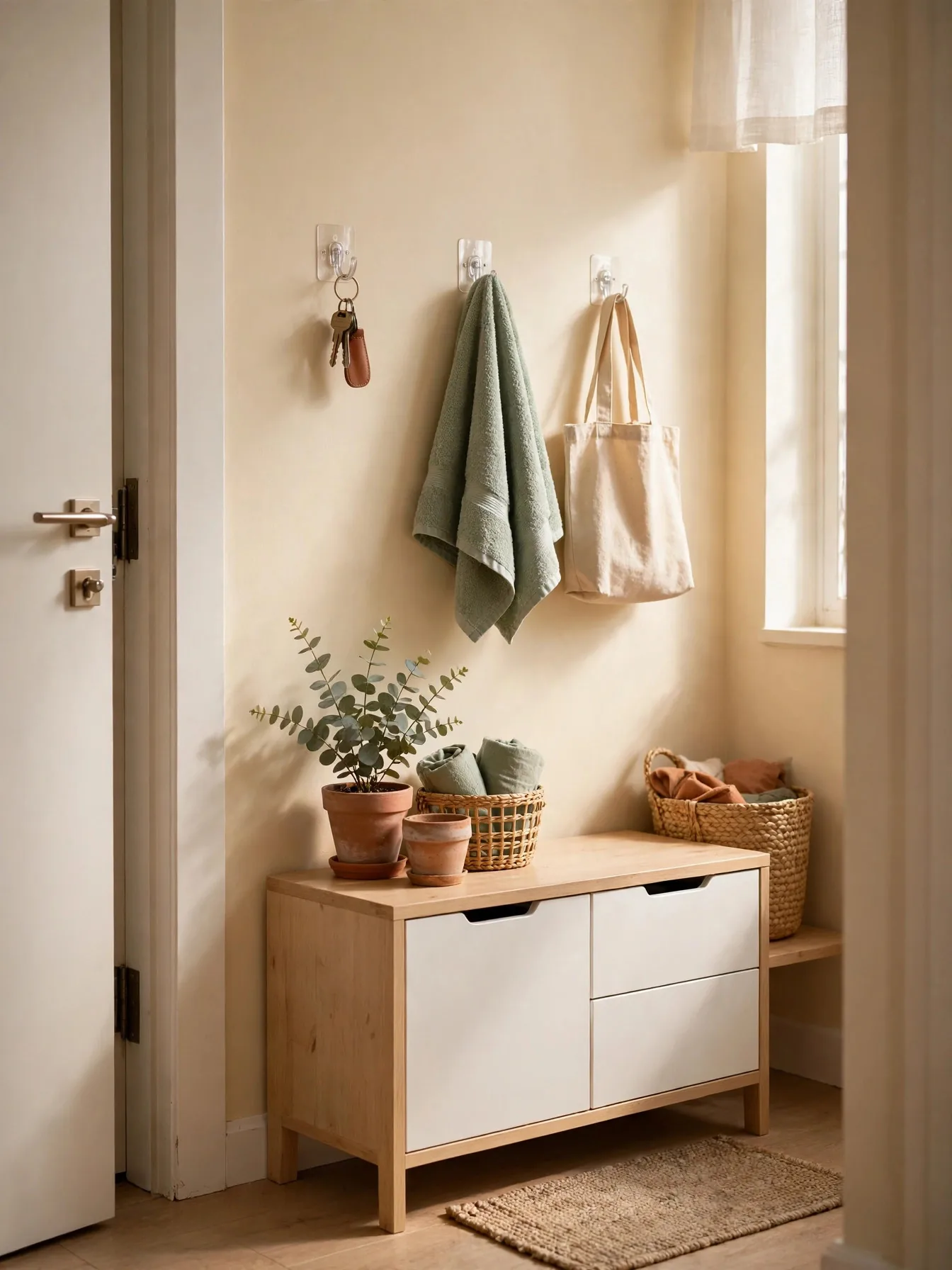
Most renters file the tension rod under “curtain hardware” and never think about it again. That undersells it badly. Used well, tension rod storage ideas for renters turn the rod into hidden infrastructure: a rail inside a cabinet, a divider between cutting boards, a shoe rack that floats inside a closet, a shelf support across a window alcove. It holds itself up with friction alone, needs no screws, no adhesive and no landlord permission, and at move-out it twists down in seconds and goes in a suitcase. For more renter-friendly shelving and storage project ideas, see Family Handyman.
This guide is organised by location rather than by product, because the rod behaves differently in each spot. A rod that is perfect inside a 14 in (36 cm) cabinet will sag and slip across a 48 in (122 cm) closet. So before the ideas, there is a short section on the physics — span, diameter, load ratings and sag — because understanding those four things is the difference between a rod that stays up for two years and one that dumps your cleaning bottles at 3 a.m. If you want to see how rods stack up against adhesive, suction and leaning options first, our comparison of no-drill shelves for apartment walls puts every method side by side.
The Physics First: Span, Diameter, Sag and Package Ratings
A tension rod stays up because friction at its two ends resists gravity. The rod pushes outward against both surfaces, and that outward force, multiplied by the friction of the rubber end caps, is all that holds your storage in the air. Everything about whether a rod works comes back to that one fact.
Span is the dominant variable. The longer a rod stretches, the weaker it gets, for two reasons. First, most rods are two tubes that telescope, and the further the inner tube extends, the less overlap there is and the more flex the joint allows. Second, any horizontal bar bends under load, and bending increases dramatically with length — a rod loaded at the centre of a 48 in (122 cm) span deflects far more than the same rod across 24 in (61 cm). That bend is what you see as sag, and sag is dangerous because a bent rod effectively shortens itself: the ends angle inward, friction drops, and the rod walks down the wall and falls. This is why package ratings always assume the shortest extension. A rod rated at 20 lb (9 kg) at 24 in (61 cm) may honestly hold only 6–8 lb (2.7–3.6 kg) stretched to 42 in (107 cm), even though the packet prints only the bigger number.
Diameter buys stiffness. Slim rods around 1/2 in (13 mm) in diameter are made for café curtains and light cabinet jobs. Standard rods at 5/8–3/4 in (16–19 mm) handle most storage uses. Heavy-duty rods near 1 in (25 mm) in diameter, usually sold as shower or wardrobe rods, are visibly stiffer and are the only sensible choice past about 40 in (102 cm) of span. When in doubt, go one diameter up rather than one price down.
Spring versus twist-lock. Spring rods contain a coil spring: you compress the rod, position it, and release, and the spring supplies the outward push. They are quick and forgiving, but the spring force is fixed and modest, so they suit short spans and light loads. Twist-lock rods extend by rotation and lock by friction between the tubes; you dial in the pressure yourself. They hold noticeably more and creep less over time, which is why most rods sold for storage rather than curtains use this mechanism. The trade-off is that a twist-lock rod can be over-tightened by an enthusiastic hand, and excess force dents paint, bows thin cabinet sides and can crack brittle tile grout lines. Firm and level is the goal — not maximum torque.
Load position matters as much as load weight. Five pounds hung at the centre of a rod stresses it far more than five pounds split between the two ends, because a centre load has the longest lever arm for bending. Hanging items — spray bottles, S-hooks, shoe heels — should be spread along the rod, and the heaviest items placed nearest the ends.
End caps are not decoration. The rubber cap is the friction surface and the paint protector in one. A rod with a missing or perished cap has metal-on-paint contact: less grip, more slip, and a scuffed wall at move-out. Replace cracked caps, and on painted drywall add a small adhesive felt pad under each end to spread the pressure over a wider area.
Choosing the Rod: A Buying Table
Prices below are typical US retail ranges for a single rod. Load figures are package ratings — what the manufacturer prints — quoted at the shortest extension, and you should plan to use roughly half of them in real life.
| Rod type | Common diameters | Typical span range | Package load rating | Realistic working load | Typical price |
|---|---|---|---|---|---|
| Slim spring rod | 1/2 in (13 mm) | 7–24 in (18–61 cm) | ~5 lb (2.3 kg) | 2–3 lb (0.9–1.4 kg) | $6–$12 |
| Standard twist-lock rod | 5/8–3/4 in (16–19 mm) | 14–36 in (36–91 cm) | 10–20 lb (4.5–9 kg) | 5–10 lb (2.3–4.5 kg) | $8–$16 |
| Heavy-duty twist-lock rod | ~1 in (25 mm) | 28–72 in (71–183 cm) | 20–30 lb (9–13.6 kg) | 10–15 lb (4.5–6.8 kg) | $14–$25 |
| Stainless shower rod | 3/4–1 in (19–25 mm) | 36–72 in (91–183 cm) | 15–25 lb (6.8–11.3 kg) | 8–12 lb (3.6–5.4 kg) | $18–$35 |
| Mini cabinet rod | 3/8–1/2 in (10–13 mm) | 6–14 in (15–36 cm) | ~3 lb (1.4 kg) | 1–2 lb (0.45–0.9 kg) | $5–$9 |
Two buying rules follow from the table. First, buy for your exact span, aiming for the middle of the rod’s range rather than the very end of it — a rod at 90% extension is at its weakest and least stiff. Second, if your span falls between sizes, the larger rod dialled back beats the smaller rod stretched out, every time.
Inside Cabinets: Dividers, Rails and Vertical Order
Kitchen cabinets waste vertical space and tangle flat items. Cutting boards, baking trays, lids and cooling racks all lean against each other in a pile, and the one you want is always at the back. Tension rods fix this by turning one open box into divided slots.
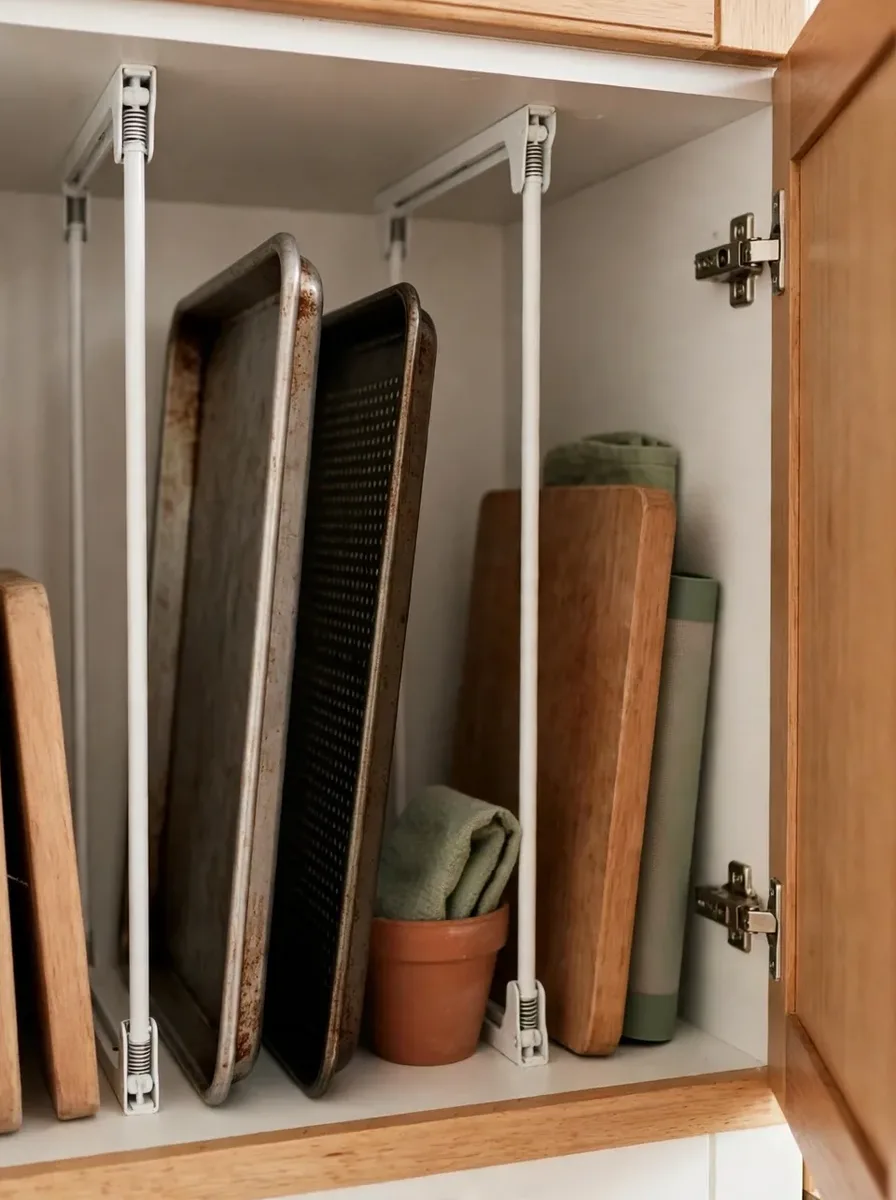
Vertical dividers for boards and trays. Fit two or three short rods vertically — or horizontally across the cabinet’s depth — to create upright slots. Stand cutting boards, trays and sheet pans on edge between the rods and they stay separated, visible and grabbable. Cabinet interiors are ideal rod territory: spans are short (typically 10–16 in / 25–41 cm), the side walls are rigid, and even a slim rod is stiff at that length. Keep total weight modest anyway; a stack of thick wooden boards is heavier than it looks.
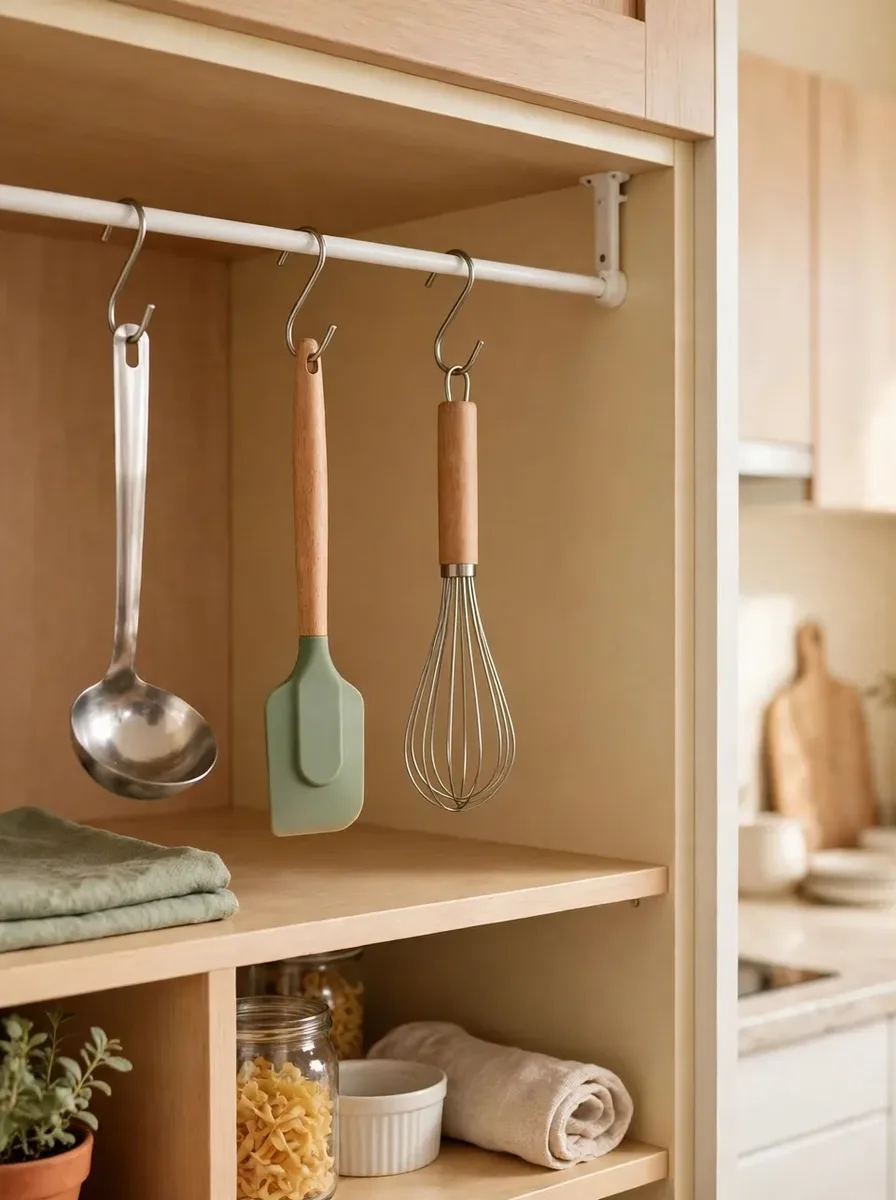
S-hook rails. A single rod across the upper part of a cabinet, fitted with S-hooks, becomes a rail for measuring cups, whisks, ladles, scissors and mugs. This works because hooks put the load close to the rod and spread it along its length. Choose hooks that fit your rod diameter snugly; loose hooks slide everything into the middle, which is exactly where you do not want the weight. The same rail trick works inside a pantry cabinet for packets hung from clips, and in a bathroom cabinet for hair tools with hanging loops.
A rod as a shelf stop. Deep cabinets swallow small jars that migrate to the back. A rod fitted across the front of a shelf, a few inches above its surface, acts as a retaining bar that keeps jars and bottles from being knocked off while adding almost no visual clutter. It is a thirty-second install and one of the least glamorous, most useful jobs a rod can do.
Paper towel and wrap duty. A short rod under a wall cabinet or inside a deep drawer holds a paper towel roll where it can spin freely. Inside a wide drawer, a rod across the width keeps cling film and foil boxes from sliding. These are mini-rod jobs — spans under 14 in (36 cm) — where even the cheapest rod is comfortably strong enough.
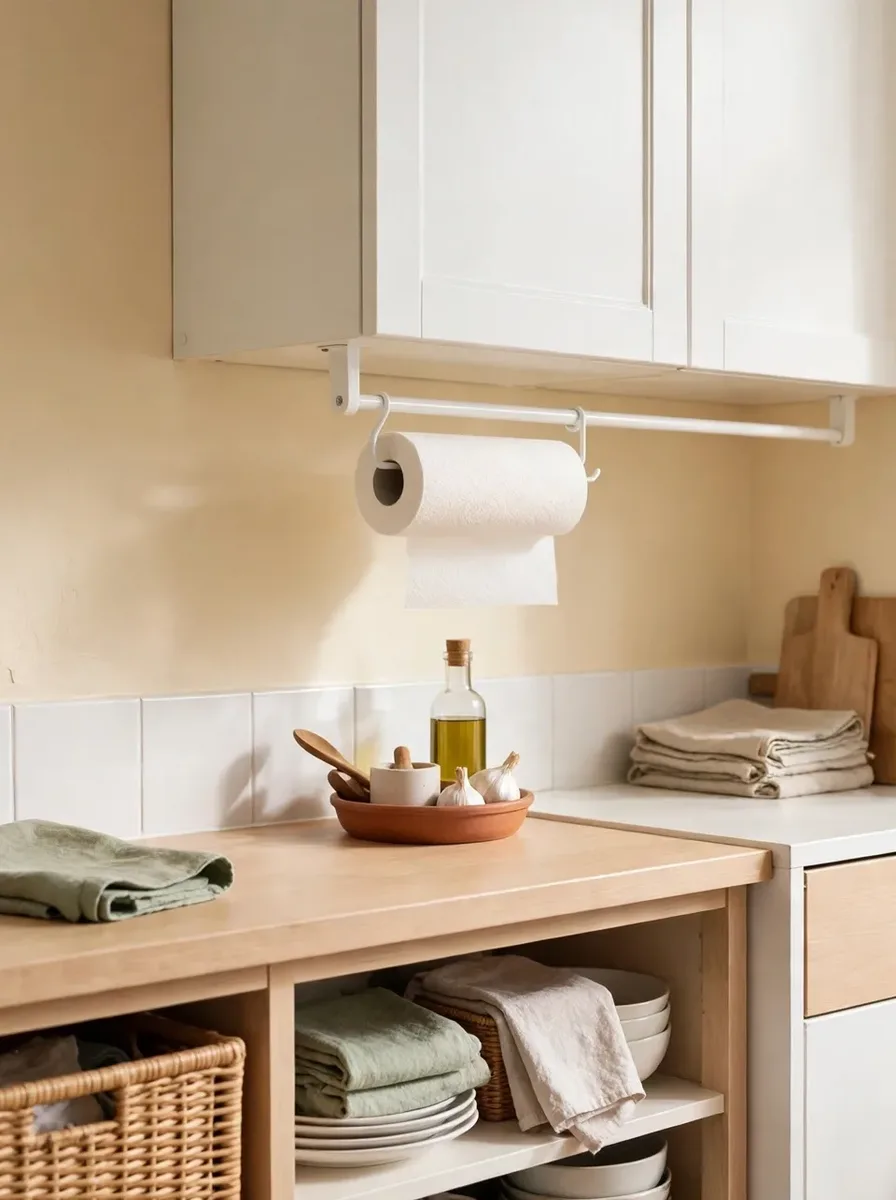
For bigger cabinet reorganisations that pair rods with bins, baskets and shelf risers, see our guide to no-drill kitchen storage for renters.
Required space: Needs short spans inside a cabinet, typically 10–16 in (25–41 cm) between rigid side walls, with a rod across the upper part for hooks or across the depth for dividers.
Installation: Fit two or three short rods vertically or horizontally across the cabinet depth to create upright slots for boards and trays. A single rod across the upper part, fitted with S-hooks, becomes a rail, and a rod across the front of a shelf a few inches above its surface acts as a retaining bar.
Approximate dimensions: No single fixed size — cabinet spans are typically 10–16 in (25–41 cm), and paper-towel and wrap jobs are mini-rod jobs with spans under 14 in (36 cm), so measure each cabinet before buying.
Rental-friendly limits: It needs no screws or adhesive and twists down at move-out. Keep total weight modest and do not over-tighten a twist-lock rod, which can bow thin cabinet sides and dent paint, and keep the rubber end caps on.
Pros: It turns one open box into divided slots, so cutting boards, trays, and sheet pans stay separated, visible, and grabbable.
Cons: A stack of thick wooden boards is heavier than it looks, and loose hooks slide everything into the middle, which is exactly where weight should not sit.
Suitable products: Slim or standard twist-lock tension rods, S-hooks, and mini cabinet rods for paper towels and wrap boxes.
Under the Sink: The Spray-Bottle Hanger
The under-sink cabinet is the worst-organised space in most rentals: a low, dark box interrupted by pipes, filled with bottles that fall over. The classic tension rod fix earns its reputation because it uses the one part of that cabinet that is otherwise empty — the air near the top.
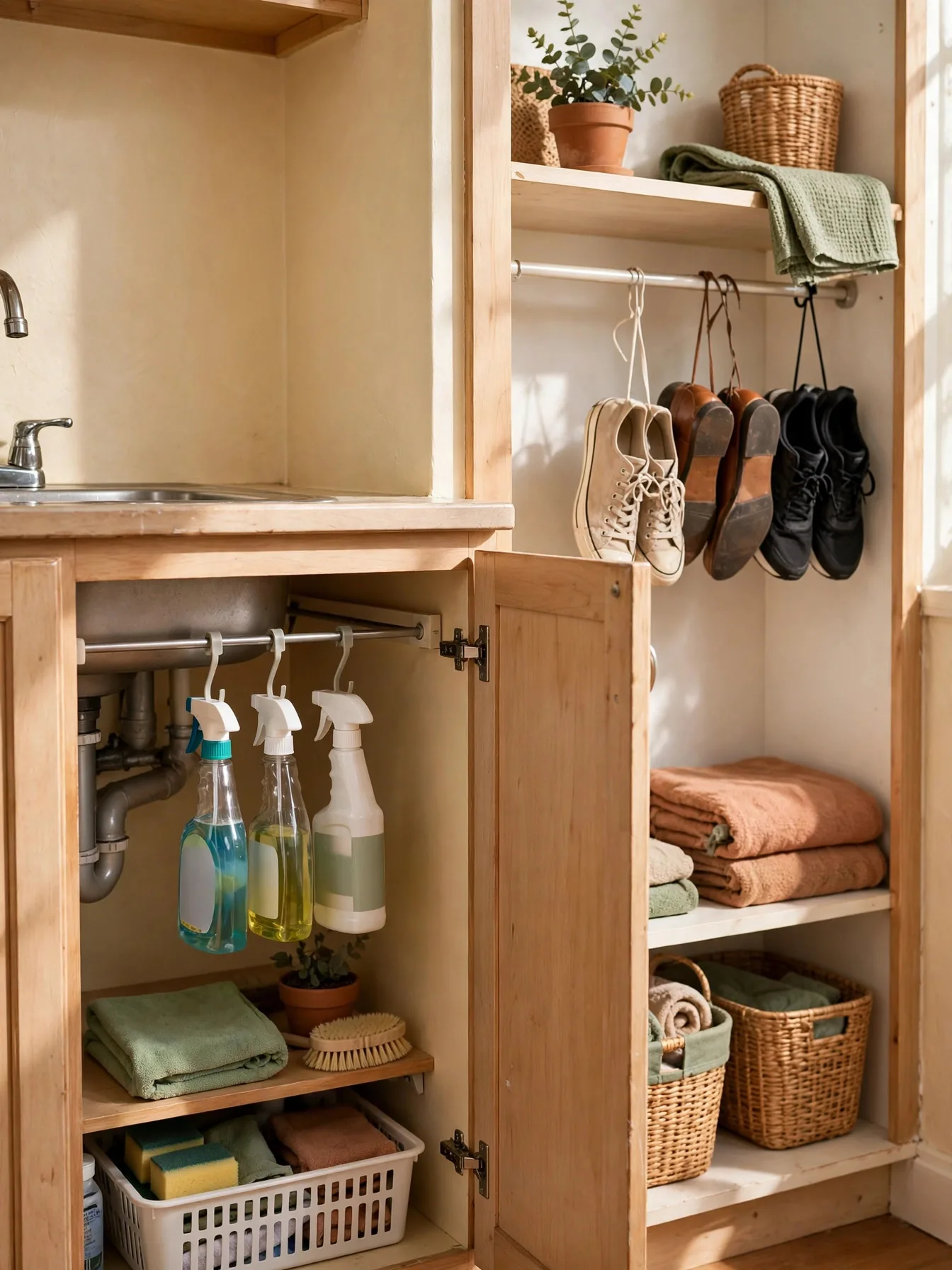
Fit a rod horizontally across the cabinet, roughly two-thirds of the way up and clear of the trap and supply lines. Then hang every spray bottle by its trigger: the bottle dangles, the trigger rests on the rod, and the whole row floats above the cabinet floor. The floor space underneath is freed for a caddy or bin holding the non-spray items — sponges, refills, dishwasher tablets.
Why it works so well, physically: each full spray bottle weighs about 1–1.5 lb (0.45–0.7 kg), the span inside a standard sink base is short — 18–30 in (46–76 cm) — and the bottles hang spread along the rod rather than stacked at its centre. That is close to a best-case load. A standard twist-lock rod handles a row of five or six bottles without drama. Two cautions: position the rod so bottles hang clear of the waste trap, because a bottle swinging against a plastic trap joint every time the door closes is a slow leak risk; and in the bathroom, where humidity is constant, choose a rust-resistant rod and keep medicines and cardboard packaging off the rod and out of that cabinet entirely.
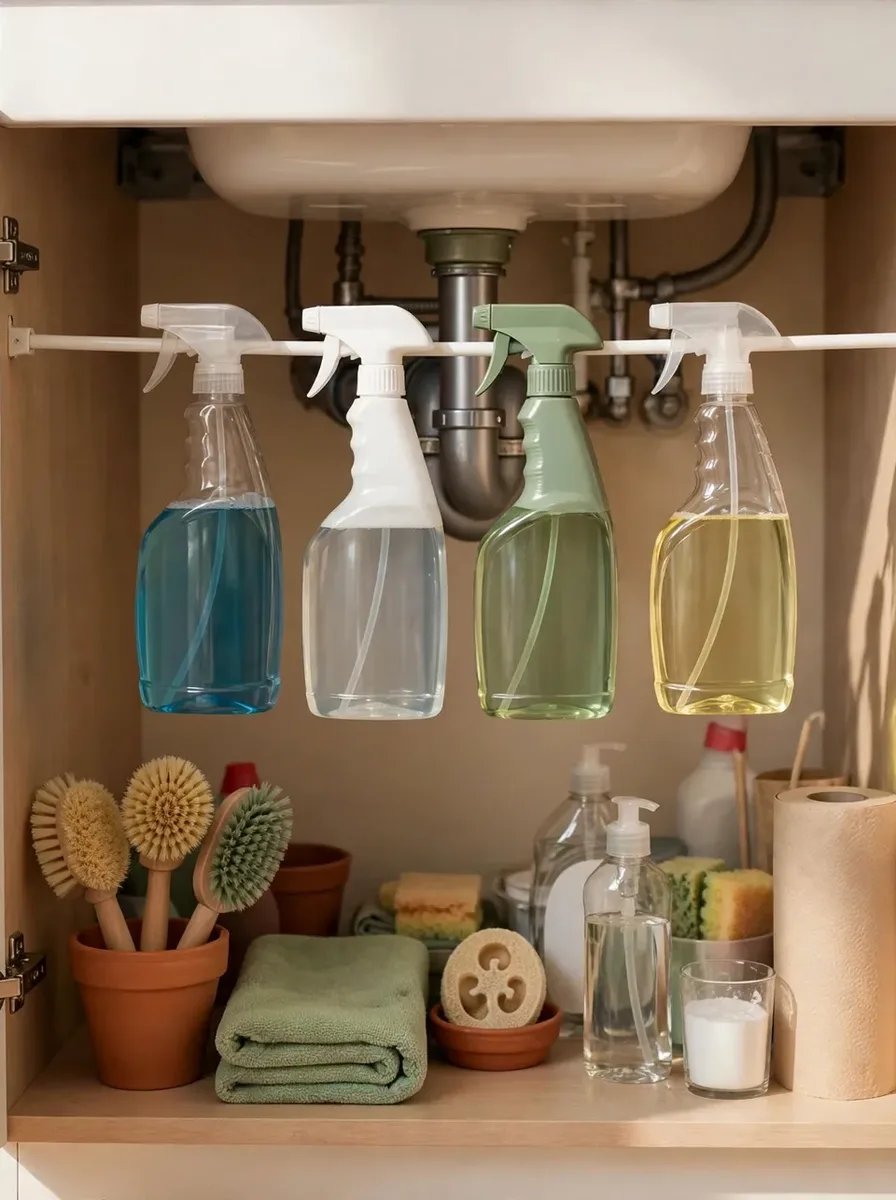
Required space: Needs a horizontal span across the under-sink cabinet, roughly two-thirds of the way up and clear of the trap and supply lines, with the floor space underneath freed for a caddy or bin.
Installation: Fit the rod horizontally across the cabinet, roughly two-thirds of the way up, then hang every spray bottle by its trigger so the row floats above the cabinet floor.
Approximate dimensions: The span inside a standard sink base is short, 18–30 in (46–76 cm), and each full spray bottle weighs about 1–1.5 lb (0.45–0.7 kg), with a standard twist-lock rod handling a row of five or six bottles.
Rental-friendly limits: It needs no fixing and twists down in seconds. Position the rod so bottles hang clear of the waste trap, and in a bathroom choose a rust-resistant rod and keep medicines and cardboard packaging off the rod.
Pros: It uses the one part of the cabinet that is otherwise empty, the air near the top, and frees the whole floor underneath for other storage.
Cons: A bottle swinging against a plastic trap joint every time the door closes is a slow leak risk if the rod is positioned badly.
Suitable products: Standard twist-lock tension rods with rubber end caps, and spray bottles with trigger handles.
Inside Closets: Shoe Rails, Heel Bars and Scarf Rows
Closets offer the widest spans most renters will attempt, which makes them the place where rod physics stops being forgiving — but also where rods add storage that simply does not exist otherwise.
The double heel rail. Two rods fitted one above the other at the back of a closet, spaced about 4–5 in (10–13 cm) apart vertically, make a rack for heeled shoes: the heel hooks over the lower rod and the toe rests against the upper one, holding pairs upright and visible at an angle. Flat shoes can rest across two parallel rods fitted at floor level. In a 36 in (91 cm) closet, two rods can hold roughly six to eight pairs this way, using depth that shoes in a pile waste. Keep the load spread out and the heaviest boots off the rails — boots belong on the floor.
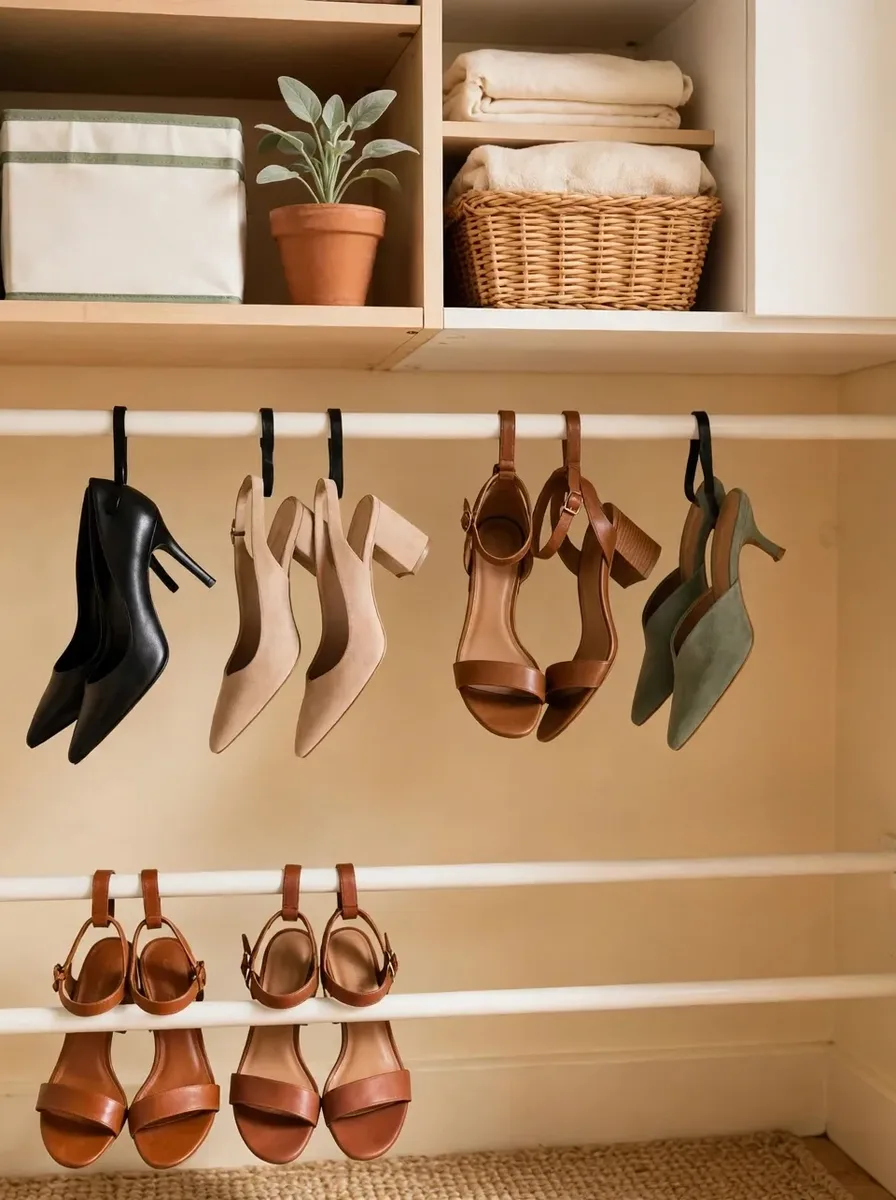
Scarf, tie and belt rows. A single rod at the back of a closet door recess or between closet side walls holds scarves draped in loops, ties, belts and lanyards — soft, light items that are the ideal rod load. This is also the kindest use for a slim spring rod you already own.
A second hanging rail. In a closet with a single fixed rail mounted high, a heavy-duty rod fitted lower and parallel can add a second tier for shirts and folded-over trousers. Be honest about the physics here: a rail of clothes is a real load — ten shirts on hangers run roughly 8–12 lb (3.6–5.4 kg) — and a 48 in (122 cm) span is long. Use a heavy-duty rod of at least 3/4 in (19 mm) diameter, keep the span as short as your layout allows, and test it loaded for a full day before trusting it. If your closet has no usable walls on both sides, or the span is over about 54 in (137 cm), a freestanding garment rack is the safer tool; our guide to doubling rental closet space without installing anything covers that layout in full.
Shelf support in an alcove closet. Where a closet is really a shallow alcove, two equal rods plus a light board make a shelf for folded clothes or storage boxes, following the two-rod shelf rules from the FAQ: same length, same height, light board, total load under about 10 lb (4.5 kg).
Required space: Needs two facing closet walls for a rod, with two rods fitted one above the other at the back of a closet for heels, or a lower parallel rod for a second hanging rail.
Installation: Fit two rods one above the other at the back of the closet, spaced about 4–5 in (10–13 cm) apart vertically, so the heel hooks over the lower rod and the toe rests against the upper one. For a second rail, fit a heavy-duty rod lower and parallel to the fixed rail and test it loaded for a full day before trusting it.
Approximate dimensions: Heel rails are spaced about 4–5 in (10–13 cm) apart vertically, and in a 36 in (91 cm) closet two rods can hold roughly six to eight pairs. Ten shirts on hangers run roughly 8–12 lb (3.6–5.4 kg) on a second rail.
Rental-friendly limits: It needs no fixing, but respect the span limits — past about 54 in (137 cm), or with no usable walls on both sides, a freestanding garment rack is the safer tool. Keep the heaviest boots off the rails.
Pros: It adds storage that simply does not exist otherwise, holding pairs upright and visible and using depth that shoes in a pile waste.
Cons: Closets offer the widest spans most renters will attempt, so a rod of clothes is a real load and a long span sags and slips more readily than a short one.
Suitable products: Heavy-duty tension rods of at least 3/4 in (19 mm) diameter for a second rail, standard rods for heel rails, and slim spring rods for scarves, ties, and belts.
Alcoves and Windows: Shelf-Over-Rod Systems
Window recesses and alcoves are dead space with great light, and a shelf-over-rod system is the only no-drill way to use them, because the rod grips the two side walls of the recess and never touches the window frame or trim.
The setup is simple: one rod for a narrow board holding a few small plants, or two rods — front and back — under a deeper board. Boards should be genuinely light: a thin pine or melamine shelf 24 in (61 cm) long and 5–6 in (13–15 cm) deep weighs about 1–2 lb (0.45–0.9 kg), leaving most of your load budget for the plants. Water is heavy, so count a freshly watered plant at roughly double its dry weight, and put a tray under pots so drips never reach the rod ends or the wall.
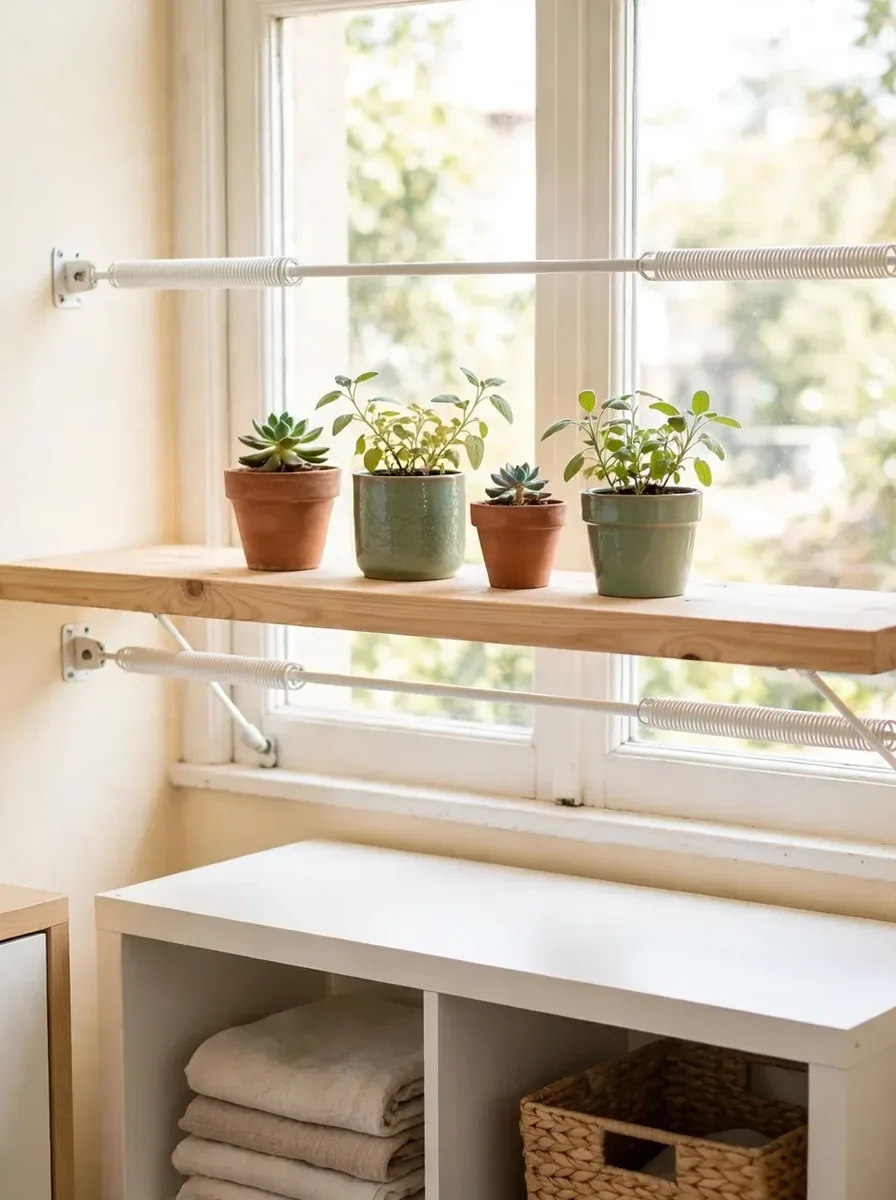
Alcoves away from windows work the same way: a rod pair over a desk alcove holds a light shelf for notebooks and a small lamp, and a single rod across a laundry alcove becomes a drying rail for delicates and hang-dry clothes — one of the highest-value uses in apartments with no balcony and no dryer. Wet clothes are heavy, though; a rail of damp laundry can reach 10 lb (4.5 kg) quickly, so spread hangers along the rod, keep the span short, and never hang dripping items over flooring you care about. The same alcove logic extends to entryway nooks, where a rod holds a curtain that hides a storage stack — the curtain use, doing quiet infrastructural work.
Required space: Needs a window recess or alcove with two side walls for the rod to grip, without touching the window frame or trim.
Installation: Use one rod for a narrow board holding a few small plants, or two rods, front and back, under a deeper board. Put a tray under pots so drips never reach the rod ends or the wall, and spread hangers along a drying rail rather than bunching them.
Approximate dimensions: A thin pine or melamine shelf 24 in (61 cm) long and 5–6 in (13–15 cm) deep weighs about 1–2 lb (0.45–0.9 kg), leaving most of the load budget for the plants, while a rail of damp laundry can reach 10 lb (4.5 kg) quickly.
Rental-friendly limits: The rod grips the two side walls of the recess and never touches the window frame or trim, so nothing is drilled or stuck. Never hang dripping items over flooring you care about.
Pros: It is the only no-drill way to use a window recess or alcove, and a single rod across a laundry alcove becomes a drying rail for delicates and hang-dry clothes.
Cons: Water is heavy, so count a freshly watered plant at roughly double its dry weight, and wet clothes are heavy too, so keep the span short on a drying rail.
Suitable products: Tension rods, thin pine or melamine shelf boards, and plant trays.
Installing a Rod So It Stays Up
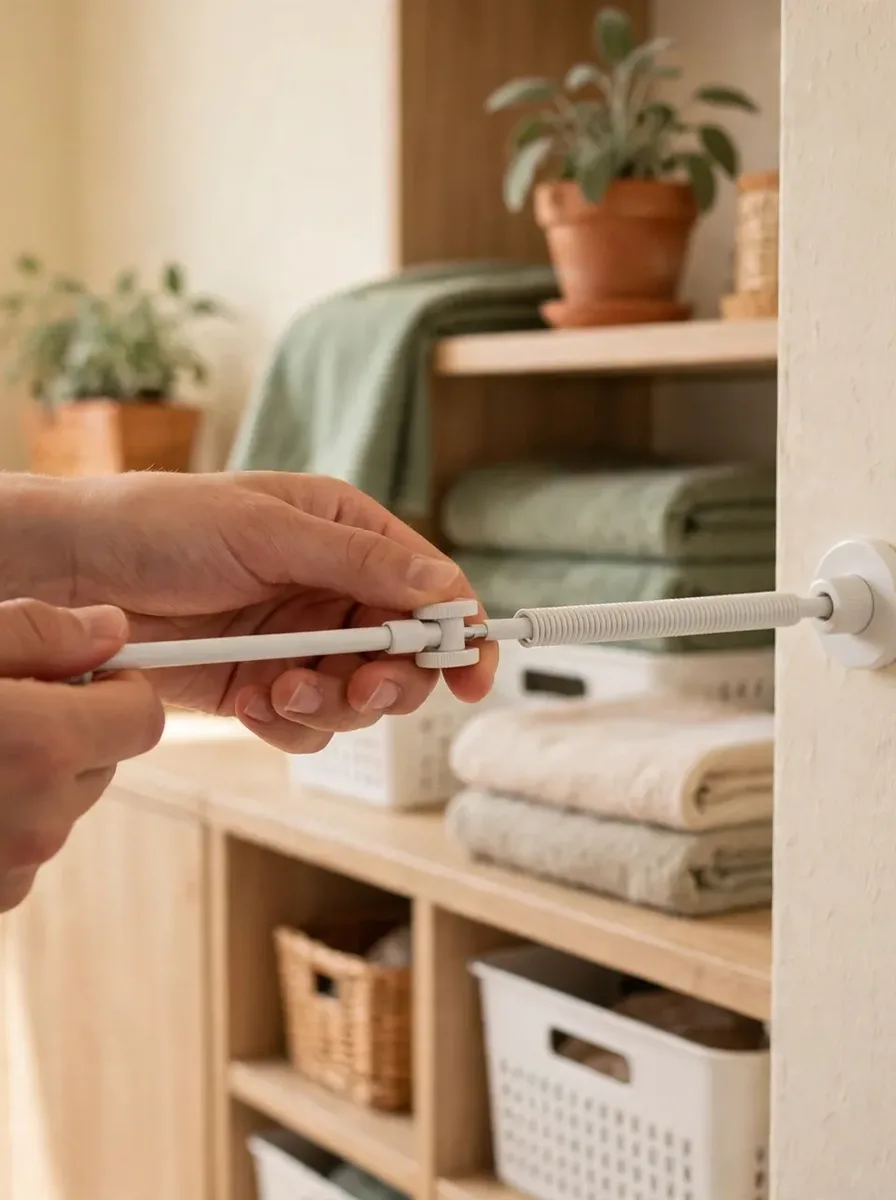
Most rod failures are installation failures. The sequence that works:
- Measure the span at the exact height you will mount, not at a convenient height — walls and cabinet sides are not always parallel, and a span can differ by 1/4 in (6 mm) between top and bottom.
- Clean both contact points with a damp cloth and let them dry. Dust, cooking grease and soap film are friction killers.
- Set the rod about 1/2 in (13 mm) longer than the measured span for a twist-lock, then compress or twist it into place. For a spring rod, extend it slightly past the span, compress, position, and release.
- Level it. A rod that slopes will slowly migrate downhill under vibration and load.
- Load it in stages: hang a third of the intended weight, wait an hour, then load the rest. Check it again the next morning. A rod that creeps even a few millimetres in the first day is telling you the span is too wide or the load too heavy — believe it.
If you are comparing rod installs with other removable methods before committing, our how we test page explains the load and removal checks we apply to every no-drill product we recommend.
Failure Rules: When a Tension Rod Is the Wrong Tool
Honest limits are what make a tool trustworthy. A tension rod is the wrong choice in these situations:
- Heavy shelves. Books, appliances, stacked dishes, a microwave — anything where the shelf and contents together pass roughly 15 lb (6.8 kg) needs its weight carried by the floor (freestanding or leaning furniture) or by screwed fixings you do not have permission for. Rods can support a light shelf; they cannot be the shelf structure for heavy storage. This is the single most ignored rule, and it accounts for most crashed-rod stories.
- Long spans with centre loads. Past about 48 in (122 cm) of span, even heavy-duty rods sag visibly under modest loads, and sag leads to slip. Split the span, add a centre support from furniture, or choose another method.
- Non-parallel or flexible surfaces. Rods need two firm, facing, roughly parallel surfaces. Thin fibreboard cabinet sides that bow outward under pressure, crumbly plaster, and walls at odd angles all defeat friction. If a surface flexes when you push it with a thumb, a rod will not hold on it.
- Anything a falling load would endanger. Do not hang rods over a crib, a bed head, a stove, or a glass tabletop. A rod that fails drops everything on it, from height, without warning.
- Steam and grease zones. Directly over a hob, grease coats the contact points and friction quietly disappears. Keep rods away from cooking splash zones, or clean the ends monthly.
- Toddlers’ climbing range. A low rod with hanging items is an invitation to pull. In homes with small children, keep loaded rods inside closed cabinets or well above reach.
The Mistakes We See Again and Again
Buying one rod size for the whole apartment. A rod bought for a 36 in (91 cm) closet stretched into a 48 in (122 cm) alcove is operating at its weakest. Measure each location and buy for that span, aiming for the middle of the rod’s range.
Trusting the package rating at full extension. The printed load assumes the shortest span. At maximum extension, plan on half the printed number or less — and treat even that as a ceiling, not a target.
Hanging everything in the middle. Loads clustered at centre maximise bending and sag. Spread items along the rod and put the heaviest nearest the ends.
Cranking a twist-lock rod as tight as it will go. Excess force dents paint, bows cabinet panels and can crack grout. Firm, level, and a test load — that is the whole technique.
Removing the rubber end caps. They look like packaging. They are the friction surface and the wall protection. A rod without caps slips sooner and scuffs paint.
Skipping the test period. Load in stages and re-check after a day. Rods almost never fail instantly under a correct load; they creep first, and creeping is your warning.
Using a plain steel rod in the shower. It will rust at the ends and around the spring, and rust stains are a genuine deposit risk on pale grout and tubs. Stainless or rust-resistant finishes only, in wet rooms.
The Short Version
A tension rod is a friction device, and everything follows from that: short spans are strong, long spans sag, diameter buys stiffness, package ratings flatter, and rubber ends protect both the grip and your deposit. Inside cabinets and under sinks, rods are close to unbeatable for the price — a $10 rod and five spray bottles is the highest-value ten minutes in this whole guide. In closets and alcoves they still earn their place, as long as you respect the span limits and keep shelves light. Buy the rod for the exact span, load it to half its rating, spread the weight, and test it before you trust it. Do that, and the humblest piece of curtain hardware becomes the hardest-working storage system in a rental. More removable, deposit-safe methods live in our renter guides hub.