Most people shopping for clothing storage in a small bedroom with no dresser go looking for one thing: a dresser substitute. A single piece of furniture that swallows the whole wardrobe the way a chest of drawers would. In a small rental bedroom, that piece rarely exists — and when it does fit through the door, it usually eats the last stretch of free wall and still leaves socks in a heap. Apartment Therapy’s small-bedroom storage ideas show more ways to use the same zones.
There is a better way to think about it. A dresser is not one job; it is five jobs wearing a wooden coat. It stores folded knits, it stores T-shirts, it corrals socks and underwear, it hides the off-season overflow, and it keeps accessories and daily bits within reach — plus it gives you a surface on top. Replace each job with a smaller, lighter, better-fitting home and the wardrobe spreads across space you already have: the closet rod, the closet shelf, the back of the door, and the dead zone under the bed. Nothing below needs a drill, a wall anchor, or a deposit-risking screw, and every piece can leave with you when the lease ends. The closet itself still does the heavy lifting for hanging clothes — the small bedroom closet storage guide for renters covers that system end to end — while this guide handles everything a dresser would have held.
The Five Jobs a Dresser Does — and What Replaces Each One
Lay your folded wardrobe out on the bed and it sorts itself into five piles almost every time:
- Folded knits and sweaters — bulky, heavy, and ruined by hangers.
- T-shirts and everyday tops — the highest-turnover clothes you own.
- Small items — socks, underwear, belts, workout gear: the things that vanish.
- Off-season and overflow — coats in July, shorts in January, the spare bedding that tags along.
- Accessories and grab-and-go — scarves, hats, bags, the watch and wallet landing strip.
Each pile wants a different kind of home. Knits want a flat shelf. Tees want shallow, visible storage. Small items want compartments. Off-season clothes want to disappear somewhere flat and forgotten. Accessories want to be reachable at standing height, near the door. A dresser forces all five into identical drawers; the replacements below fit each pile properly, and most cost less than a single drawer unit. Start with the pile that annoys you most — for most renters that is tees or small items — and add the rest as budget allows.
Folding Systems First: Flat Stacks, File Folding and Rolling
Before buying a single bin, decide how the clothes will be folded, because the fold decides the container. There are three systems worth knowing, and each has a job it is genuinely best at.
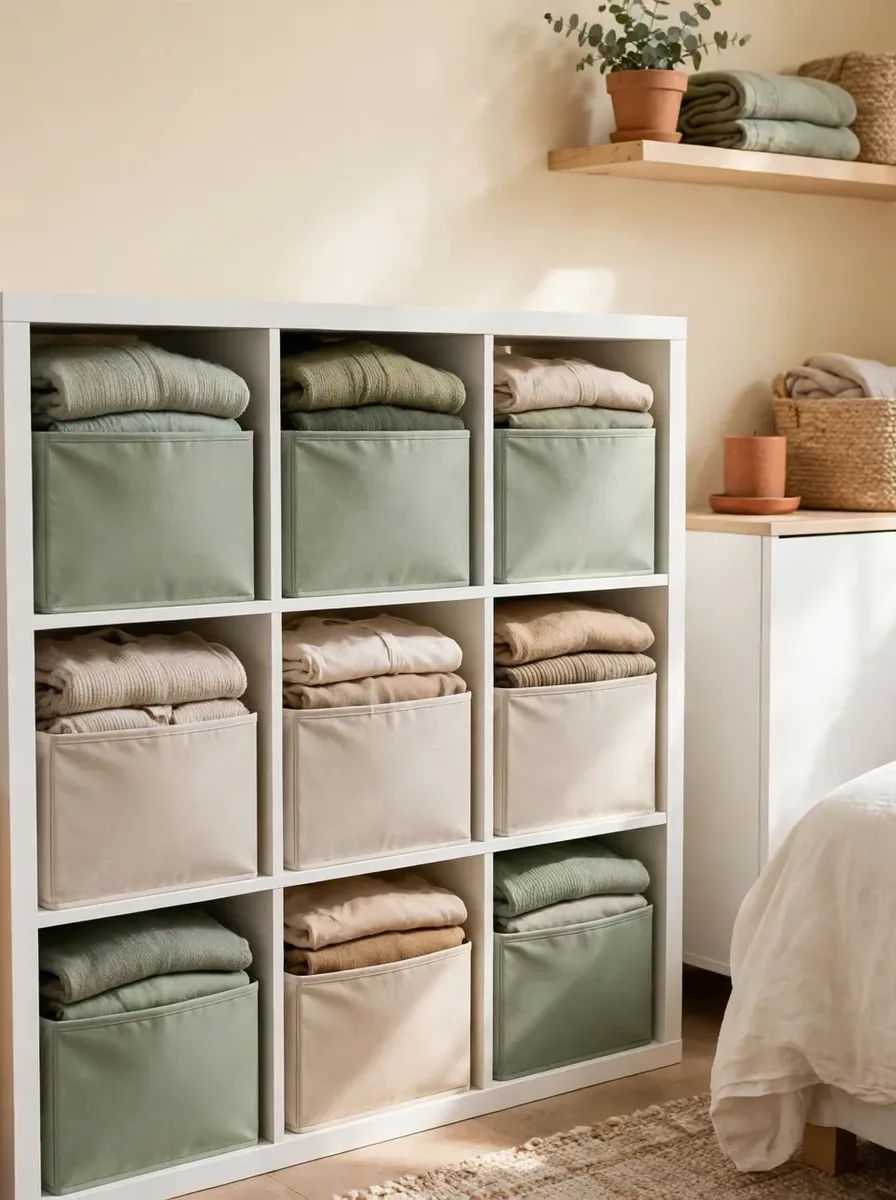
Flat stacking is the dresser-drawer classic: fold to a rectangle, stack five to eight high. It is the most space-efficient fold for stiff, structured items and the only sensible one for bulky sweaters. Its weakness is access — the bottom of the stack is effectively in storage, and pulling one shirt out disturbs the four above it. Flat stacks belong on shelves and in cubes, where you can see the stack from the front and slide items out sideways.
File folding folds each item into a compact rectangle — a T-shirt ends up roughly 9 × 6 in (23 × 15 cm) — and stands it upright in a row, like files in a cabinet. Nothing gets buried, and you can see every shirt at a glance. The honest trade-offs: it takes a few minutes longer per laundry load, the rows slump if the bin is half empty (a bookend or a smaller bin fixes that), and it wastes space on anything thick. File folding is for T-shirts, underwear, leggings and light tops in shallow bins 6–8 in (15–20 cm) deep — never for chunky knits.
Rolling suits soft, wrinkle-tolerant clothes: workout gear, pyjamas, casual tees. Rolled items pack tightly into deep bins and odd gaps, but rolling creases anything crisp and makes a bin heavy fast. Treat it as the overflow fold, not the default.
A workable rule for a dresser-free wardrobe: flat-stack the knits, file-fold the tees and small items, roll the gym kit. The sections below assume exactly that split.
Required space: A shallow bin 6–8 in (15–20 cm) deep for file-folded tees, or a shelf or cube for a flat stack of five to eight items.
Installation: Fold each item into a compact rectangle — a T-shirt ends up roughly 9 × 6 in (23 × 15 cm) — and stand it upright in a row like files in a cabinet. Flat-stack the knits, file-fold the tees and small items, and roll only the gym kit.
Approximate dimensions: File-folded T-shirts are roughly 9 × 6 in (23 × 15 cm), and file folding suits shallow bins 6–8 in (15–20 cm) deep.
Rental-friendly limits: No drilling or fixing is needed for any of the three folds, and every container here leaves with you when the lease ends.
Pros: File folding makes every item visible and reachable with nothing buried, flat stacking is the most space-efficient fold for stiff items, and rolling packs tightly into deep bins and odd gaps.
Cons: File folding adds a few minutes to every laundry load and rows slump in a half-empty bin, flat stacks bury the bottom items, and rolling creases anything crisp.
Suitable products: Shallow bins or fabric cubes for file folding, shelves for flat stacks, and deep bins for rolled overflow items.
Job One: Folded Knits — Hanging Shelves, Cubes and Clear Boxes
Sweaters and knits are the worst tenants in a dresser drawer: too bulky for the space, and heavy enough to crush whatever is underneath. They are also the clothes you must never hang — a sweater left on a hanger grows shoulder bumps and stretched hems within a season. Knits want a flat, supported surface, and a small bedroom offers three.
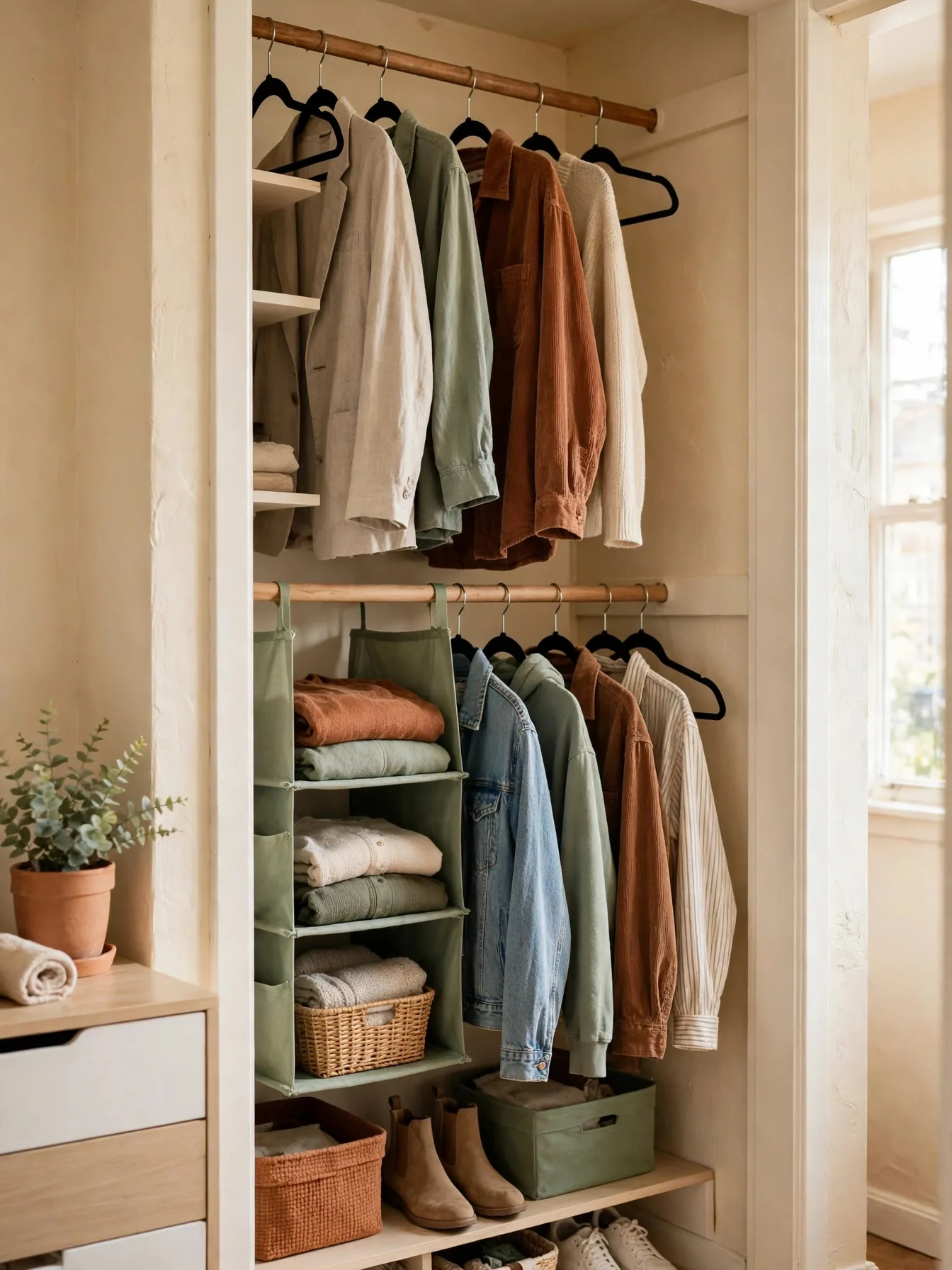
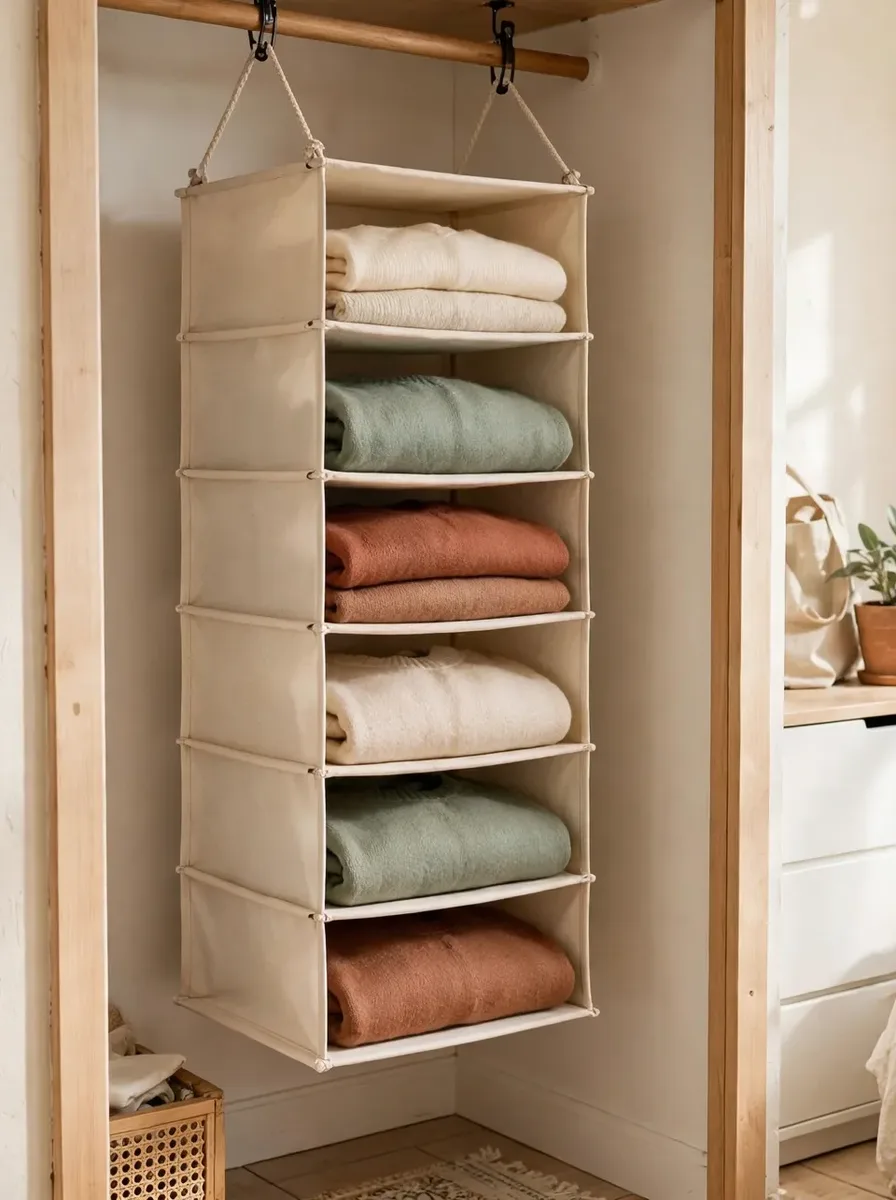
A hanging shelf organizer turns 12 in (30 cm) of closet rod into five or six shelves. A standard six-shelf unit measures about 12 in wide × 12 in deep × 48 in tall (30 × 30 × 122 cm), with each shelf roughly 7–8 in (18–20 cm) high — room for a flat stack of three or four sweaters. Prices run $12–$25. The honest limitation is sag: fabric shelves bow under weight, so keep each shelf to one modest stack and put the heaviest knits on the bottom shelf or skip this option for a big knitwear collection. It also spends rod space, which matters in a small closet — the tricks in how to double rental closet space without installing anything help win that rod space back.
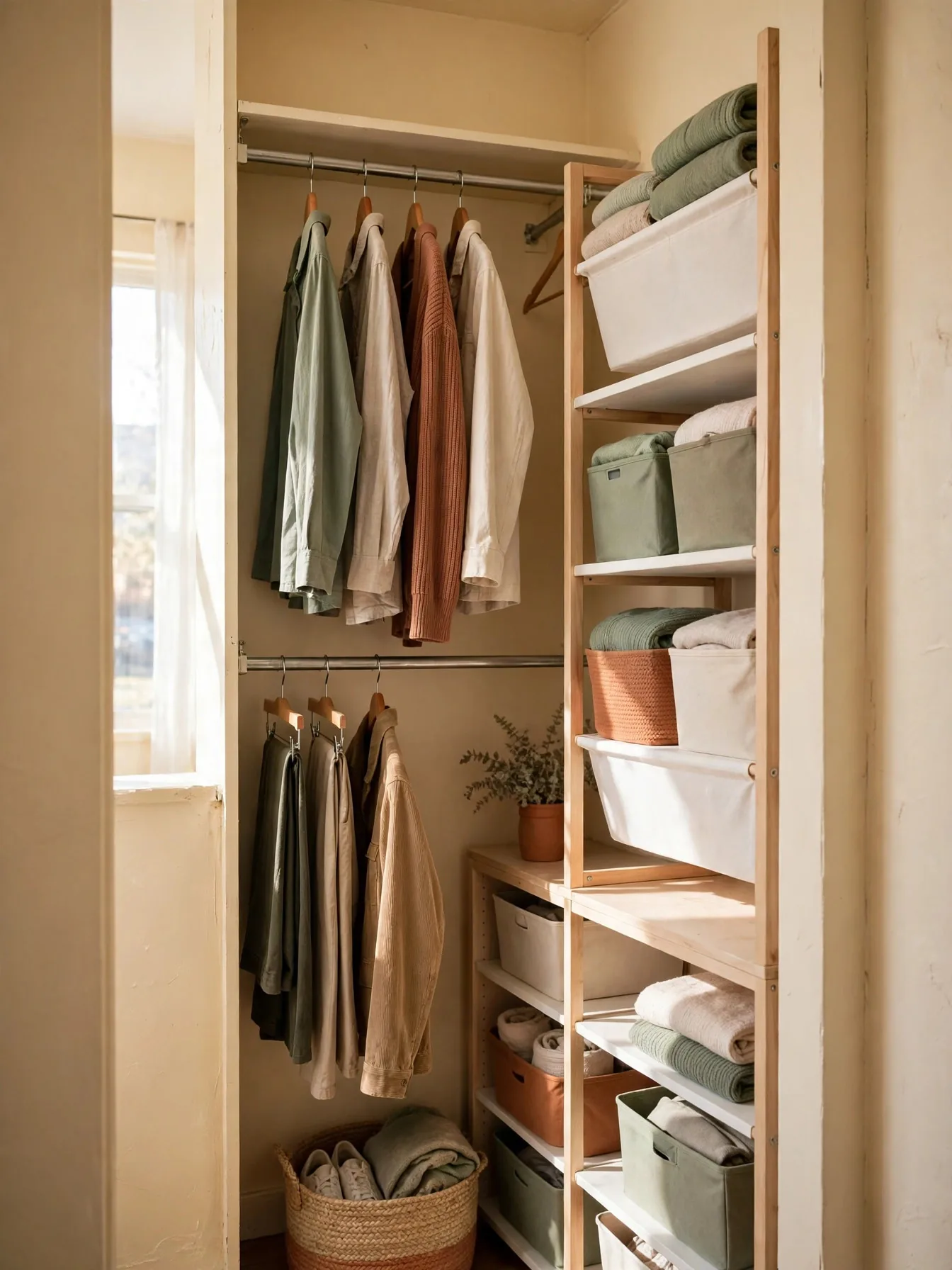
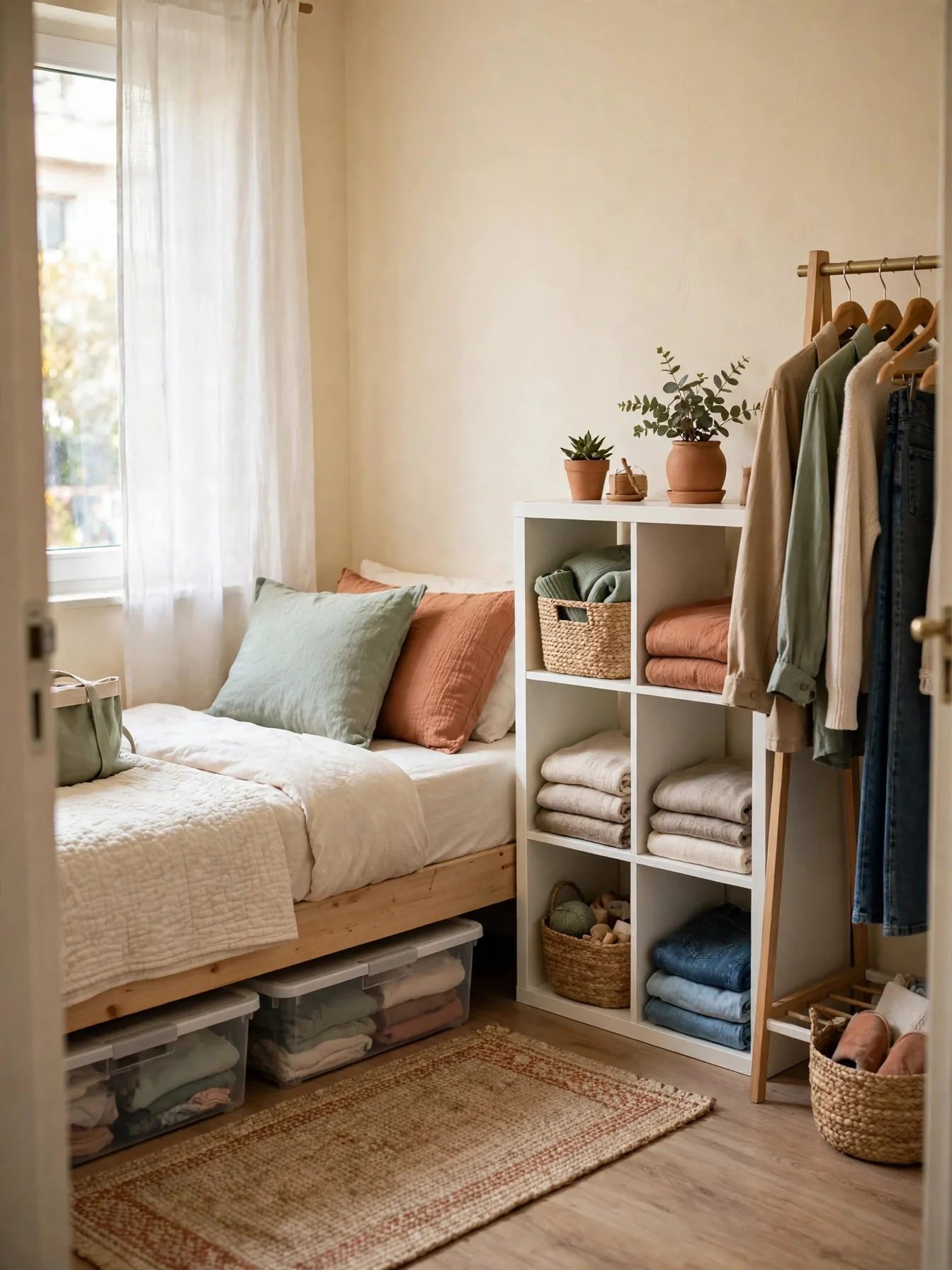
A cube unit with fabric bins is the closest thing to a dresser that is not one. Standard fabric cubes are 11 in (28 cm) square; large ones are 13 in (33 cm). A six-cube unit stands about 36 in wide × 12 in deep × 36 in tall (91 × 30 × 91 cm) and costs roughly $35–$60, with a six-pack of fabric bins at $12–$20. One cube per category — sweaters, jeans, hoodies — keeps things findable. The trade-offs are real: fabric bins have no structure of their own and bulge when stuffed, they slide rather than glide, and a tall cube unit should be loaded heavy-at-the-bottom so it cannot tip. In exchange you get drawer-like capacity that one person can carry up the stairs.
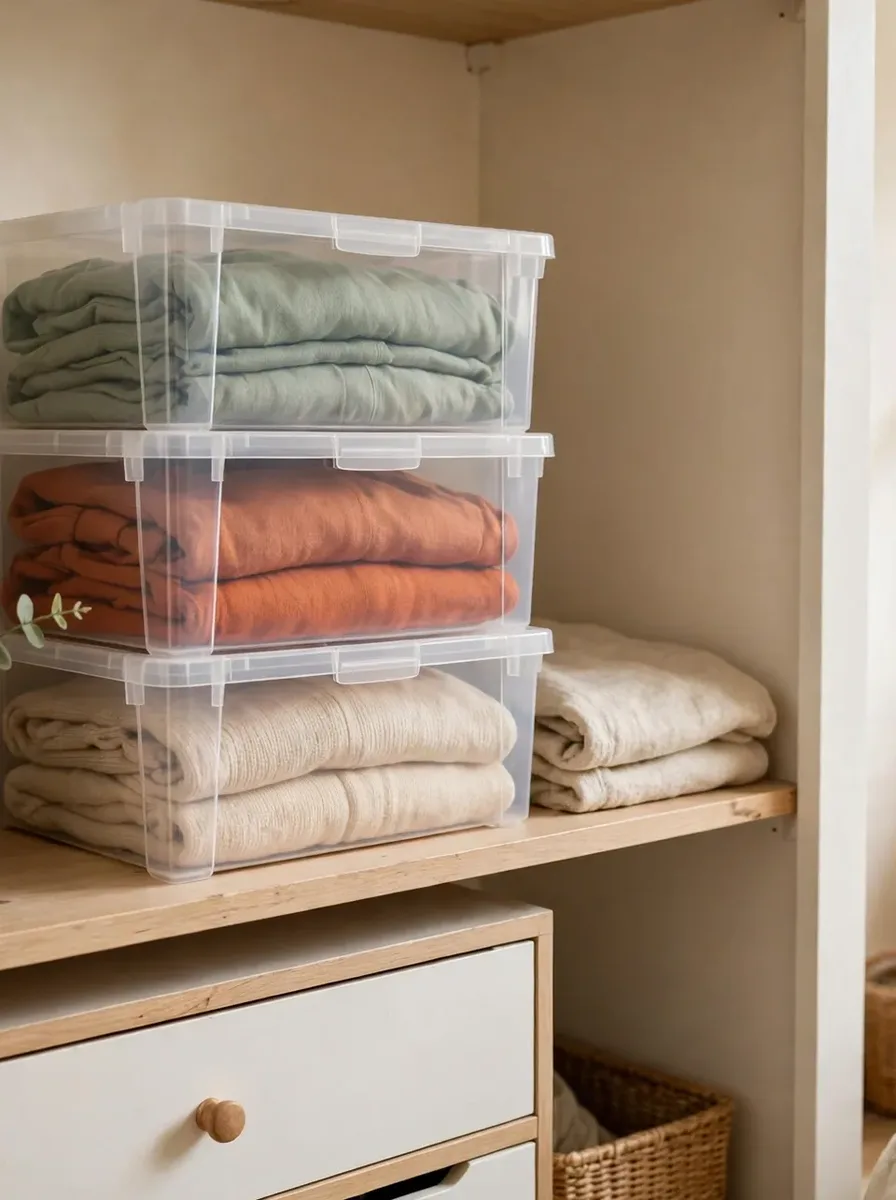
Clear stackable boxes on the closet shelf suit renters whose shelf space is going spare. Sweater-size boxes run about 16 × 12 × 6 in (41 × 30 × 15 cm) and cost $3–$6 each or $20–$35 for a set. Because they are clear, the label is optional; because they stack, three boxes use the same shelf footprint as one. Keep stacks to three high — beyond that, the bottom box becomes a excavation project.
Required space: About 12 in (30 cm) of closet rod for a hanging shelf organizer, or a wall run about 36 in (91 cm) wide for a six-cube unit. Clear boxes use the closet shelf you already have.
Installation: Hang the shelf organizer from the rod and keep each shelf to one modest stack with the heaviest knits on the bottom, load a cube unit heavy-at-the-bottom, and stack clear boxes no more than three high.
Approximate dimensions: Hanging shelves are about 12 in wide × 12 in deep × 48 in tall (30 × 30 × 122 cm). Standard fabric cubes are 11 in (28 cm) square and sweater boxes about 16 × 12 × 6 in (41 × 30 × 15 cm).
Rental-friendly limits: Nothing here needs screws or anchors — the hanging shelf hangs from the rod and the cube unit is freestanding — but a tall cube unit should be loaded heavy-at-the-bottom so it cannot tip.
Pros: A cube unit is the closest thing to a dresser that is not one and one person can carry it up the stairs, while clear boxes let you see the contents so no label is needed.
Cons: Fabric shelves bow under weight, fabric bins bulge when stuffed and slide rather than glide, and a stack of clear boxes more than three high turns the bottom box into an excavation project.
Suitable products: Hanging shelf organizers, cube units with fabric bins, and clear stackable boxes.
Job Two: T-Shirts — File-Folded Bins You Can Actually See Into
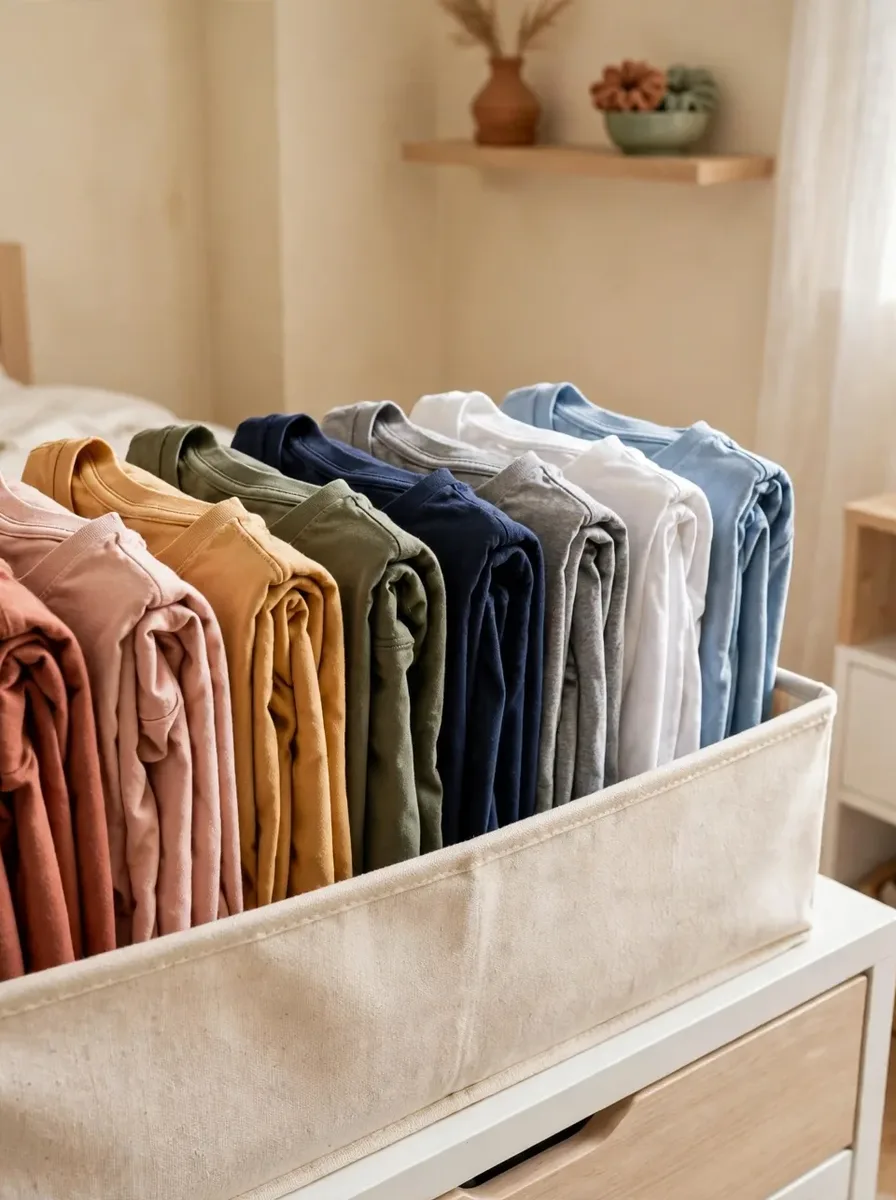
T-shirts are where dresser drawers fail first. They go in folded, and within a week the drawer is a layered archaeology of shirts you forgot you owned. File folding in a shallow bin fixes the visibility problem completely: every tee stands upright, its fold edge facing you, and pulling one out leaves the rest untouched.
Use a bin 10–13 in (25–33 cm) long and 6–8 in (15–20 cm) deep — a typical fabric bin, a plastic basket, or one cube of the unit above. A bin that size holds roughly 8–12 file-folded tees. Sort by colour or by use (work tees, plain tees, band tees) only if you will maintain it; one undifferentiated row you actually keep tidy beats a colour-coded system that collapses by Thursday.
Two upkeep truths worth stating plainly. File folding adds a couple of minutes to putting laundry away, every time, forever — the system only works if that stays a habit. And a half-empty bin slumps: the files lean, then slide, then it is a pile again. Solve it by choosing a bin that fits your real collection, or by keeping a rolled towel or a small box at the end of the row as a bookend. If your tee collection is large — thirty or more — skip the bin and flat-stack on a cube shelf instead, where stacks of eight stay stable and visible from the front.
Required space: A shallow bin 10–13 in (25–33 cm) long and 6–8 in (15–20 cm) deep, or a cube shelf for a collection of thirty or more tees.
Installation: File-fold each tee upright with its fold edge facing you, pull one out without disturbing the rest, and keep a rolled towel or small box at the end of the row as a bookend when the bin is half empty.
Approximate dimensions: Bins are 10–13 in long × 6–8 in deep (25–33 × 15–20 cm) and hold roughly 8–12 file-folded tees.
Rental-friendly limits: No fixing is needed — the bin sits inside a cube, on a shelf, or in a drawer — and it moves with you at move-out.
Pros: Every tee stands upright and visible, and pulling one out leaves the rest untouched.
Cons: File folding adds a couple of minutes to putting laundry away every time, and a half-empty bin slumps into a pile again.
Suitable products: Fabric bins, plastic baskets, or one cube of a cube unit.
Job Three: Socks, Underwear and Small Things — Dividers, Not Drawers
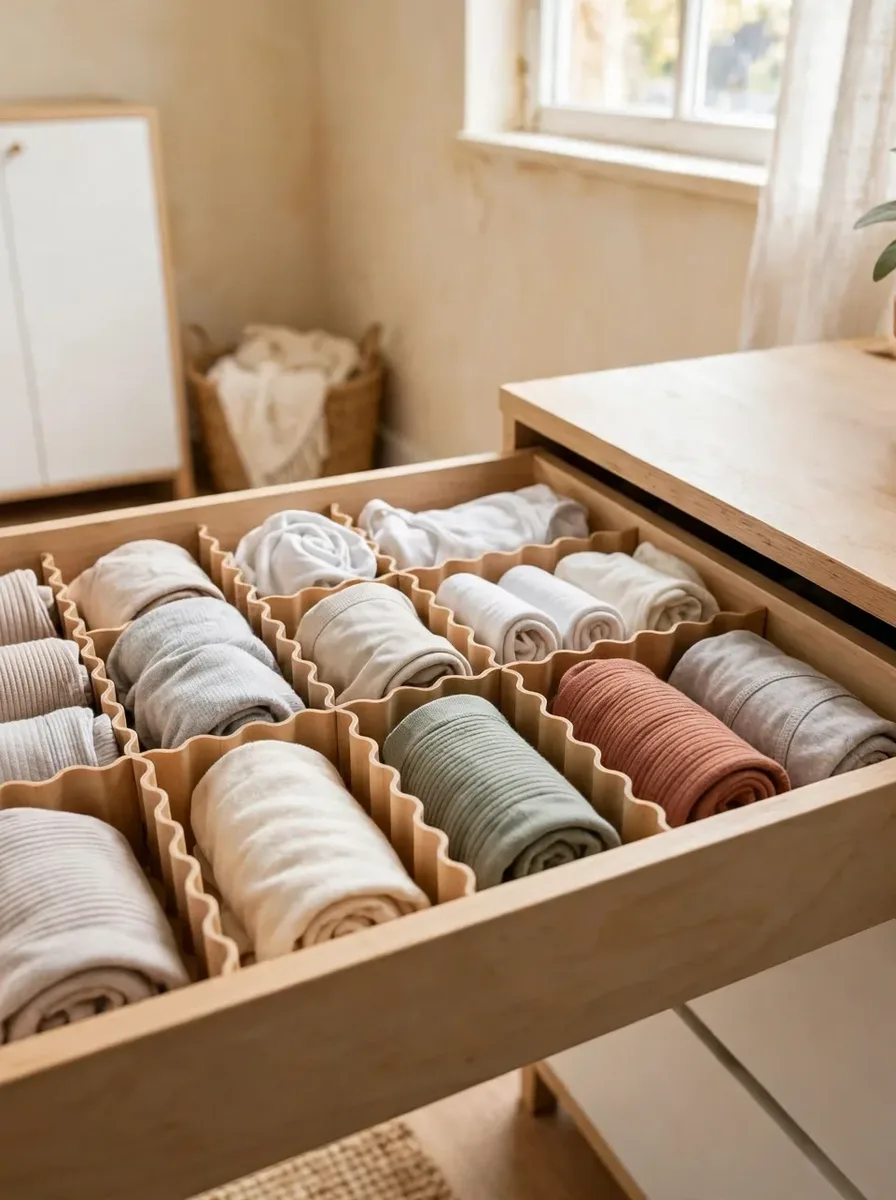
Small items do not need much space; they need boundaries. Without compartments, socks and underwear migrate into a single tangled stratum wherever they land. Dividers create the compartments inside whatever shallow container you already have — a nightstand drawer, a desk drawer, a cube bin, or a lidded box on a shelf.
Three divider styles cover most cases. Spring-loaded drawer dividers expand to fit drawers 11–17 in (28–43 cm) wide and cost about $10–$15 for a pack of four; they are the most flexible option and move to your next home unchanged. Honeycomb grids — typically a 12.6 × 12.6 in (32 × 32 cm) panel of 24–32 cells — are made for socks and underwear specifically, one pair per cell, and run $8–$14. Small open bins, around 4 in (10 cm) wide, work inside a fabric cube: one for socks, one for underwear, one for belts and ties.
The placement matters more than the product. Put small items at waist height or above — in the top cube, the top shelf of the hanging organizer, the nightstand drawer — because you reach for them daily, often half asleep. Reserve the low and deep spots for things you touch weekly. And keep one small “homeless items” tray for the single earring, the spare button, the lone sock awaiting its partner; a defined landing spot stops these from colonising every surface.
Required space: A shallow container you already have — a nightstand drawer, a desk drawer, a cube bin, or a lidded box on a shelf — at waist height or above.
Installation: Fit spring-loaded dividers across the drawer, lay a honeycomb grid inside for socks and underwear, or set small open bins inside a fabric cube, one per category.
Approximate dimensions: Spring-loaded dividers expand to fit drawers 11–17 in (28–43 cm) wide, honeycomb grids are typically 12.6 × 12.6 in (32 × 32 cm), and small open bins are around 4 in (10 cm) wide.
Rental-friendly limits: Dividers move to your next home unchanged and nothing is fixed to the furniture, so there is no deposit risk.
Pros: Dividers create the compartments small items need, one pair per honeycomb cell, and the most flexible option adapts to any drawer.
Cons: Without a fixed, divided home, socks and underwear migrate into a single tangled stratum wherever they land.
Suitable products: Spring-loaded drawer dividers, honeycomb grids, and small open bins.
Job Four: Off-Season and Overflow — The Under-Bed Rotation
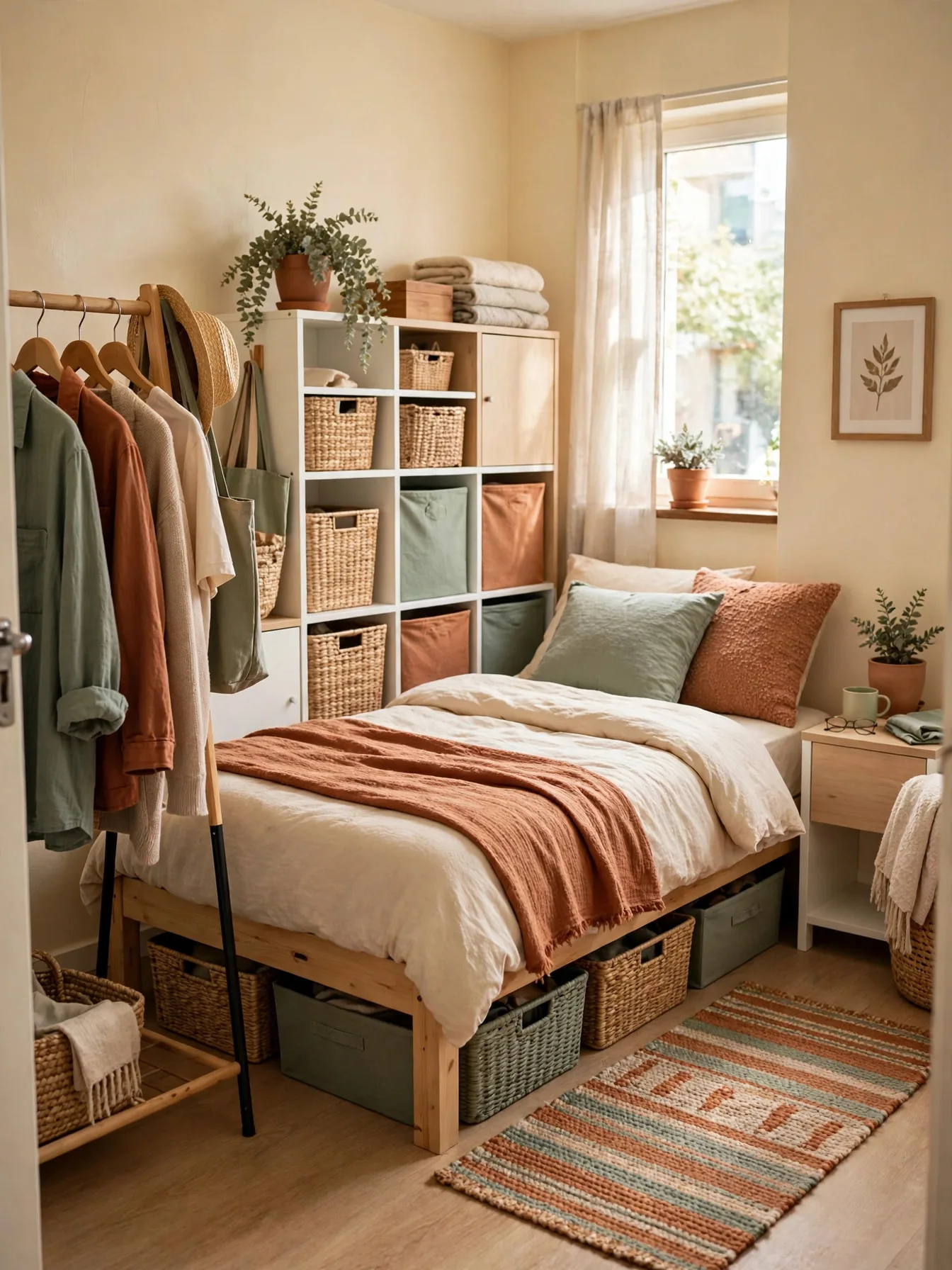
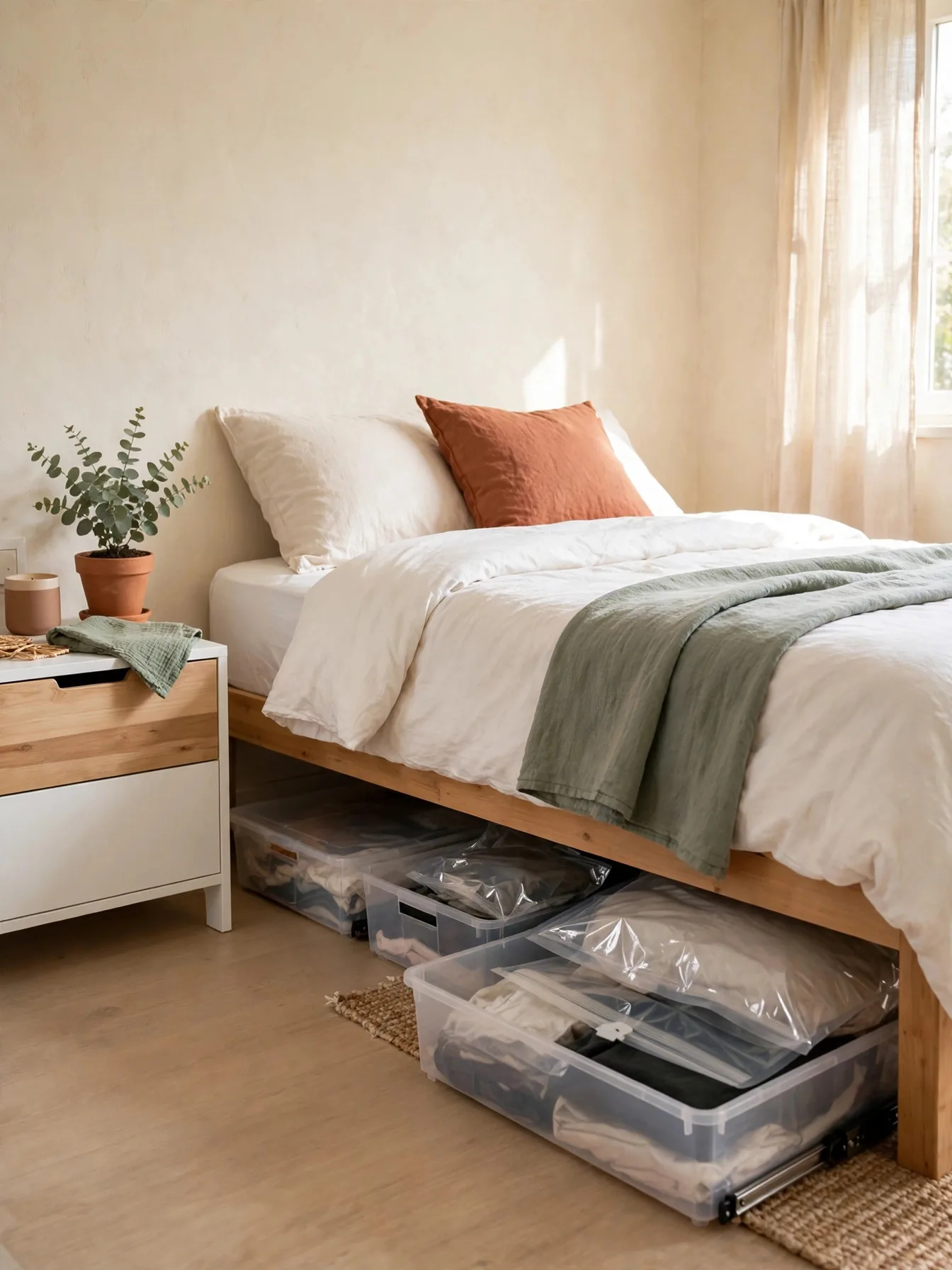
Every wardrobe has a shadow wardrobe: the coats, heavy knits and spare bedding that are out of season but cannot leave the room. In a dresser household they clog the bottom drawers. In a small bedroom with no dresser, they belong under the bed — the largest flat storage area in the room, and the one most renters measure wrong.
Measure before you buy. Run a tape measure from the floor to the underside of the bed frame or slats at two or three points; frames sag and floors slope, so plan around the smallest number. Many platform and metal frames give 5–7 in (13–18 cm) of clearance; low-profile bins are made for exactly this, standing 5.5–6 in (14–15 cm) tall including the lid. Remember the lid and the bin’s rim add height the product headline sometimes omits — a bin sold as 6 in (15 cm) that actually measures 6.5 in (17 cm) will scrape or refuse to slide.
Low-profile bins cost $15–$30 for a set of two or four. For bulky items — winter coats, duvets, heavy sweaters — vacuum bags shrink the pile dramatically and a set runs $15–$25; be honest about their limits, though, since seals can slowly leak over months and down or delicate knits should not stay compressed for a whole year. Rotate twice a year, spring and autumn: current season up into the closet and cubes, off-season down under the bed. Label each bin on the short end facing out, so the rotation takes minutes instead of an afternoon of opening lids. For a fuller treatment of clearances, wheels and bin types, see the guide to under-bed storage ideas for small rental bedrooms.
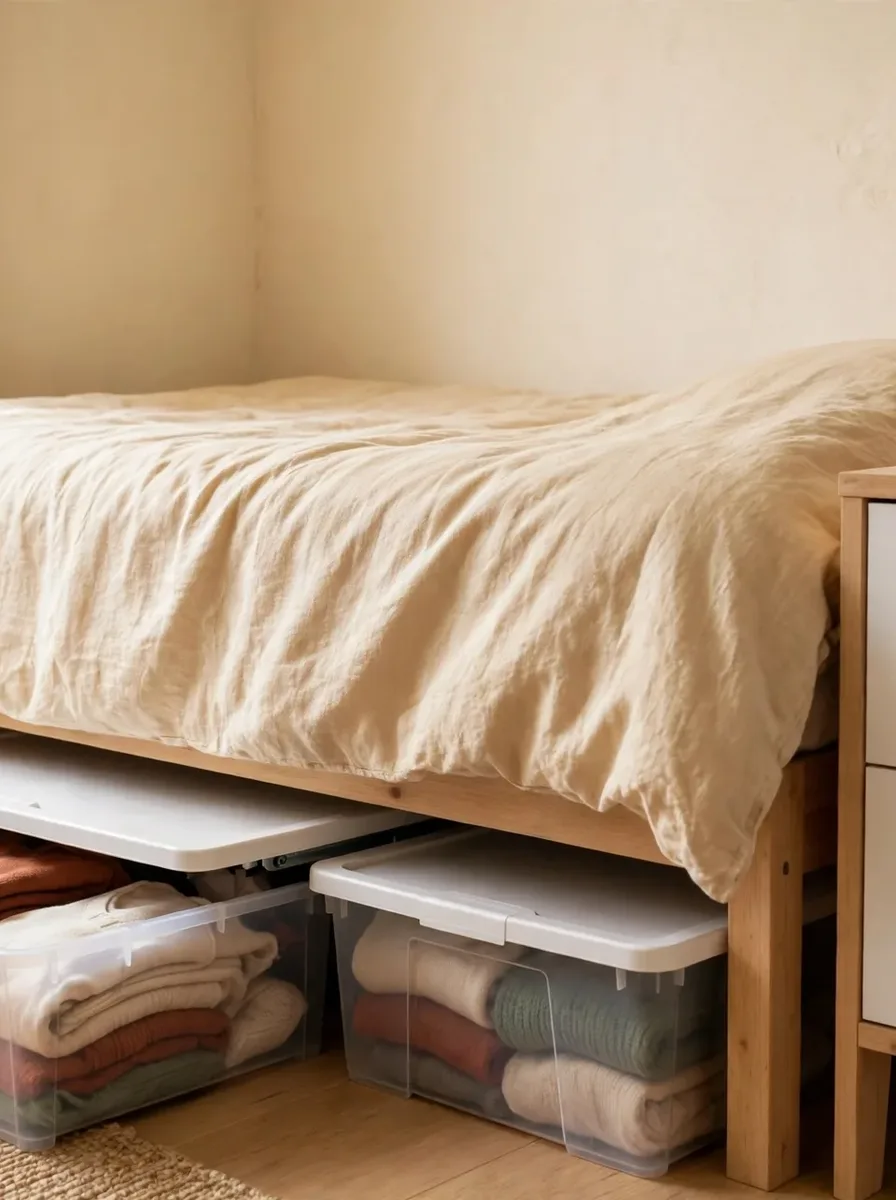
Required space: The dead zone under the bed — measure the clearance at two or three points and plan around the smallest number, since many platform frames allow only 5–7 in (13–18 cm).
Installation: Slide low-profile bins under the bed with the labelled short end facing out, and rotate twice a year, spring and autumn, so the closet holds only what you are wearing now.
Approximate dimensions: Low-profile bins stand 5.5–6 in (14–15 cm) tall including the lid, and a bin sold as 6 in (15 cm) that actually measures 6.5 in (17 cm) will scrape or refuse to slide.
Rental-friendly limits: Nothing is fixed to the bed or the floor, and the bins slide out and leave with you. Vacuum bags should not hold down or delicate knits compressed for a whole year.
Pros: Under-bed bins use the largest flat storage area in the room, and vacuum bags shrink bulky coats and duvets dramatically.
Cons: Seals can slowly leak over months, and buying before measuring is the classic mistake, since clearance varies by several inches between frames.
Suitable products: Low-profile under-bed bins and vacuum bags.
Job Five: Accessories and Grab-and-Go — The Back of the Door
Scarves, hats, belts, bags and jewellery are the last dresser job, and the one a drawer does worst — accessories in a drawer are accessories you stop wearing. They want to be visible and vertical, and a rental bedroom has one large vertical surface that is almost always wasted: the back of the door.
A clear over-door pocket organizer, typically 18 in wide × 66 in tall (46 × 168 cm) with pockets around 5 × 7 in (13 × 18 cm), holds scarves, gloves, sunglasses, belts and small bags where you can see all of them at once. Expect to pay $10–$18. Check two things before ordering: the hook thickness against your door’s clearance — most doors need the slim 1.5 in (4 cm) hooks, and the door must still close without scraping — and the total load, since a door full of heavy bags strains hinges over time. Keep this organizer for light items only.
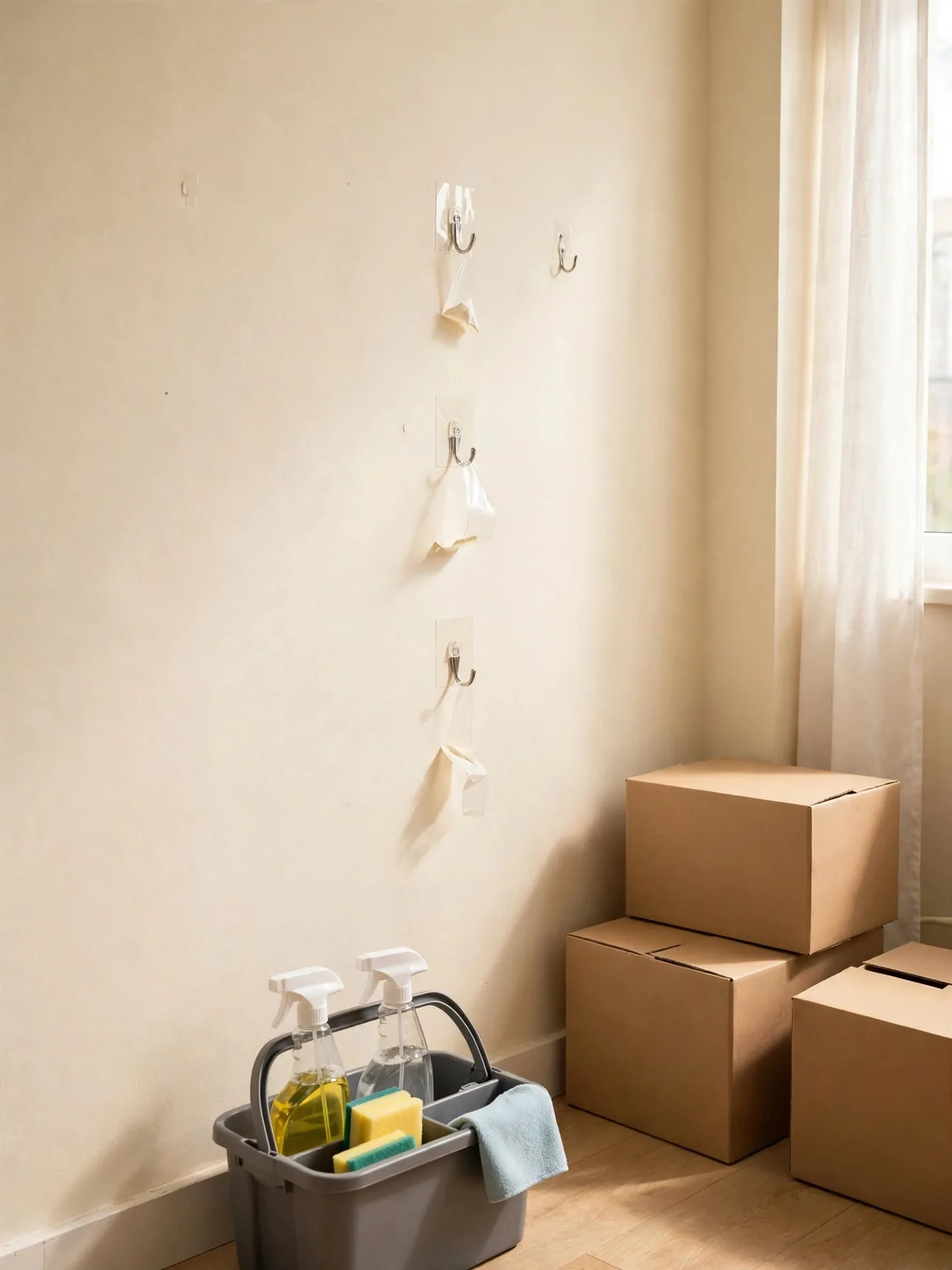
Removable adhesive hooks handle the overflow: a row inside the closet door or on the wall beside it for hats and the bags in current rotation. Follow the package weight rating and stay well under it, and mount them on smooth painted wall rather than wallpaper or textured plaster, where adhesive either fails or peels the finish. Renters without any closet at all can scale this whole approach up — creating a wardrobe in a no-closet bedroom builds a full dressing zone from a rack, a door and a wall.
Required space: The back of the door — a clear over-door organizer about 18 in wide × 66 in tall (46 × 168 cm) — plus a row of hooks inside the closet door or on the wall beside it.
Installation: Hang the organizer over the door and check that the door still closes without scraping, then add adhesive hooks for hats and bags in current rotation on smooth painted wall.
Approximate dimensions: Organizers are typically 18 × 66 in (46 × 168 cm) with pockets around 5 × 7 in (13 × 18 cm), and most doors need the slim 1.5 in (4 cm) hooks.
Rental-friendly limits: Keep this organizer for light items only, since a door full of heavy bags strains hinges over time, and mount adhesive hooks on smooth painted wall rather than wallpaper or textured plaster.
Pros: Scarves, gloves, sunglasses, belts and small bags sit visible and vertical where you can see all of them at once.
Cons: A door full of heavy bags strains the hinges, and the wrong hook thickness stops the door closing cleanly.
Suitable products: Clear over-door pocket organizers, slim over-door hooks, and removable adhesive hooks.
The Forgotten Job: A Surface to Put Things On
People miss the dresser top more than the drawers. It is where the wallet lands, where tomorrow’s outfit gets staged, where the laundry basket sits mid-fold. A dresser-free room needs one deliberate surface, and a three-tier rolling cart is the best stand-in: about 17 in wide × 13 in deep × 30 in tall (43 × 33 × 76 cm), $25–$40, with a top tier that works as a landing strip and lower tiers that hold folded clothes, a laundry basket’s worth of overflow, or the iron and steamer.
Park the cart beside the bed or in the gap between closet and wall. Because it rolls, it doubles as a folding station you can pull to the bed and park again — a trick no dresser ever managed. If floor space is truly zero, the top of the cube unit does the same job at standing height; just keep it to a tray’s worth of items so the surface does not become another pile.
Required space: A gap beside the bed or between the closet and the wall, about 17 in wide × 13 in deep (43 × 33 cm).
Installation: Park the cart beside the bed or in the gap between closet and wall, use the top tier as the landing strip, and roll it to the bed as a folding station before parking it again.
Approximate dimensions: About 17 in wide × 13 in deep × 30 in tall (43 × 33 × 76 cm).
Rental-friendly limits: The cart is freestanding and rolls away at move-out, with nothing fixed to the wall or floor.
Pros: The top tier works as a landing strip and the lower tiers hold folded clothes or laundry overflow, and because it rolls it doubles as a folding station no dresser ever managed.
Cons: If floor space is truly zero there is no room for it, and the surface needs discipline — cap it at one tray of items or it becomes another pile.
Suitable products: Three-tier rolling carts, or the top of a cube unit as the fallback surface.
The Five Jobs at a Glance
| Dresser job | Replacement | Typical size | Typical cost | Watch out for |
|---|---|---|---|---|
| Folded knits | Hanging shelf organizer or cube unit | 12 in (30 cm) of rod, or cubes of 11 in (28 cm) | $12–$60 | Fabric shelves sag under heavy stacks |
| T-shirts | File-folded shallow bin | 10–13 in long × 6–8 in deep (25–33 × 15–20 cm) | $8–$20 | Rows slump in a half-empty bin |
| Small items | Dividers, honeycomb grid, mini bins | Grid 12.6 in (32 cm) square; bins 4 in (10 cm) wide | $8–$15 | Needs a fixed home or it drifts |
| Off-season | Low-profile under-bed bins, vacuum bags | 5.5–6 in (14–15 cm) tall including lid | $15–$30 | Measure clearance first; seals leak over months |
| Accessories | Over-door pocket organizer, adhesive hooks | 18 × 66 in (46 × 168 cm), pockets 5 × 7 in (13 × 18 cm) | $10–$18 | Light items only; check door clearance |
| Surface | Rolling cart or cube-unit top | Cart 17 × 13 × 30 in (43 × 33 × 76 cm) | $25–$40 | Cap it at one tray of items |
Every product type in this guide is the kind of thing we assess the same way — by capacity, by how it treats the room, and by whether it still works after a month of real laundry cycles; how we test explains the criteria in full.
Three Setups, Three Budgets
Under $40 — the starter. One hanging shelf organizer for knits ($12–$25) and one honeycomb divider grid in an existing drawer or bin ($8–$14). This solves the two most chaotic piles and nothing else — which is the point.
Around $80 — the full replacement. A six-cube unit with fabric bins ($47–$80 combined) covering knits, tees and small items, plus a two-pack of low-profile under-bed bins ($15–$30) for the off-season rotation. At this level the dresser is genuinely replaced, not approximated.
Around $120 — with the finishing pieces. The $80 setup plus a rolling cart ($25–$40) for the surface job and an over-door organizer ($10–$18) for accessories. Every one of the five jobs has a home, and the room gains a landing strip instead of losing a wall to furniture.
Where Renters Usually Go Wrong
Buying one big substitute. A single wardrobe box or giant storage unit recreates the dresser’s problem — five different jobs crammed into one shape. Split the jobs and each piece can be smaller, cheaper and better fitted.
Hanging sweaters to save shelf space. Knits stretch on hangers: shoulders grow points, hems lengthen unevenly. Fold them, always, even if it means the hanging organizer takes more rod than you planned.
Overloading fabric shelves and cubes. A hanging shelf stacked edge-to-edge with jeans will bow within weeks, and an overstuffed fabric cube loses its shape and its handles. Leave visible headroom in every compartment; if a category outgrows its home, it needs a second home, not a harder stuff.
File-folding everything. File folding bulky sweaters and hoodies wastes a third of the bin to air gaps. Match the fold to the garment: file for tees and small items, flat stacks for knits, rolls for gym gear.
Buying under-bed bins before measuring. Clearance varies by several inches between frames, and the lid counts. Measure at the lowest point, subtract half an inch (about 1 cm) for sliding ease, then shop.
Skipping the small-items home. Socks and underwear without a divided, fixed home will colonise the nearest bin, bag or chair. It is the cheapest job to solve and the first one that makes the room feel organised.
Forgetting the system has to survive laundry day. Any arrangement that takes ten extra minutes to put clothes away will be abandoned by the third wash. If a fold or a bin feels like a chore during setup week, simplify it now — the best system here is the one still in use in six months.
From the Cozy Tiny Space shop
A bedroom with no dresser needs a plan before it needs furniture
Small-Space Furniture Layout Kit — scale grid sheets and cut-outs to test wardrobe and storage layouts at true size · $9
Start With the Job That Annoys You Most
You do not need the full five-job system this weekend. Pick the pile that frustrates you daily — usually the invisible T-shirts or the sock chaos — give it its proper home for the price of a takeaway lunch, and live with it for a fortnight. The remaining jobs can follow one at a time, each in the space the dresser would have wasted. That is the real advantage of replacing jobs instead of furniture: the system grows around the wardrobe you actually have, in the room you actually rent.