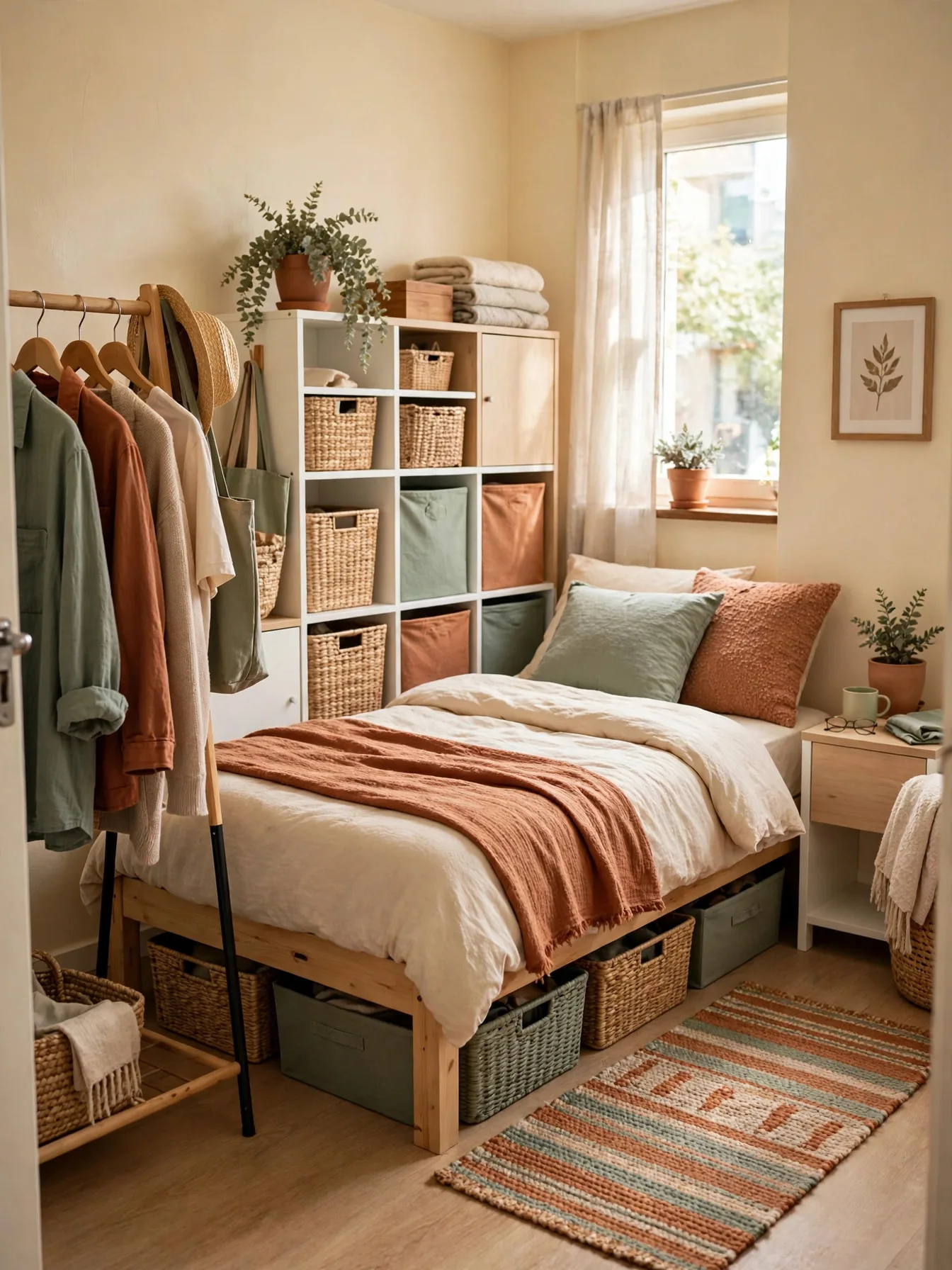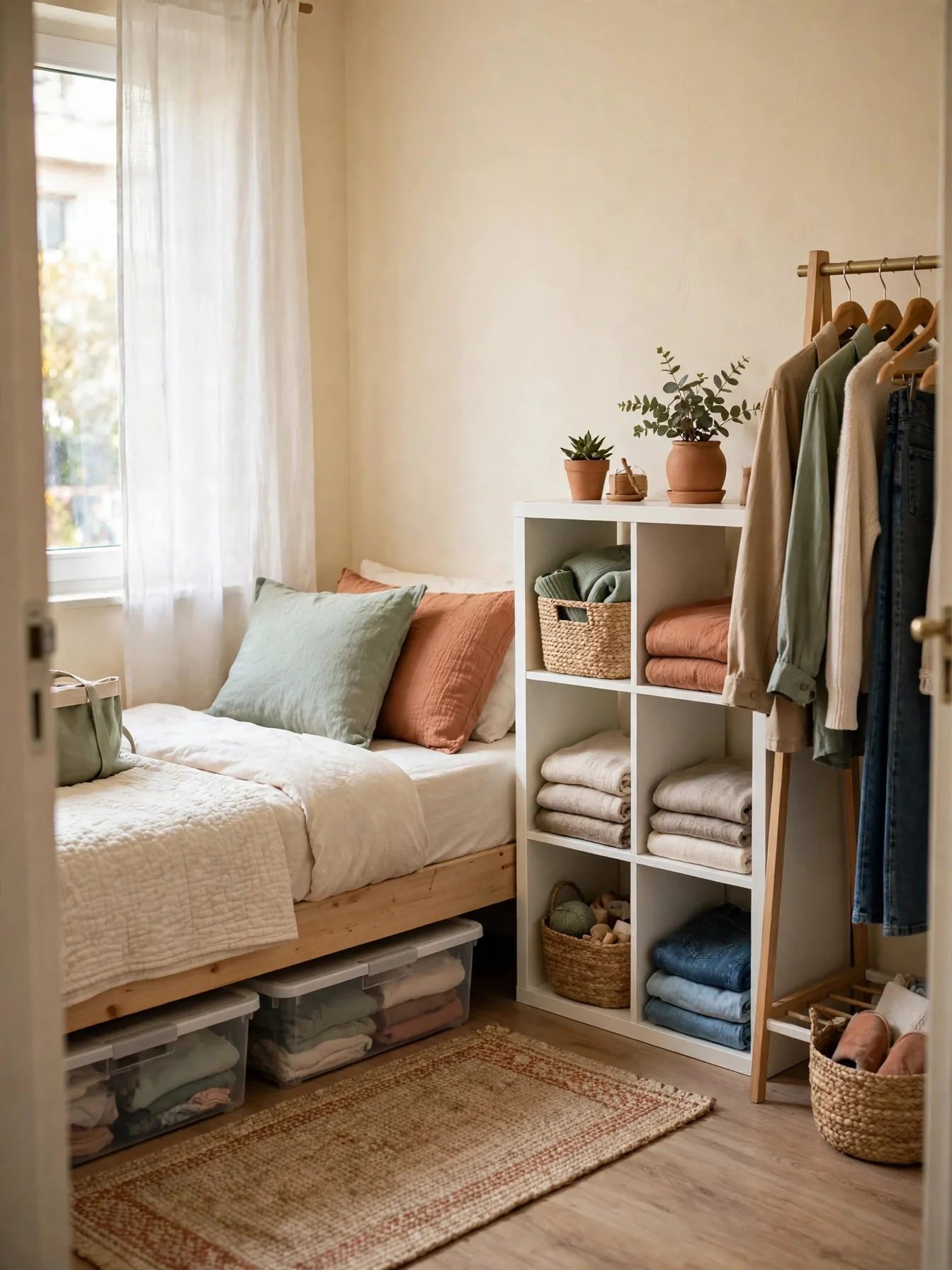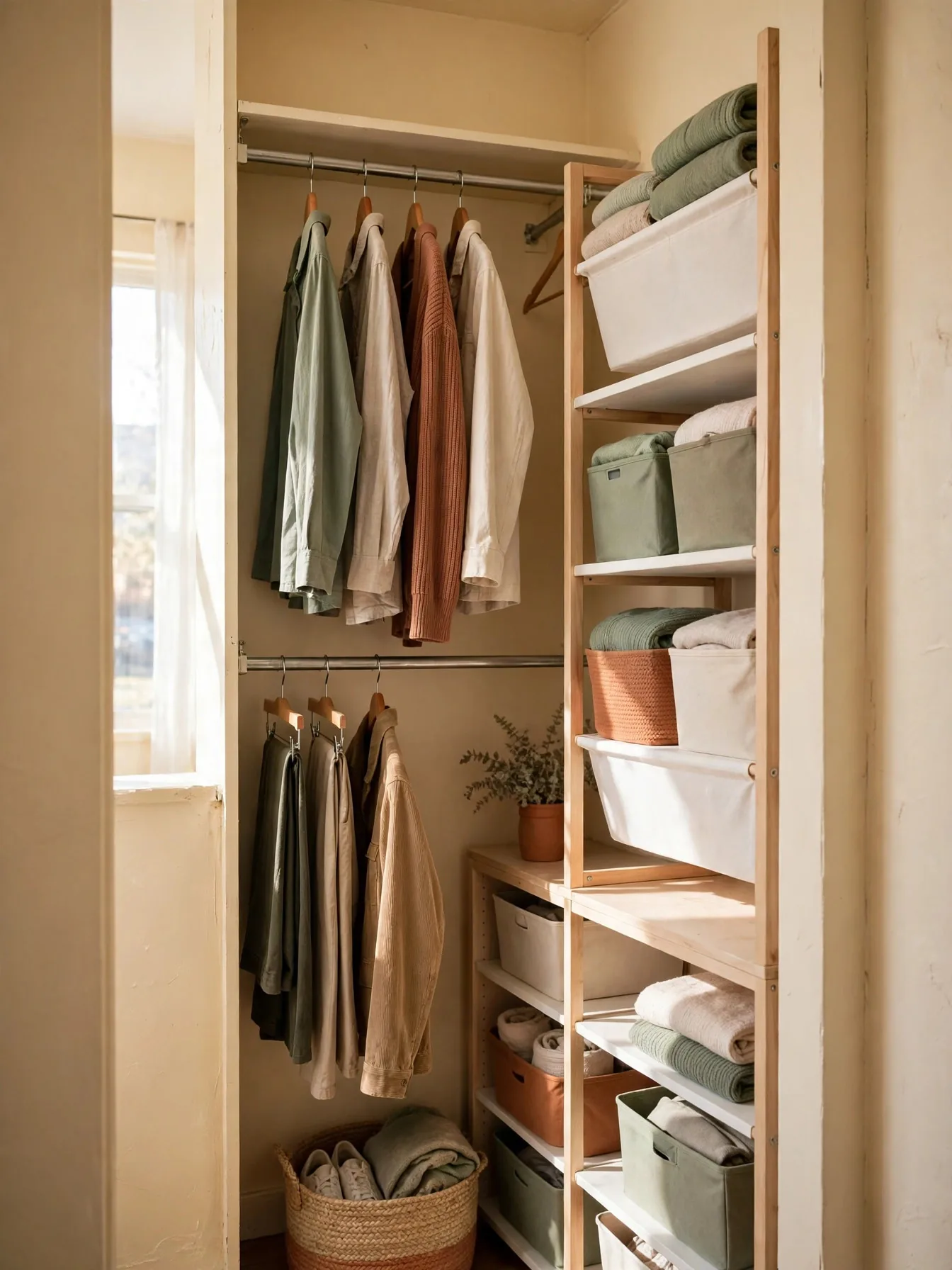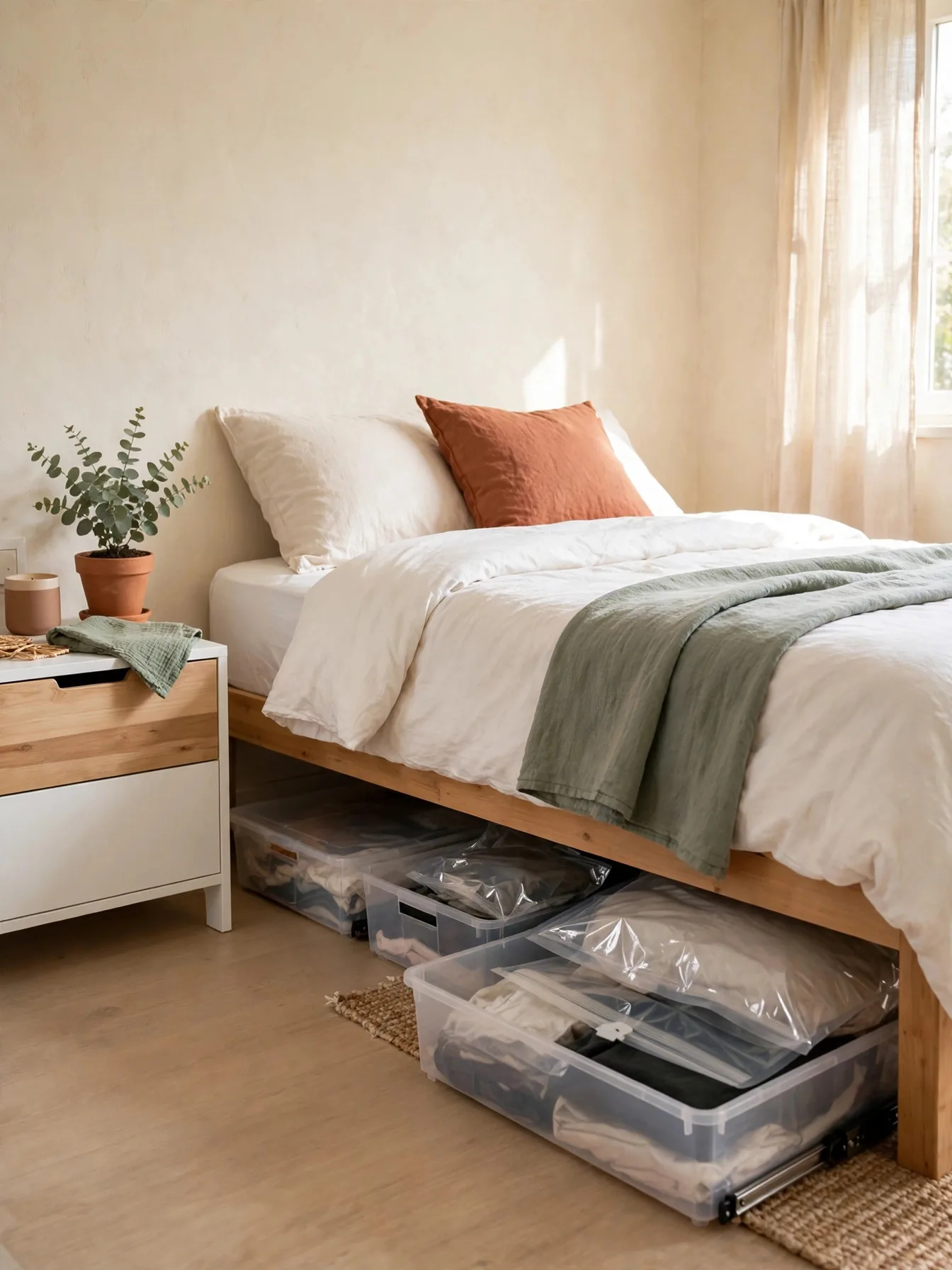
The space under your bed is the largest storage zone in a small bedroom that costs nothing to unlock. Under bed storage for small bedroom renters works because it needs no drilling, no landlord permission, and no wall space: a queen bed covers roughly 33 square feet (about 3 sq m) of floor, and in most rentals nearly all of it sits empty. But under-bed storage fails in one predictable way — people buy containers before they measure. A bin that is half an inch too tall is not storage; it is new clutter you now have to store somewhere else. Apartment Therapy’s under-bed storage ideas cover the same clearance problem.
This guide is built around the single number that decides everything: your clearance. Measure it honestly, match the container to the gap, sort what goes under there by how often you reach for it, and protect it from dust. If you are organizing the whole room rather than just the bed, this pairs with the complete small bedroom closet storage guide, which handles the closet half of the same system.
Measure First: Clearance Is the Whole Decision
Clearance is the distance from the floor to the lowest point of your bed frame — and the lowest point is rarely where people measure. The side rail is easy to reach with a tape, but most frames also have a center support bar or legs that hang 1–2 in (2.5–5 cm) lower than the rails. A bin that clears the rail will jam against the center support halfway in.

Measure in three places: at the side rail, at the middle of the bed where the center support runs, and at the head or foot if your frame has a low crossbar there. Your real clearance is the smallest of the three numbers. Then subtract about 1/2 in (1 cm) of wiggle room — the container you buy should be at least that much shorter than the gap, so it slides without being forced and without scraping the frame on the way out.
Two more measurements matter. First, the width between support legs: legs divide the under-bed space into bays, and a long bin only fits if it fits between them or slides in from the end. Second, your pull-out space: a 33 in (84 cm) bin needs roughly that much clear floor beside the bed to come all the way out. In a tight room, two shorter bins you can fully remove beat one long bin you can only open halfway.
The Four Clearance Bands and What Fits in Each
Once you have your number, your options sort themselves into bands. There is no point falling in love with rolling drawers if your frame gives you 5 in (13 cm) to work with.
Under 4 in (10 cm) — the flat band. Only soft, compressible storage works here: vacuum-seal bags pressed down to 2–4 in (5–10 cm), and flat fabric organizers for linens or out-of-season light clothing. No rigid bins at all. This band is common with low platform beds, and vacuum bags are genuinely good here — this is the one situation where they are the best option rather than a compromise.
4–6 in (10–15 cm) — the low-profile band. Low-profile bins at 4.5–5 in (11–13 cm) tall, divided shoe organizers, and standard fabric organizers fit this band. It is the most common band for platform beds in rentals, and it rewards careful shopping: two bins both sold as “under-bed” can differ by a full inch in height.
6–8 in (15–20 cm) — the standard band. Standard flat bins at about 6 in (15 cm), wheeled bins with their casters included, and the lowest rolling drawers all fit. This is the most flexible band — almost every product category is open to you.
8 in (20 cm) and up — the drawer band. Full rolling drawers at 7–10 in (18–25 cm), taller bins, and even two slim bins stacked in the deepest part of the frame. Traditional frames with legs often land here, as do beds on risers.
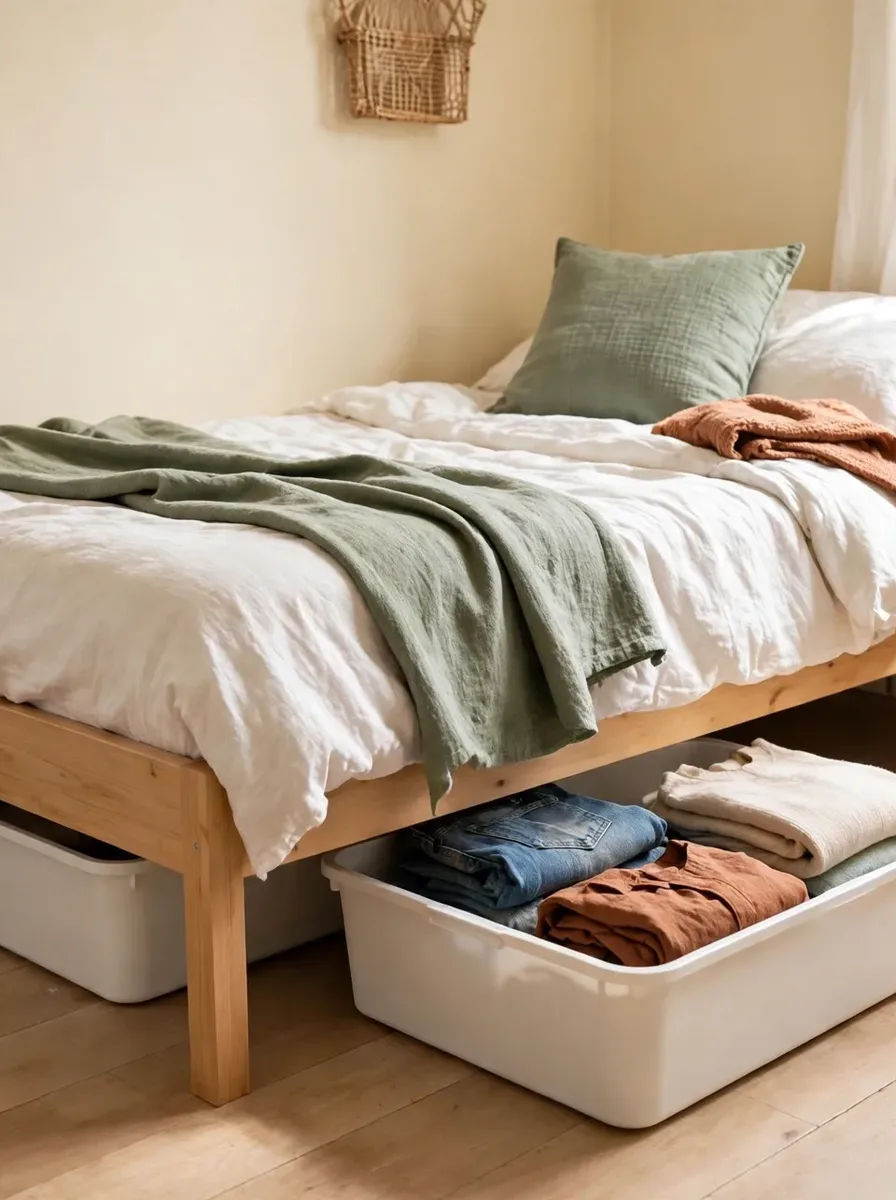
One honesty check applies to every band: manufacturers list container height including the lid, and usually including the wheels — but “usually” is doing some work there. Check the full product dimensions, and if a listing only gives the body height, assume the lid and wheels add up to another inch.
Sort by Reach: Daily, Weekly, Seasonal
The second decision is not what container to buy but what deserves to go under the bed at all. Sort by how often you will reach for each item, because position under the bed should follow frequency.
Weekly items — spare bedding, guest towels, the blanket you rotate on cold nights — belong along the front edge of the side you access, in a bin you can pull out with one hand. Seasonal items — off-season clothes, heavy comforters, holiday textiles — go deeper: the far side and the middle, where they will sit undisturbed for months. Rare items — keepsakes, the air mattress for guests twice a year — take the least accessible spots at the head and center.
Daily items do not belong under the bed at all. Anything you need every morning will turn a good system into a daily annoyance, and the system will collapse into a pile beside the bed within a month. Daily clothes stay in the closet and dresser.
Rentals add one wrinkle: many small bedrooms fit the bed against a wall, leaving only one accessible side. If that is your layout, everything must be reachable from that side — put the rarest items against the wall side and accept that the deep zone is a twice-a-year zone.
Vacuum-Seal Bags for the Bulky Stuff
Vacuum bags solve the one problem bins cannot: bulk. A winter comforter or three heavy sweaters occupy a bin by themselves but compress to a flat slab a few inches thick. Large bags run about 28 × 20 in (71 × 51 cm), jumbo sizes around 40 × 30 in (102 × 76 cm), and a multipack typically costs $15–$30. Compressed thickness depends on what is inside — down-alternative comforters and fleece press flattest; structured coats resist.
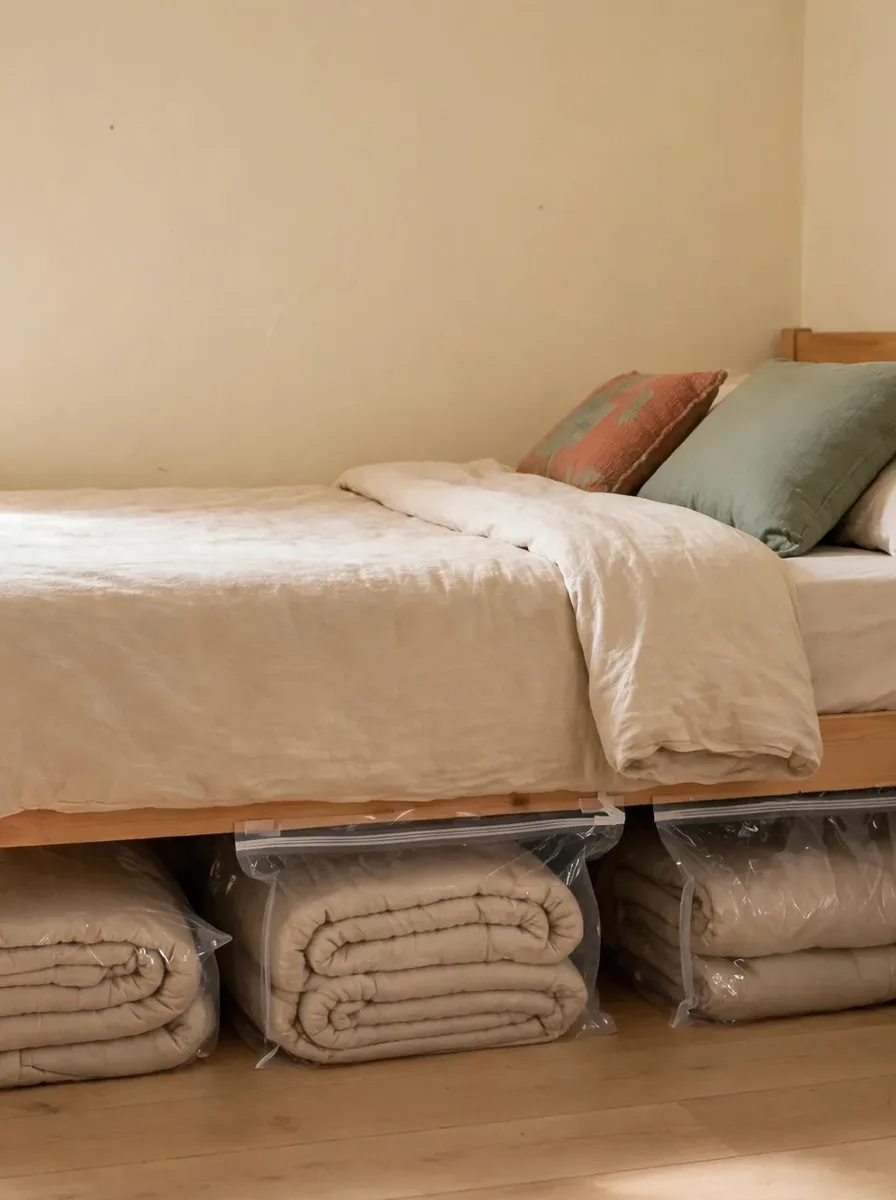
The trade-offs are real and worth stating plainly. Clothes come out wrinkled and need airing or steaming before wear. Seals slowly leak over months, so a bag that was flat in October may have reinflated by February — check and re-vacuum at each seasonal swap. And two materials should not spend months compressed: down, whose loft recovers poorly after long compression, and leather, which creases and can crack along the folds. Store those in a breathable lidded bin instead.
Practical details: do not overfill — an overstuffed bag strains its seams and bulges above its stated thickness, which is how bags jam under frames. If your rental has no vacuum cleaner, choose bags with a hand pump included, and test the pump before the bag is full.
Required space: Needs as little as 3 in (8 cm) of clearance, so it works in the flat band under 4 in (10 cm) where no rigid bin fits at all.
Installation: Do not overfill, since an overstuffed bag strains its seams and bulges above its stated thickness. If your rental has no vacuum cleaner, choose bags with a hand pump included and test the pump before the bag is full, then check and re-vacuum at each seasonal swap.
Approximate dimensions: Large bags run about 28 × 20 in (71 × 51 cm), jumbo sizes around 40 × 30 in (102 × 76 cm), and compressed thickness is 2–4 in (5–10 cm) depending on what is inside.
Rental-friendly limits: Nothing attaches to the room, so the bags lift out and move with you. Do not store down or leather compressed for months, since down recovers its loft poorly and leather creases and can crack along the folds.
Pros: It solves the one problem bins cannot, bulk, compressing a winter comforter or three heavy sweaters to a flat slab a few inches thick.
Cons: Clothes come out wrinkled and need airing or steaming before wear, and seals slowly leak over months, so a bag flat in October may have reinflated by February.
Suitable products: Vacuum-seal bags in large and jumbo sizes, in multipacks, with a hand pump where included.
Rolling Drawers and Wheeled Bins: Access Without the Drag
Wheels are the most misunderstood part of under-bed storage, because they are simultaneously a height cost and the feature that makes the system pleasant to use. Casters add roughly 3/4–1 in (2–2.5 cm) to a container’s total height. In exchange, you stop dragging rigid plastic across the floor — which matters for your deposit as much as for your patience, since a loaded bin dragged weekly across hardwood will eventually leave tracks.
Rolling drawers are the premium version: a real drawer on casters, typically 7–10 in (18–25 cm) tall and $40–$80 each in wood or MDF, less for fabric-front versions. The drawer action means you access the contents without removing the whole unit, and dividers keep folded clothes upright. They need the drawer band of clearance or a bed raised on risers.
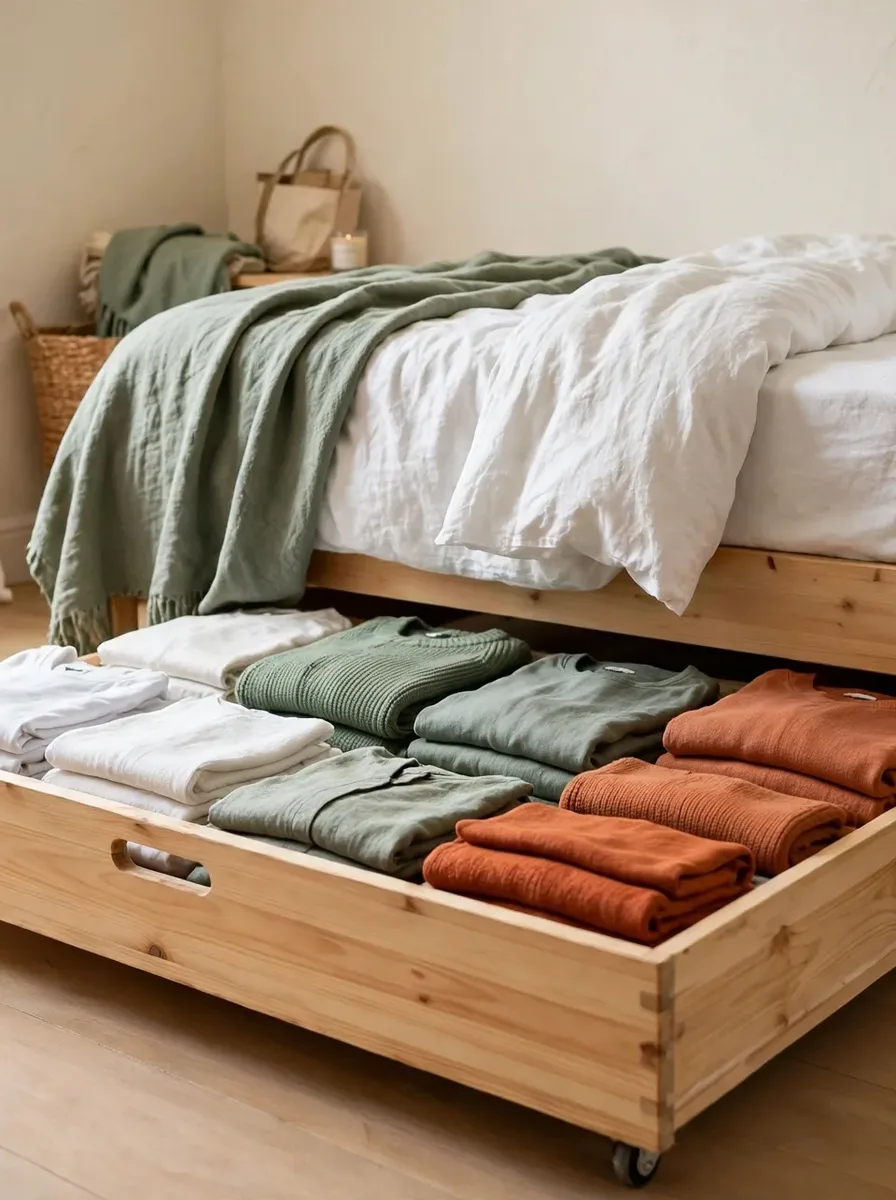
Wheeled bins are the middle ground at $15–$30: a lidded bin you roll rather than drag. Two details decide whether wheels help or hurt. Wheel tread: soft rubber tread rolls quietly and grips; hard plastic casters can dent soft pine floors under a heavy load, so on delicate floors put a low rug runner under the bed’s edge or choose bins with wide, soft wheels. Handles: look for recessed handles or cut-outs — a protruding handle is the first thing to snag on the frame.
Required space: Needs the drawer band of clearance, 8 in (20 cm) and up, for rolling drawers, or a bed raised on risers, while wheeled bins fit the standard band of 6–8 in (15–20 cm).
Installation: Include the casters in your clearance measurement before you buy, since they add height, and roll the container out rather than dragging it across the floor.
Approximate dimensions: Rolling drawers are typically 7–10 in (18–25 cm) tall, wheeled bins are 6–7 in (15–18 cm) with wheels, and casters add roughly 3/4–1 in (2–2.5 cm) to a container total height.
Rental-friendly limits: Nothing attaches to the room, and rolling never scratches the floor. On delicate floors choose bins with wide, soft wheels or put a low rug runner under the bed edge, since hard plastic casters can dent soft pine under a heavy load.
Pros: Wheels stop you dragging rigid plastic across hardwood, and a real drawer lets you access contents without removing the whole unit, with dividers keeping folded clothes upright.
Cons: Casters are a height cost as well as a benefit, and rolling drawers are the premium version, needing the most clearance.
Suitable products: Rolling drawers in wood or MDF or fabric-front versions, and wheeled lidded bins with soft rubber tread and recessed handles.
Shoe Trays: The Quiet Overachiever
Shoes waste closet floor in most small rentals, and under the bed is a better home for the pairs you wear occasionally. Divided under-bed shoe organizers hold roughly 6–12 pairs at about 4–5 in (10–13 cm) tall, and rigid trays keep pairs separated without compartments. Expect to pay $12–$25.
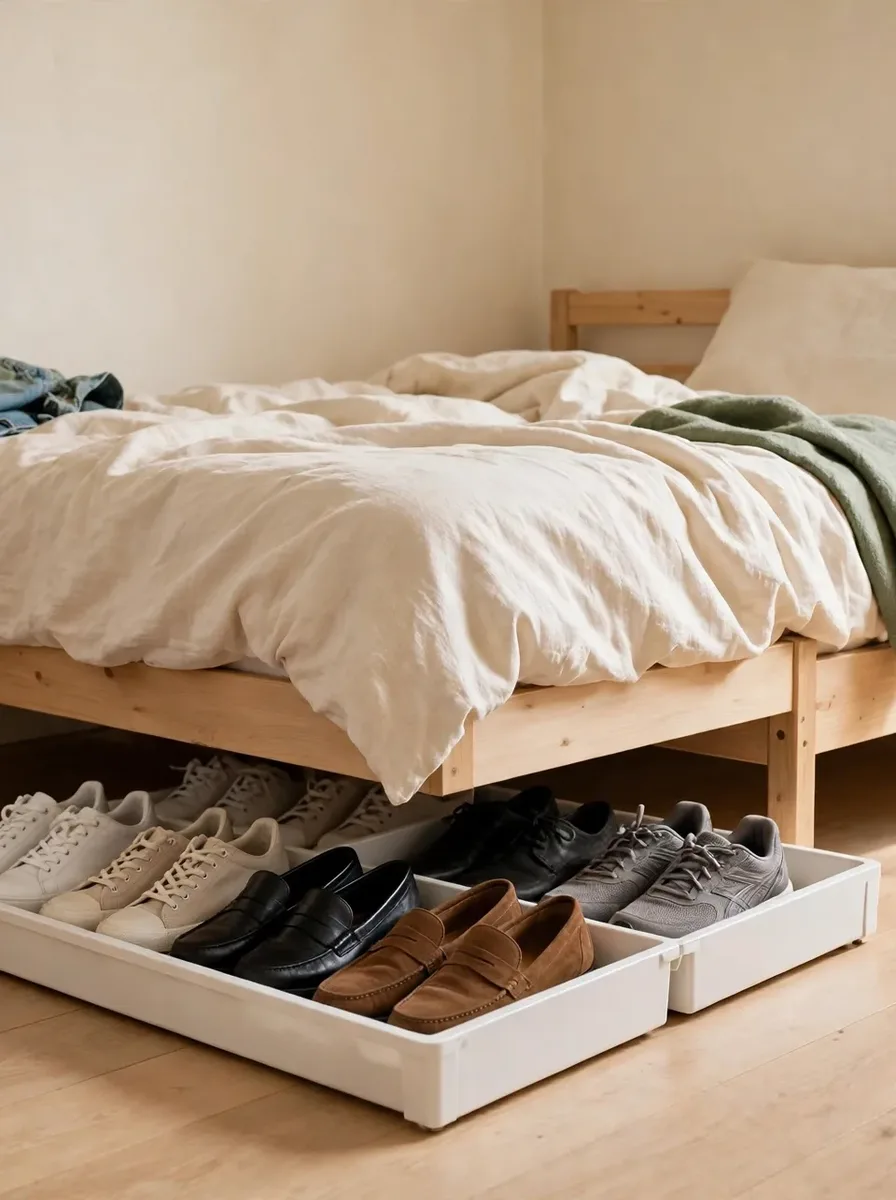
The rules are simple. Occasional and off-season shoes only — the pair you wear daily lives by the door, not under the bed. Choose a lidded version or accept dust on the shoes; an open tray under a bed collects a surprising amount of it. Boots lie flat with the shaft folded rather than standing, and delicate heels do better in their boxes stacked inside a bin than loose in a tray.
Required space: Needs under-bed space about 4–5 in (10–13 cm) tall for occasional and off-season shoes, while the pair you wear daily lives by the door, not under the bed.
Installation: There is no installation — slide the tray or organizer under the bed, with boots lying flat and the shaft folded rather than standing, and delicate heels in their boxes stacked inside a bin rather than loose in a tray.
Approximate dimensions: Divided under-bed shoe organizers hold roughly 6–12 pairs at about 4–5 in (10–13 cm) tall.
Rental-friendly limits: Nothing attaches to the room, so the tray lifts out at move-out. Choose a lidded version or accept dust on the shoes, since an open tray under a bed collects a surprising amount of it.
Pros: Shoes waste closet floor in most small rentals, and under the bed is a better home for the pairs you wear occasionally, keeping pairs separated without compartments in a rigid tray.
Cons: It is for occasional and off-season shoes only, and an open tray offers poor dust protection.
Suitable products: Divided under-bed shoe organizers, rigid shoe trays, and lidded versions.
Too Low? Bed Risers, Used Safely
If your bed sits in the flat band but you want bins or drawers, risers are the legitimate way to change bands. They lift the whole frame by a fixed amount — common sizes add 3 in, 5 in, or 8 in (8, 13, or 20 cm) — and a set of four costs about $10–$25. Nothing attaches to the room, so nothing needs permission and everything reverses in minutes at move-out.
Safety is about matching and seating, not luck. Match the riser cup to your bed legs: the leg should sit fully inside the cup, not balance on its rim, so check the cup’s width against your leg’s width or diameter before buying. Respect the package weight rating — manufacturers commonly rate a set of four somewhere between 1,000 and 2,000 lb (450–900 kg) in total, but ratings vary widely, so go by the rating printed on the set you buy and include the frame, mattress, and sleepers in your estimate. We check manufacturer ratings rather than marketing claims on products like these; how we test and evaluate storage products explains the criteria. Never stack risers unless the set is explicitly designed to stack. Lift one corner at a time, ideally with a second person, and test the bed for wobble before sleeping on it.
Know the honest downsides too. A raised bed is higher to climb into, which matters with thick mattresses. The gap between mattress and headboard grows. Fitted sheets may need deeper pockets. Risers concentrate the bed’s whole weight onto four small points, so on hardwood choose wide-base risers or add felt pads beneath them, and check the floor at move-out. Skip risers entirely on bunk beds, and do not use them under adjustable bases, which are not designed to sit on risers.
Required space: Needs space under each bed leg, lifting the whole frame by a fixed amount to change clearance bands, with nothing else attached to the room.
Installation: Lift one corner at a time, ideally with a second person, and make sure each leg seats fully inside the riser cup rather than balancing on its rim. Test the bed for wobble before sleeping on it.
Approximate dimensions: Common sizes add 3 in, 5 in, or 8 in (8, 13, or 20 cm), and a set of four costs about 10–25 dollars.
Rental-friendly limits: Nothing attaches to the room, so risers reverse in minutes at move-out. Never stack risers unless the set is explicitly designed to stack, respect the package weight rating including frame, mattress, and sleepers, and skip risers entirely on bunk beds and under adjustable bases.
Pros: It is the legitimate way to change bands when a bed sits in the flat band but you want bins or drawers.
Cons: A raised bed is higher to climb into, the gap between mattress and headboard grows, fitted sheets may need deeper pockets, and risers concentrate the bed whole weight onto four small points.
Suitable products: Bed risers in 3, 5, and 8 in sizes, wide-base risers, and felt pads for hardwood floors.
Under-Bed Containers Compared
| Container | Typical height | Minimum clearance | Best for | Access | Dust protection | Typical price |
|---|---|---|---|---|---|---|
| Flat lidded bin | 6 in (15 cm) | 6.5 in (17 cm) | Off-season clothes | Pull-out | Good — sealed lid | $10–$20 each |
| Low-profile bin | 4.5–5 in (11–13 cm) | 5 in (13 cm) | Low platform beds | Pull-out | Good — sealed lid | $12–$22 each |
| Vacuum-seal bag | 2–4 in (5–10 cm) compressed | 3 in (8 cm) | Bulky bedding, winter coats | Seasonal only | Excellent — airtight | $15–$30 per multipack |
| Fabric organizer | 5–6 in (13–15 cm) | 5 in (13 cm) | Shoes, accessories | Pull-out | Poor to fair | $10–$20 |
| Shoe tray / organizer | 4–5 in (10–13 cm) | 4.5 in (11 cm) | Occasional shoes | Pull-out | Fair, better with a lid | $12–$25 |
| Rolling drawer | 7–10 in (18–25 cm) | 7.5 in (19 cm) | Weekly clothes, linens | Excellent — true drawer | Good | $40–$80 each |
| Wheeled bin | 6–7 in (15–18 cm) with wheels | 6.5 in (17 cm) | Mixed storage | Very good — rolls out | Good — sealed lid | $15–$30 each |
Read the table with your band in mind: your clearance eliminates most rows before price or preference gets a say, and what remains is usually an easy choice.
Dust, Moisture, and Pest Protection
Under a bed is a dust trap by physics: floor-level air currents carry dust, lint, and pet hair across the floor, and the sheltered space under the frame is where they settle. Any honest under-bed system has to treat protection as part of the design, not an afterthought.
Lids and seals do most of the work. A lidded bin or a sealed vacuum bag keeps stored items clean for months; an open fabric organizer is acceptable for shoes and little else. A bed skirt adds a second layer of defense — it blocks some of the drifting dust before it reaches the bins, and it hides the storage so the room still looks like a bedroom.
Moisture is the quieter risk. Never store anything damp or even slightly under-dried: in a sealed bin, trapped moisture becomes mildew. Wash and fully dry clothes and bedding first, then add one silica gel packet per bin — a multipack costs about $8–$12 — and in humid climates, check the bins at every seasonal swap. For pests, sealed containers are the real protection; cedar blocks are a mild deterrent at best, while clean fabric matters more, because moths target soiled and food-stained textiles. Finally, vacuum or sweep the under-bed floor at each swap before the bins go back — returning clean bins to a dusty floor defeats half the point.
Labels and a Simple Map
The difference between under-bed storage and under-bed archaeology is knowing what is where without pulling everything out. Label the outward-facing end of every bin — contents and season, in print large enough to read at floor level. Clip-on label holders and removable labels cost $5–$10 and survive reorganization better than tape.
Add a position convention and keep it: left side for winter clothing, right side for bedding, far end for guests, or whatever matches your habits. A photo of the loaded under-bed space, saved on your phone, works as a map when you are hunting for one specific item. Update labels at the seasonal swap — ten minutes, twice a year, and the system stays honest.
Protecting the Floor and Your Deposit
Under-bed storage attaches to nothing, so the storage itself carries zero deposit risk. The one real risk is floor damage, and it comes from a single habit: dragging. A loaded rigid bin pulled across hardwood or laminate every week will eventually scuff or scratch the finish, and that is exactly the kind of damage that comes out of a deposit.
Three habits eliminate the risk. Choose wheels where your clearance allows them, since rolling never scratches. Where wheels do not fit, stick felt pads under the bin’s corners — a roll costs about $5 — and lift bins rather than sliding them whenever they are heavy. And if you use risers, remember they concentrate the bed’s weight: wide bases and felt pads underneath protect the floor at those four points. Do a quick floor check under the bed at each seasonal swap, and you will never get a move-out surprise.
Three Ready-Made Setups by Budget
Around $25 — the seasonal starter. One multipack of vacuum-seal bags plus a pack of labels. Off-season clothes and the spare comforter go under the bed; the closet shelf they occupied becomes daily space. Best for the flat and low-profile bands.
Around $50 — the standard setup. Two flat lidded bins, a multipack of silica gel packets, and felt pads. One bin for off-season clothes, one for extra bedding, both protected from dust and both floor-safe. Best for the standard band.
Around $90 — the raised setup. A set of bed risers plus one rolling drawer or two wheeled bins. This buys your way into the drawer band and gives you weekly-access storage that behaves like furniture. Best when the closet is genuinely full and the bed frame is sturdy enough for risers.
From the Cozy Tiny Space shop
Under-bed storage only works if the bins fit — measure first, free
Room Measuring Cheat Sheet — a two-page measuring checklist covering clearances, door swings, and the delivery path · Free
Slip-Ups That Waste Space
Buying containers before measuring. The most common and most expensive mistake. Measure the center support, not just the side rail, and subtract wiggle room.
Forgetting the wheels in the height. A 6 in bin with 1 in casters is a 7 in container. If the listing is ambiguous, assume the taller number.
Storing daily items under the bed. Morning friction kills the system within weeks. Under-bed space is for weekly, seasonal, and rare items — daily clothes belong in the closet.
Vacuum-sealing down or leather for months. Down loses loft under long compression and leather creases and cracks. Both belong in breathable bins.
Dragging bins across hardwood. Wheels, felt pads, or lifting — pick one. A scratched floor is the only way this damage-free storage method can cost you deposit money.
Skipping labels. An unlabeled bin is a mystery box you will avoid opening, which means its contents might as well not exist.
Overloading soft organizers. A fabric organizer stuffed past its shape bulges above its stated height and jams under the frame. If it needs force to slide, it is too full.
Never doing the seasonal swap. The system works because the closet holds the current season and the under-bed holds the other one. Skip the swap and both spaces end up holding a bit of everything and working for nothing.
Under-bed storage is the rare rental upgrade that is cheap, reversible, and entirely within your control: measure the gap, pick the container your clearance band allows, sort by reach, and seal everything against dust. Start with one category — off-season clothes are the usual winner — and the closet relief is immediate. For the rest of the room, the bedroom and closet storage hub collects every guide in this series, and small bedroom organization ideas that work in a rental takes the same damage-free approach beyond the bed and closet.