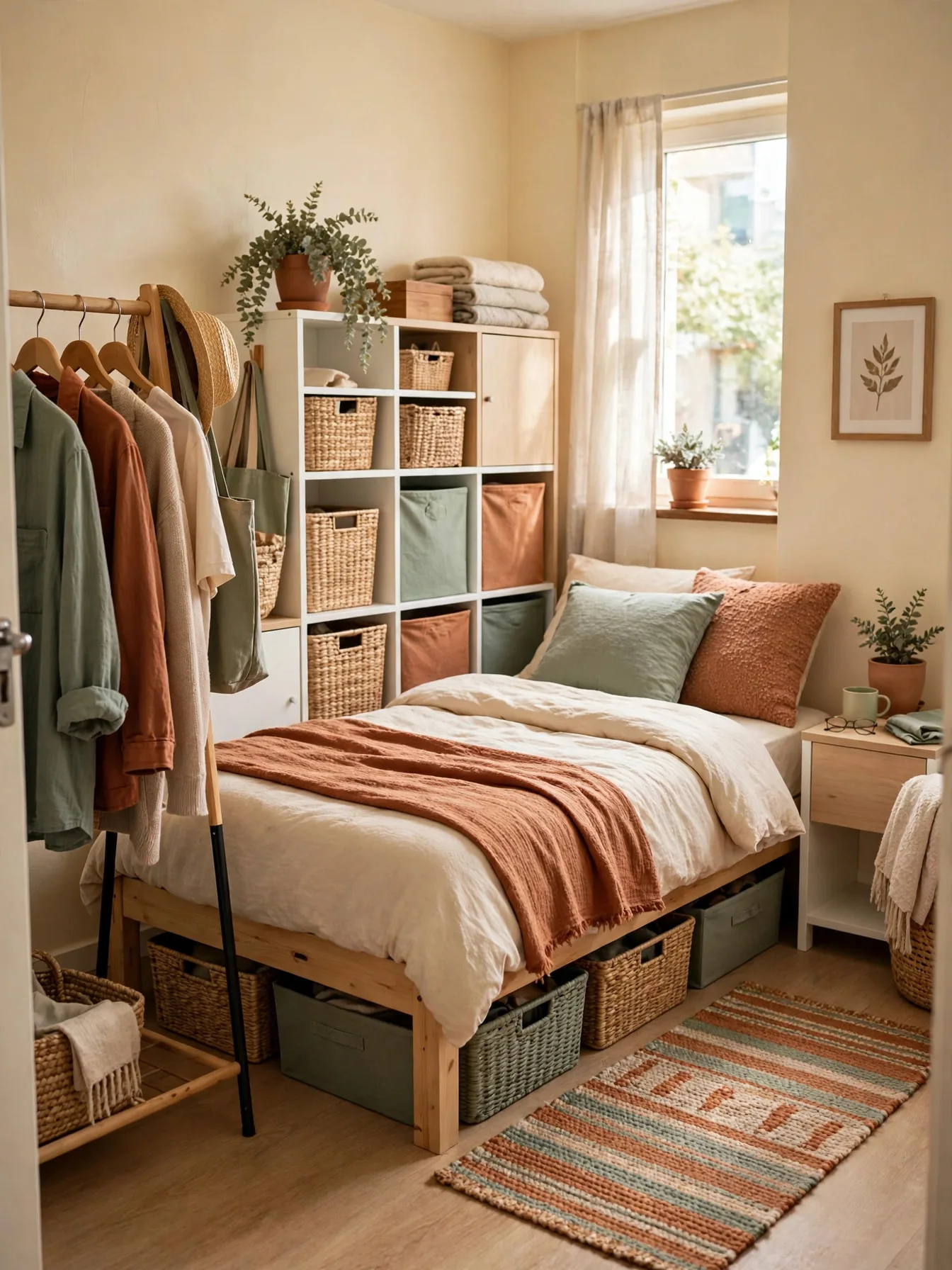
If you are collecting small bedroom organization ideas, rental rules quietly delete half of them: no drilling, no anchors, no built-ins, and nothing you cannot carry out the door on moving day. What survives that filter is not a product list — it is a layout. A small rental bedroom stays tidy when the whole room is divided into zones, and each zone gets exactly the storage it needs and nothing more. This guide organizes the entire room that way: a sleep zone, a dress zone, a work zone, and a store zone, every one of them damage-free. Apartment Therapy’s small-bedroom storage ideas show the same zones in real rented bedrooms.
The closet is part of this plan, but only one part. Closet interiors — double rods, hanging organizers, shelf dividers — are covered in depth in our small bedroom closet storage guide for renters, so here the closet gets a short treatment and the rest of the room gets the attention it usually misses.
Start With Zones: The Layout Behind Every Tidy Small Rental Bedroom
Before buying anything, stand in the doorway and divide the room into four zones. The sleep zone is the bed and the 24 in (61 cm) or so around it that you need to get in and out. The dress zone is wherever clothes are put on and taken off — the closet, a rack, the chair that currently holds everything (the chair is a dress zone that failed). The work zone, if you need one, is a desk footprint of roughly 36 × 20 in (91 × 51 cm) plus chair space. The store zone is everything that holds things you do not touch daily: under the bed, the top of the closet, the back of the door, the wall above the dresser.
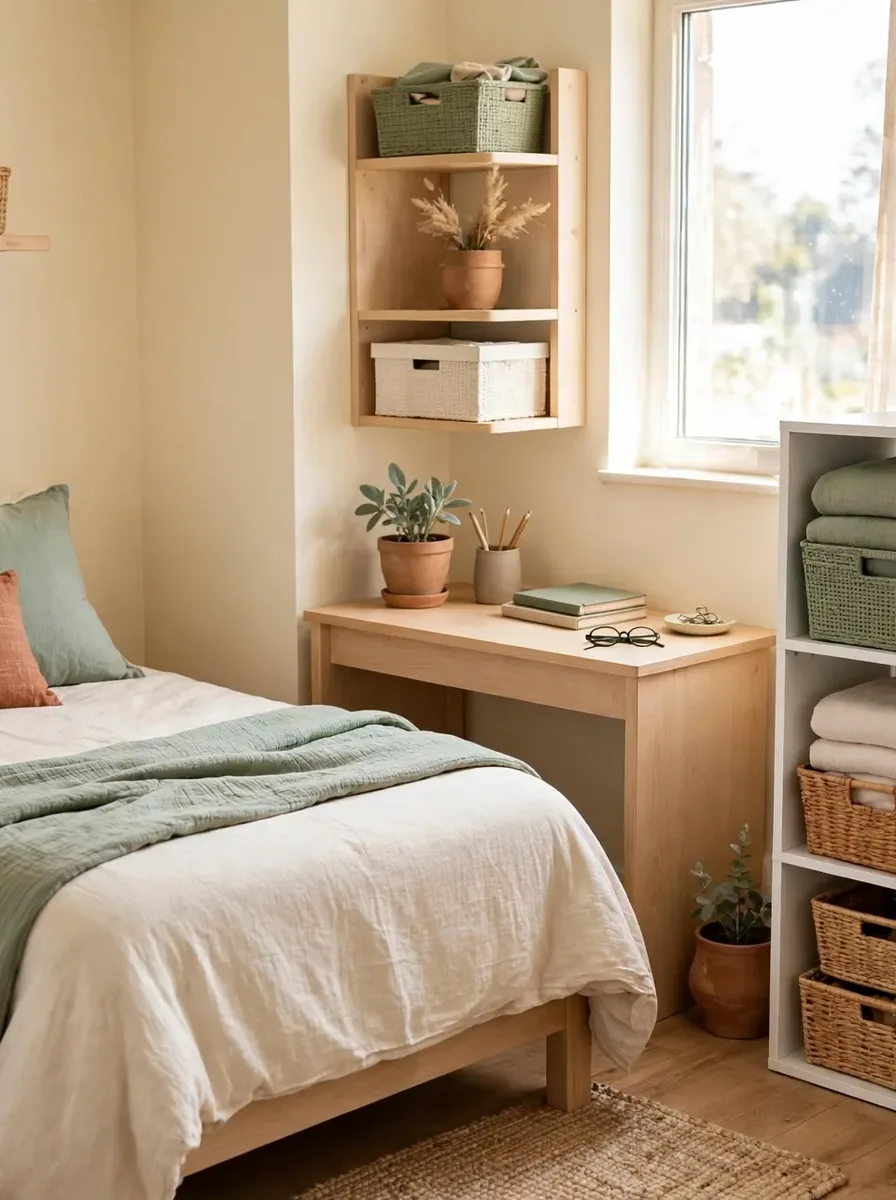
Zoning matters more than storage products because most small-bedroom mess is zone bleed: mail on the nightstand, work papers on the bed, gym clothes on the floor because the dress zone is across the room from where you undress. When each category has a zone near where it is used, tidying becomes a two-minute reset instead of a weekend project.
Two measurements decide whether the plan works. First, walkways: 24 in (61 cm) is the minimum gap you can move through comfortably, 30 in (76 cm) feels generous, and anything under 20 in (51 cm) becomes a sideways shuffle you will resent daily. In a typical 10 × 10 ft (3.0 × 3.0 m) rental bedroom with a queen bed (60 × 80 in / 152 × 203 cm), you have roughly 40 in (102 cm) of free width to split between the two sides — which is why one side usually gets the walkway and the other gets pushed near the wall. Second, door swings: mark where the room door and closet door open, and keep those arcs empty. Storage that blocks a door swing gets moved within a week, usually to the floor.
Sketch the zones on paper with real measurements before spending anything. Every product in the rest of this guide lists its footprint, so you can check it against your sketch instead of against hope.
The Sleep Zone: Storage That Works While the Room Is Dark
The sleep zone has one job — rest — so its storage should be invisible, silent, and reachable without turning on a light. That rules in exactly three pieces.
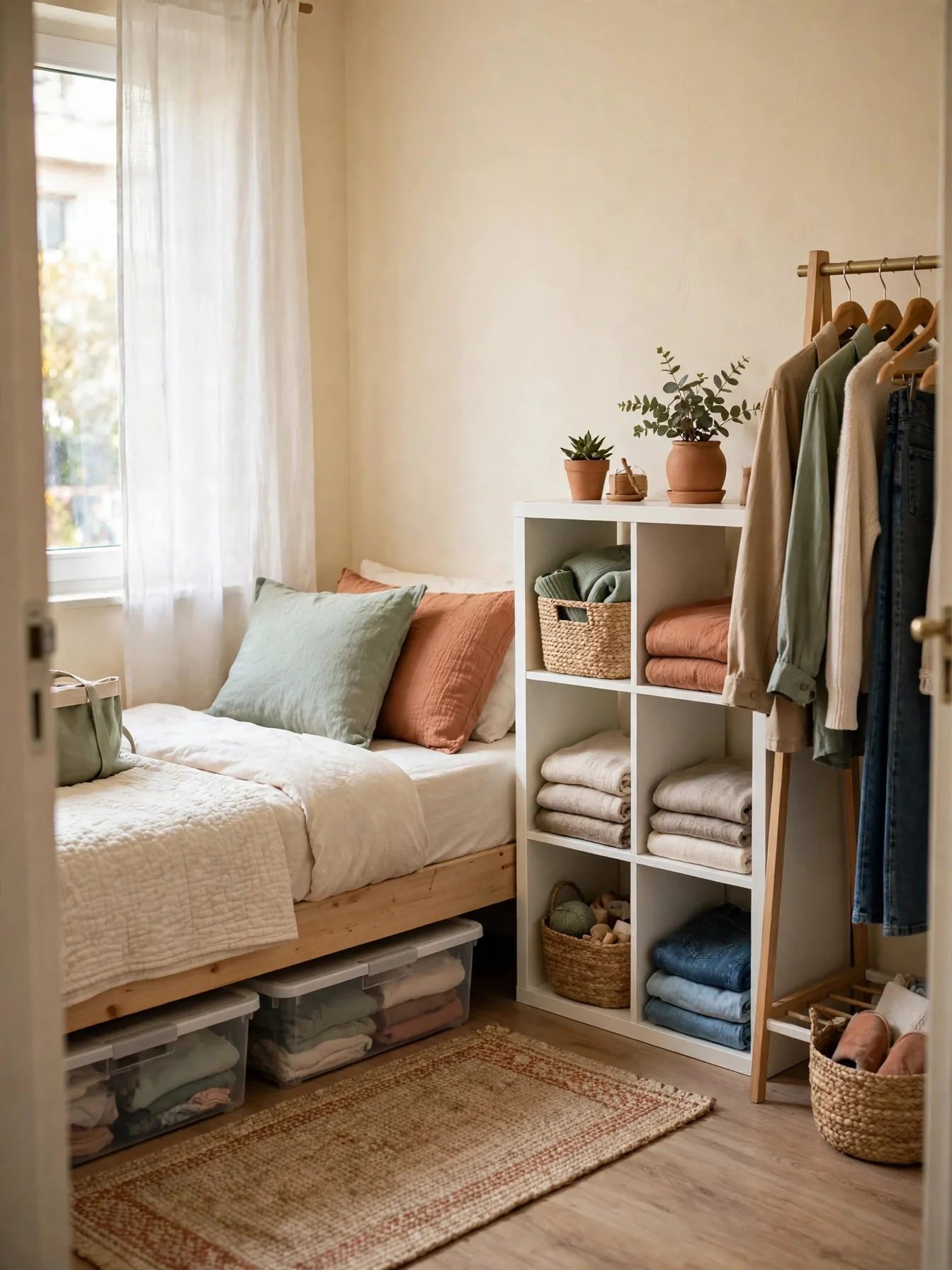
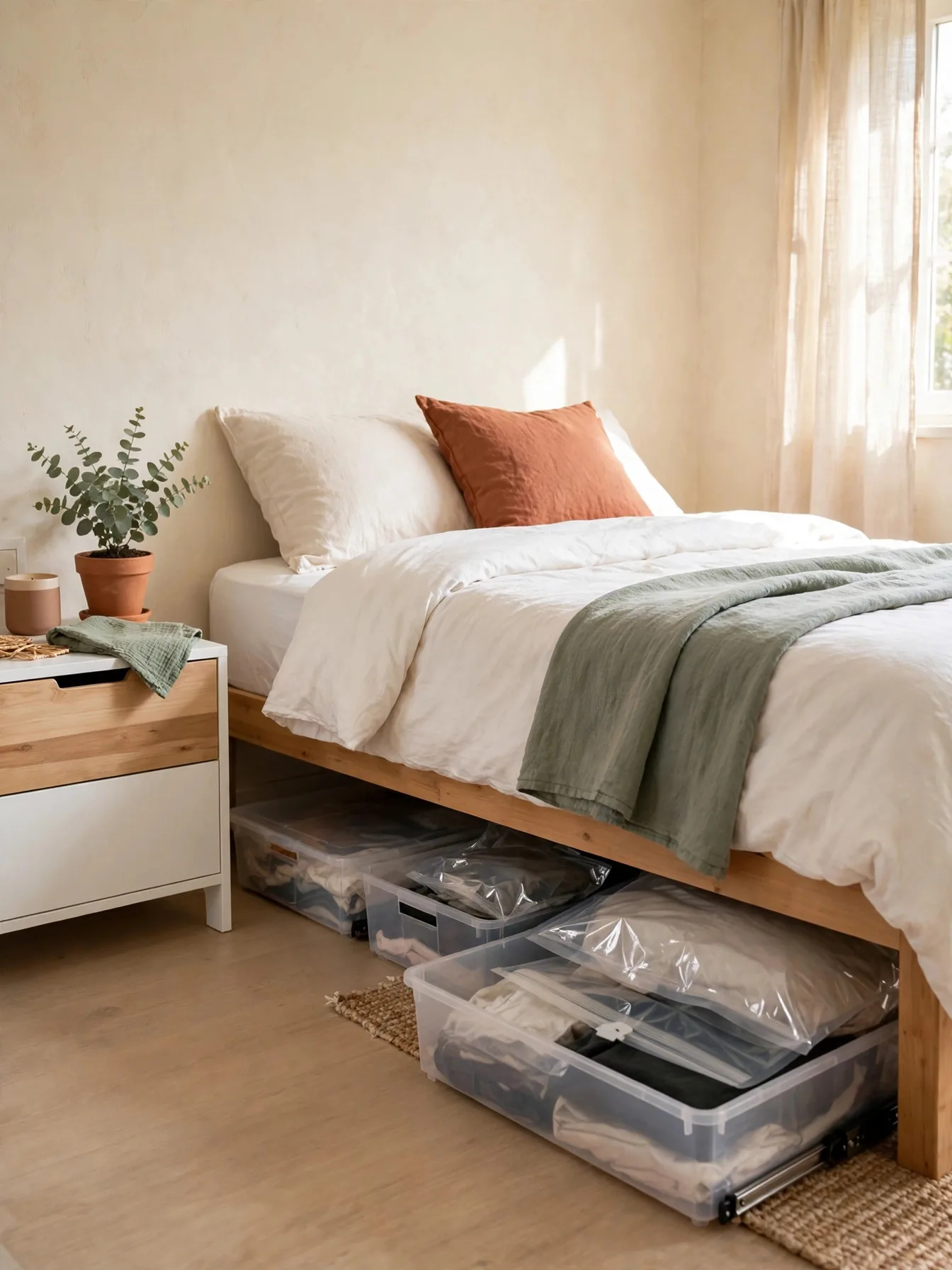
Under the bed is the largest storage area in most small bedrooms and the most wasted. A queen bed covers about 33 sq ft (3.1 sq m); even using half of it beats most dressers. Standard bed frames leave 5–7 in (13–18 cm) of clearance, which fits flat bins around 6 in (15 cm) tall. Bed risers add 3–5 in (8–13 cm) for $10–$25 a set if you need taller bins, at the cost of a slightly higher bed and a less stable feel on carpet. Keep daily things out of this zone — it is for off-season clothes, spare bedding, and shoes you wear weekly at most. The full method, including which bin types survive dust and dragging, is in our guide to under-bed storage ideas for small rental bedrooms.
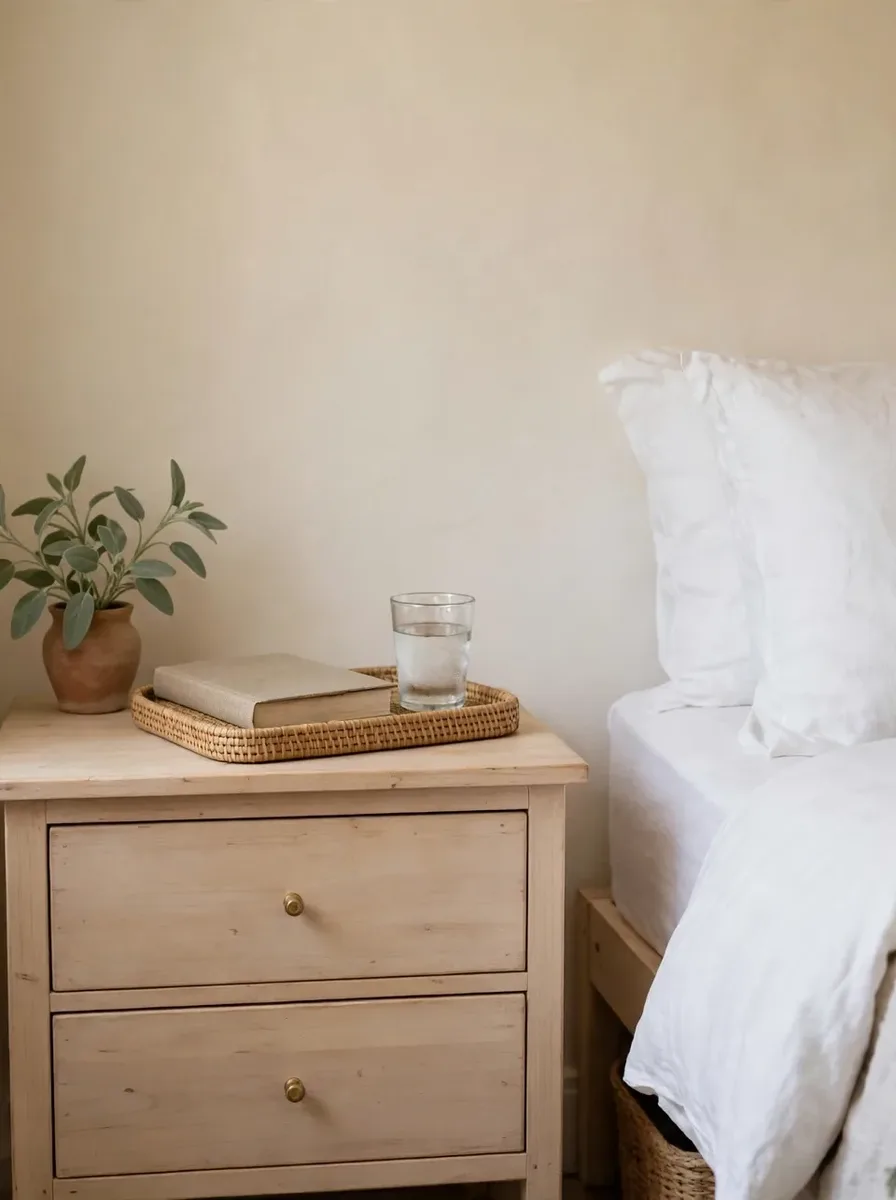
The nightstand should have drawers, full stop. An open-leg table turns the bedside into a display shelf for clutter; two drawers hide the chargers, books, medication, and cables that otherwise colonize the bed. Look for a footprint near 16–20 in wide × 14–16 in deep (41–51 × 36–41 cm) — bigger eats walkway. A small tray on top corrals the phone, glasses, and water glass into one visual unit, which sounds fussy and works anyway. Drawer nightstands run $40–$90; it is the one furniture upgrade in this guide that earns its cost in almost every room.
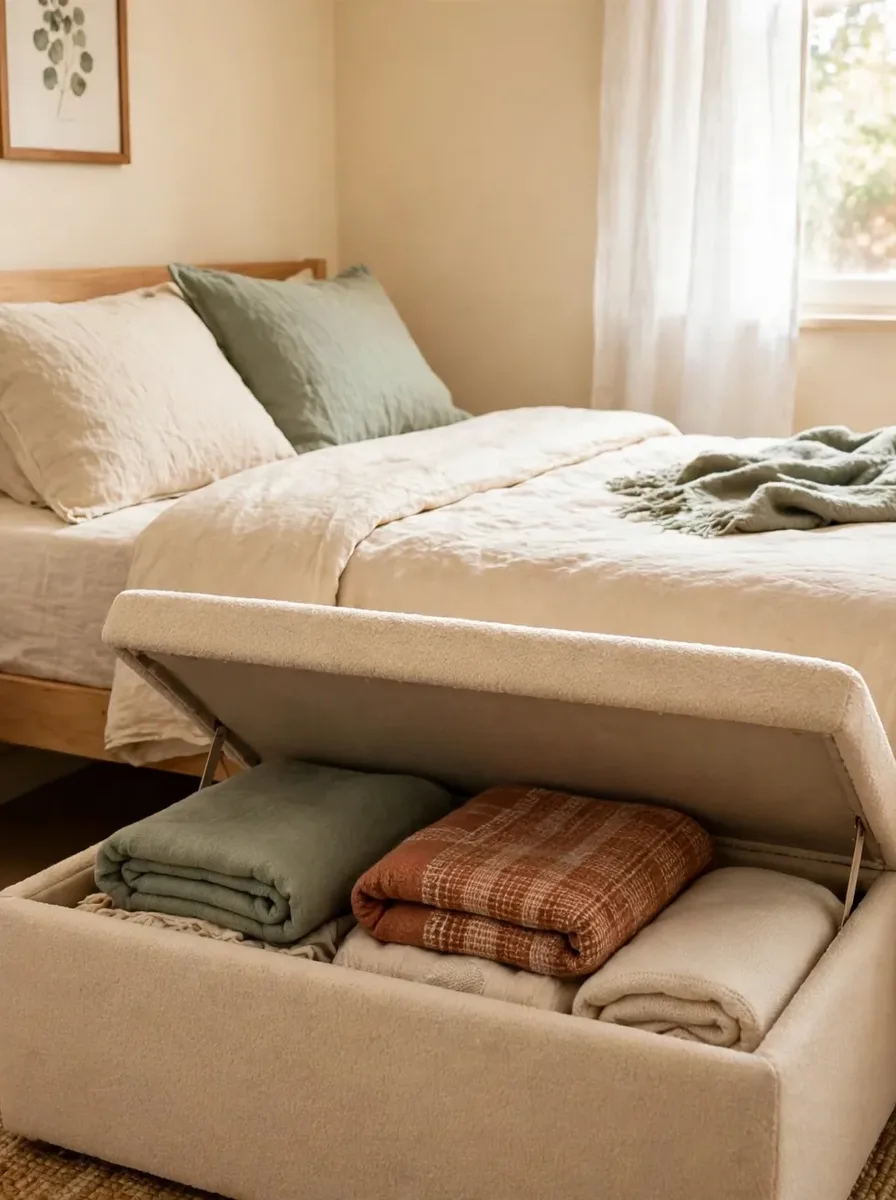
The foot of the bed fits a storage ottoman if your room length allows it: most are 30–40 in wide × 15–18 in tall (76–102 × 38–46 cm) and cost $30–$70. It swallows the spare blanket and the throw pillows that otherwise migrate to the floor, and it gives you somewhere to sit while putting on shoes — which keeps the bed made longer. The honest trade-off: in a room under 10 ft (3.0 m) long, the ottoman steals the walkway at the bed’s foot, and a lidded basket in the corner does the same job for less money and less floor.
What does not belong in the sleep zone: laundry (it migrates to the bed), work items, and anything with a blinking light you cannot switch off. If it is not for sleeping, it lives in another zone.
Required space: The bed and about 24 in (61 cm) around it for getting in and out, a nightstand footprint near 16–20 in wide × 14–16 in deep (41–51 × 36–41 cm), and a storage ottoman 30–40 in wide (76–102 cm) at the foot of the bed if the room length allows it.
Installation: Slide flat bins under the bed, place a drawer nightstand beside the bed, and put the ottoman at the foot of the bed. Bed risers add 3–5 in (8–13 cm) for $10–$25 a set if you need taller bins.
Approximate dimensions: Standard bed frames leave 5–7 in (13–18 cm) of clearance, fitting flat bins around 6 in (15 cm) tall; a queen bed covers about 33 sq ft (3.1 sq m). Drawer nightstands run $40–$90, and ottomans are 30–40 in wide × 15–18 in tall (76–102 × 38–46 cm) at $30–$70.
Rental-friendly limits: All freestanding and silent, with no drilling — nothing is screwed in. Bed risers cost a slightly higher bed and a less stable feel on carpet.
Pros: Even using half the under-bed area beats most dressers, a drawer nightstand hides chargers, books, medication, and cables, and the ottoman swallows the spare blanket and gives you somewhere to sit while putting on shoes.
Cons: Daily things do not belong under the bed — it is for off-season clothes, spare bedding, and shoes worn weekly at most — and in a room under 10 ft (3.0 m) long the ottoman steals the walkway at the bed’s foot.
Suitable products: Flat under-bed bins, drawer nightstand with a small tray, storage ottoman or lidded basket.
The Dress Zone: Closet, Rack, and Door Sharing One Job
Getting dressed should happen in one place, with everything for it inside arm’s reach. In most rentals that place is a triangle: the closet, a garment rack, and the back of the bedroom door.
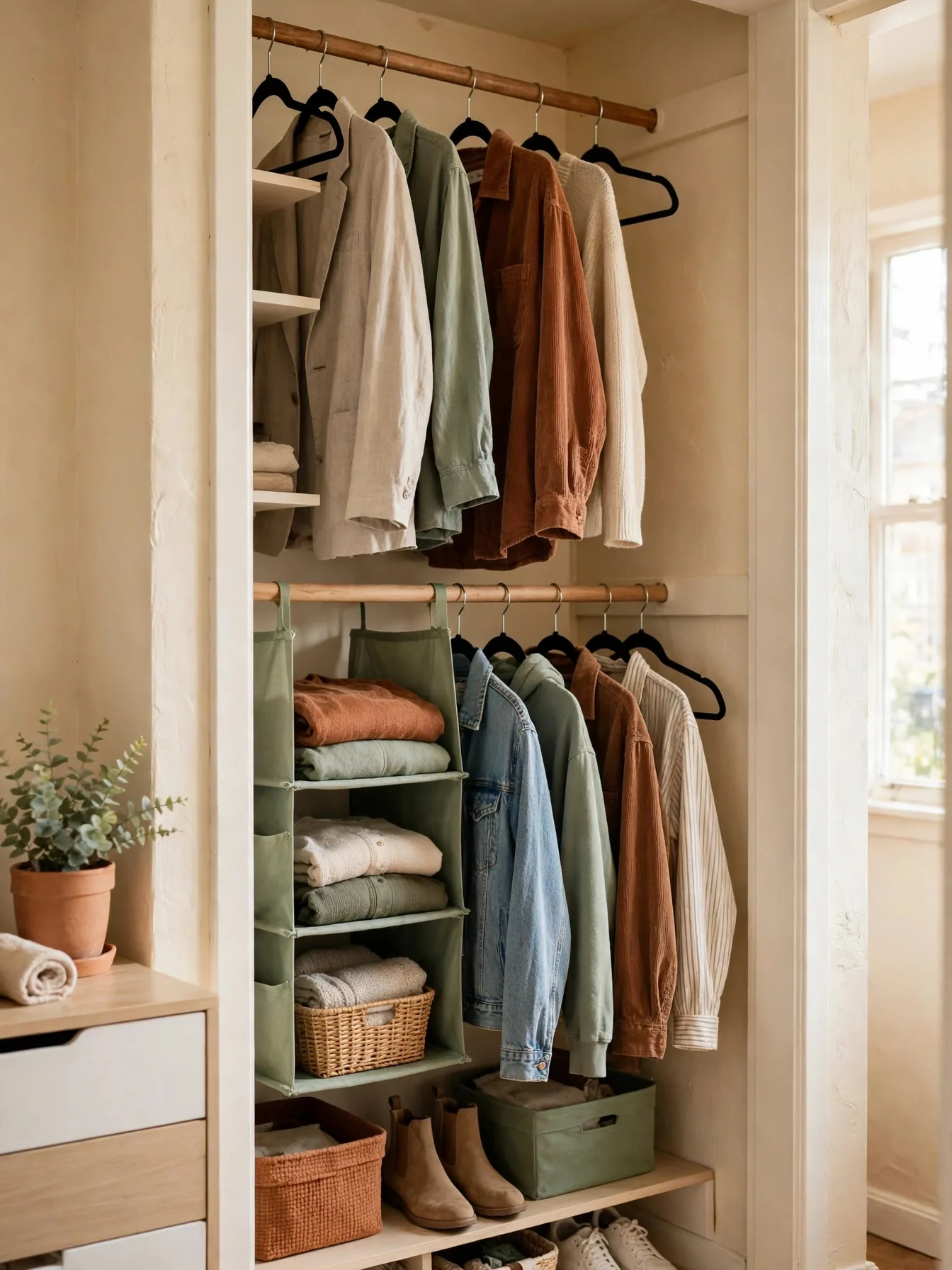
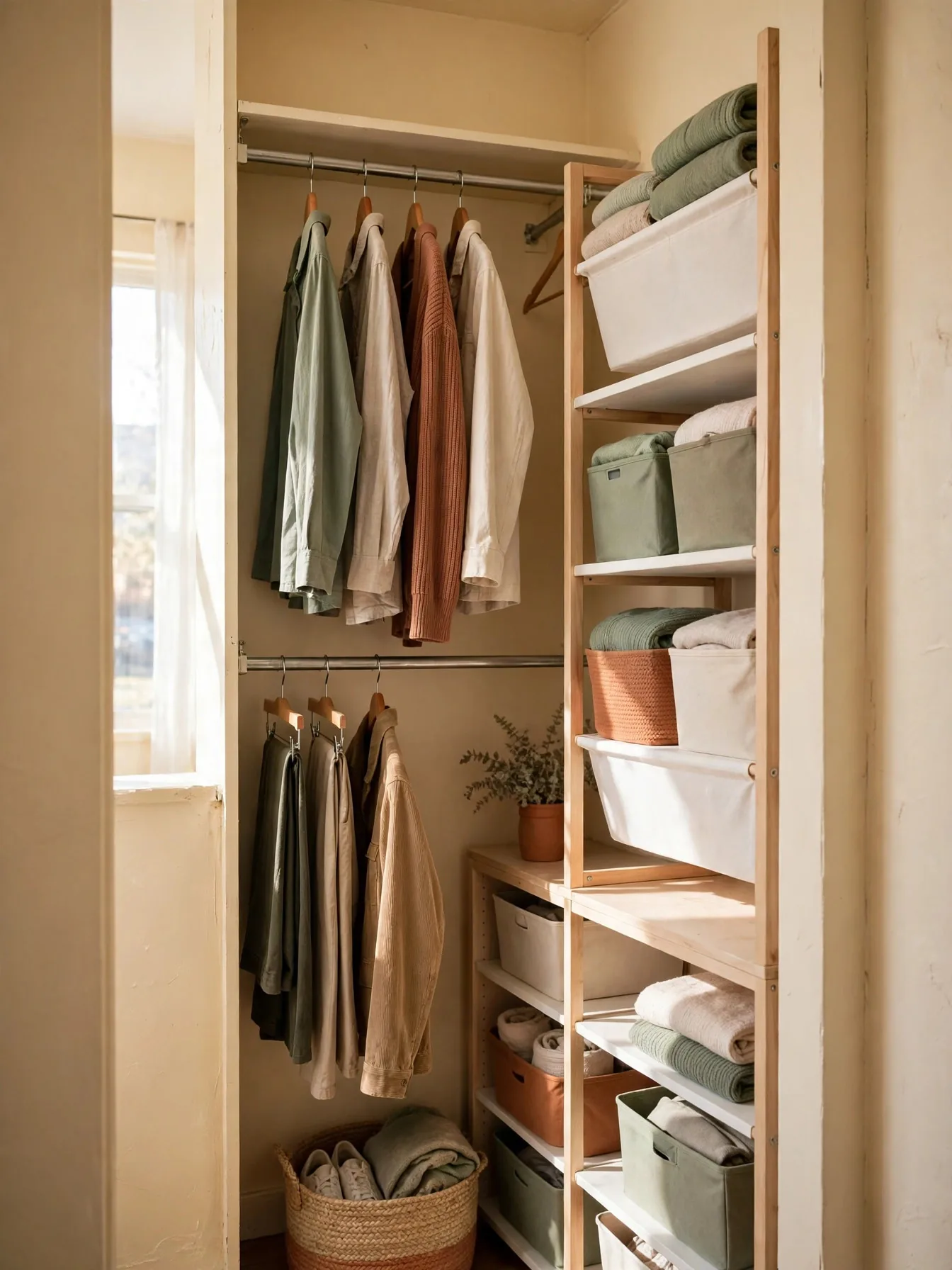
The closet handles the bulk — hanging clothes, folded stacks, shoes. Do not let this guide’s brevity fool you into skipping it; a reach-in closet organized with a second rod and a hanging organizer is still the highest-capacity storage in the room, and the step-by-step is in the complete closet storage guide in the bedroom and closet storage hub. What belongs in this article is the overflow plan for when the closet is full, shared, or — in older rentals — barely 36 in (91 cm) wide.
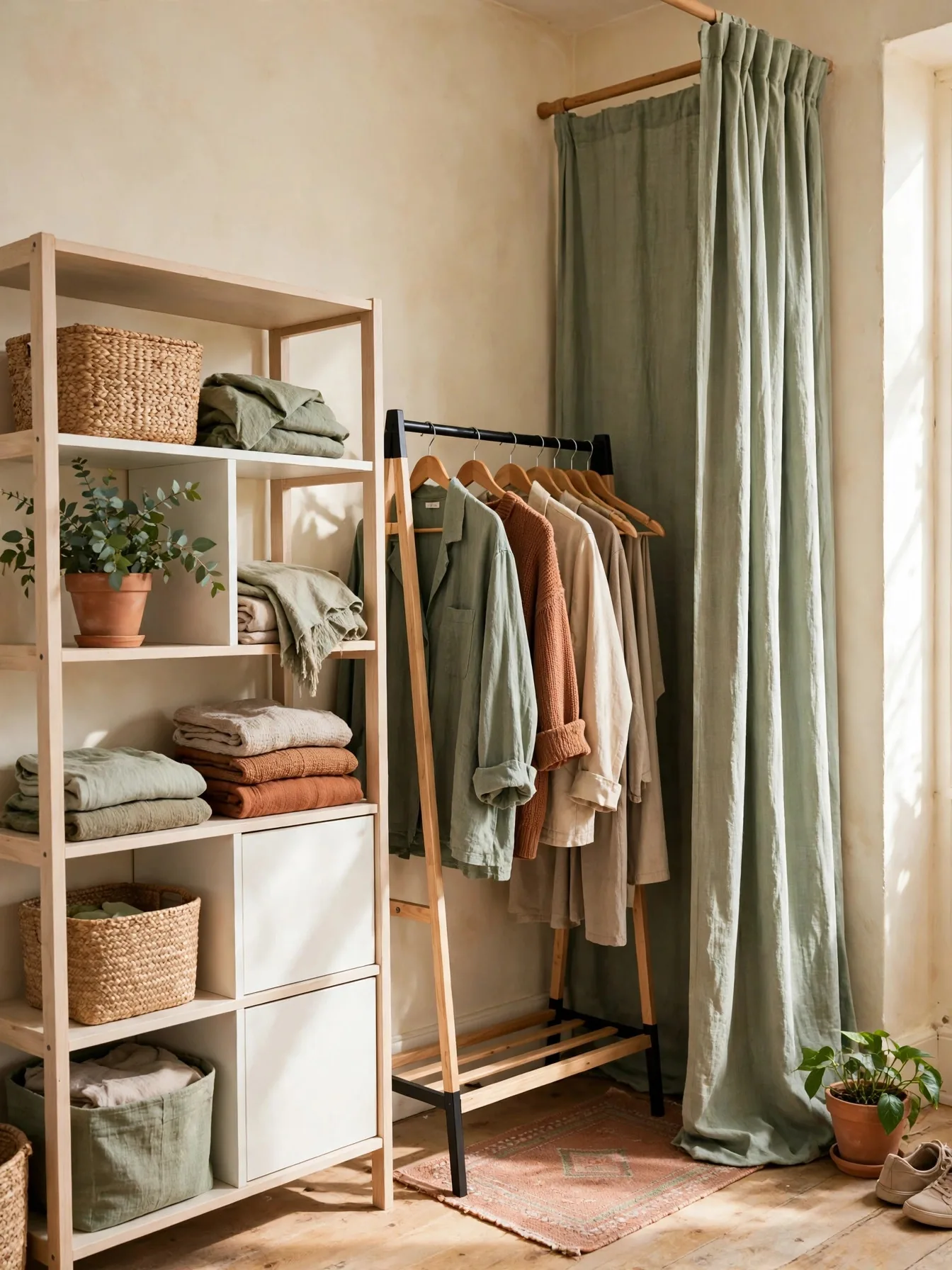
A garment rack is the overflow that works. A single-rail rack 36–48 in wide (91–122 cm), about 18 in (46 cm) deep, and 59–66 in (150–168 cm) tall costs $25–$60 and holds roughly a week of outfits. Manufacturers rate these anywhere from 50 to 110 lb (23–50 kg) — treat the rating as a ceiling, not a target, and buy the heavier frame if you hang winter coats. Put the rack where you actually dress, not where it looks best in a photo; a rack beside the closet door gets used, a rack in the far corner becomes a sculpture. The trade-off is real: an open rack shows everything, so it stays tidy only if you limit it to clothes in current rotation and move the rest to the store zone.
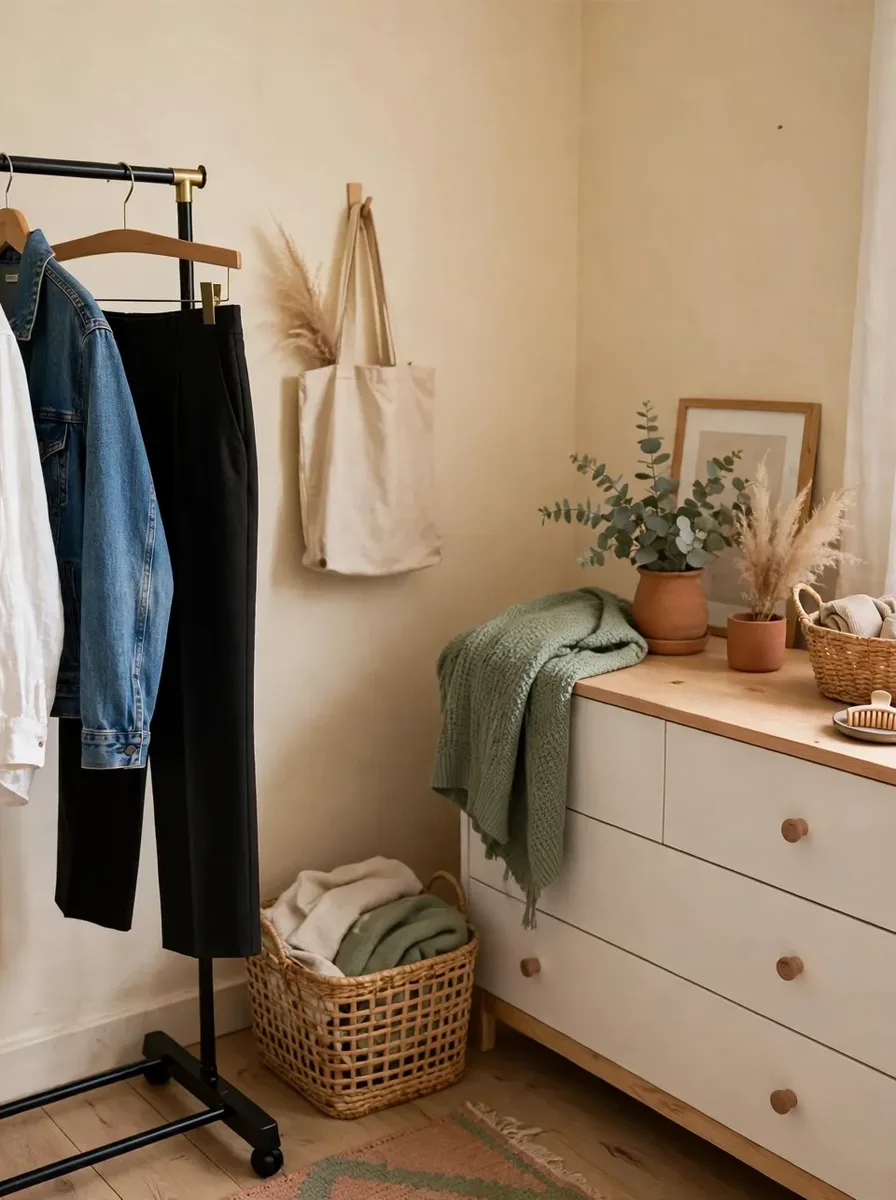
The back of the door is the dress zone’s free wall. Over-door hooks fit standard 1⅜ in (35 mm) thick interior doors and cost $10–$25 for a rail of four to six hooks. Give them a job description — tomorrow’s outfit, the robe, the two bags you rotate — rather than letting them collect everything hook-shaped. One caution: check the gap between the door top and the frame before buying; some older rentals have almost no clearance, and a hook rail that scrapes the frame will annoy you every single day. Thin-profile hooks exist for exactly this case.

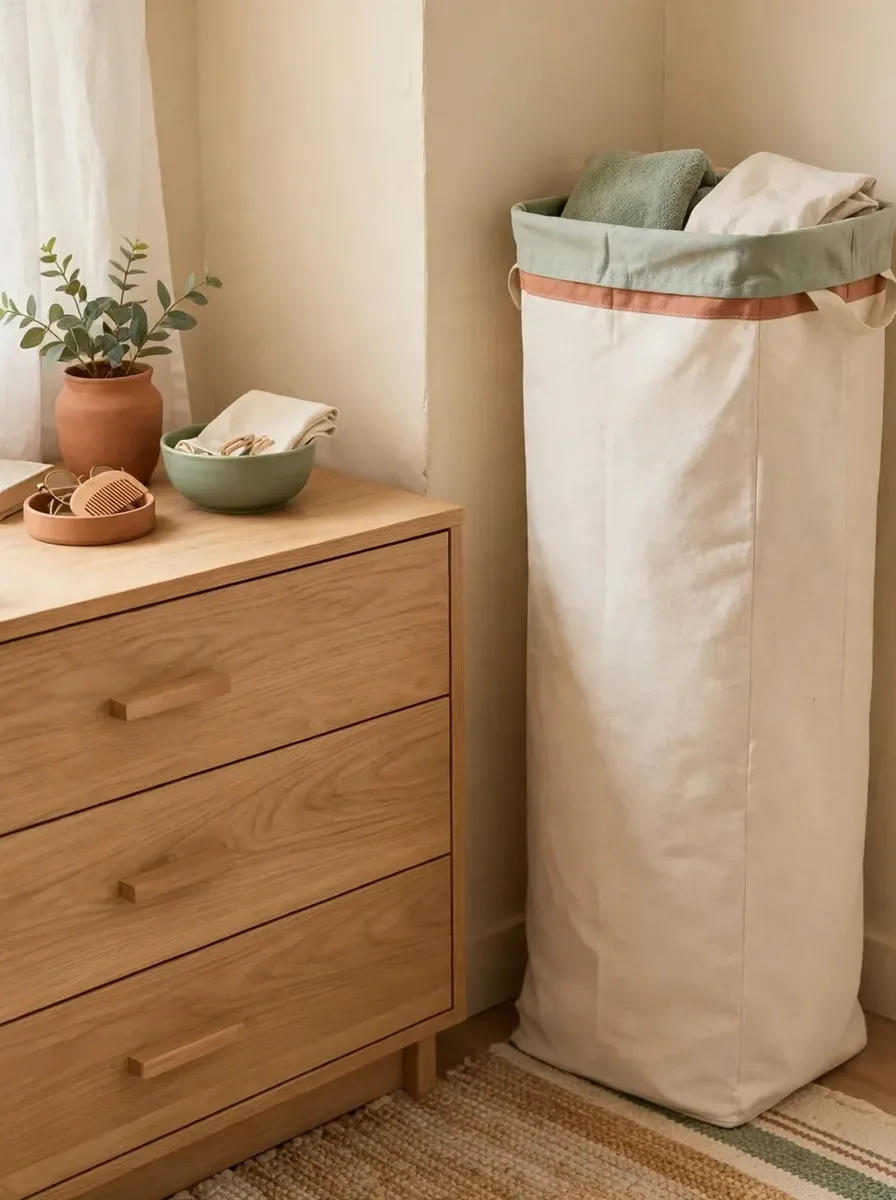
Finally, put a slim hamper where you undress, not in the bathroom and not in the closet. Hampers 8–10 in (20–25 cm) deep exist precisely for the gap beside a dresser or rack, they cost $15–$30, and they end the floor pile more reliably than any resolution to try harder. If dirty clothes land within two steps of where they come off, they land in the hamper.
Shoes belong to the dress zone too, and they are where it usually breaks down. Keep the two or three pairs in current rotation by the rack or door — a low tray or a mat with a lip contains the dirt and the visual noise — and move the rest to the store zone: under-bed shoe boxes or the closet floor. A shoe rack inside the dress zone makes sense only if it is narrower than the space it stands in; the popular 3-tier racks are around 31 in (79 cm) wide and 12 in (30 cm) deep, which is a lot of walkway to spend on footwear. In most small bedrooms, a tray for daily pairs beats a rack for all pairs.
Required space: The closet, a garment rack beside the closet door, the back of the bedroom door, and a hamper gap 8–10 in (20–25 cm) deep beside a dresser or rack.
Installation: Put the rack where you actually dress, not where it looks best in a photo; hang over-door hooks on a standard 1⅜ in (35 mm) thick interior door after checking the gap between the door top and the frame; put a slim hamper where you undress.
Approximate dimensions: A single-rail garment rack 36–48 in wide (91–122 cm), about 18 in (46 cm) deep, and 59–66 in (150–168 cm) tall costs $25–$60 and holds roughly a week of outfits; an over-door hook rail of four to six hooks costs $10–$25; a slim hamper costs $15–$30.
Rental-friendly limits: The rack and hamper are freestanding and the hooks lift off the door — nothing is screwed in. Thin-profile hooks exist for older rentals with almost no clearance at the door top.
Pros: A rack beside the closet door gets used and makes it easier to put clothes away, and a hamper within two steps of where clothes come off ends the floor pile more reliably than any resolution.
Cons: An open rack shows everything, so it stays tidy only if you limit it to clothes in current rotation; the popular 3-tier shoe racks are around 31 in (79 cm) wide and 12 in (30 cm) deep, which is a lot of walkway to spend on footwear.
Suitable products: Single-rail garment rack, over-door hook rail, slim hamper, low shoe tray or mat with a lip.
The Store Zone: Walls, Height, and the Corners Nobody Uses
The store zone holds what you need monthly, not daily — and in a small rental bedroom it has to be built out of vertical space and corners, because the floor is already spoken for.
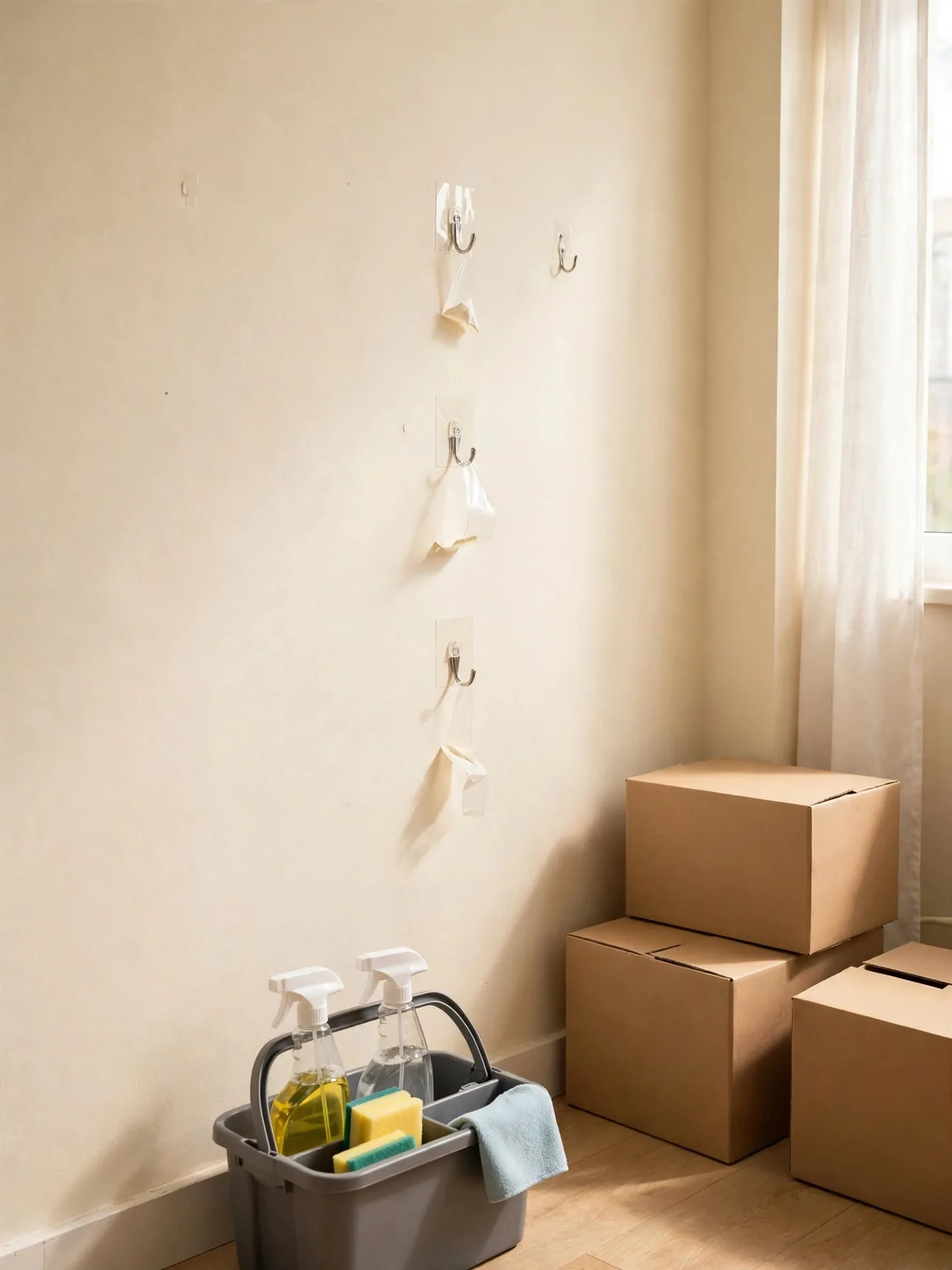
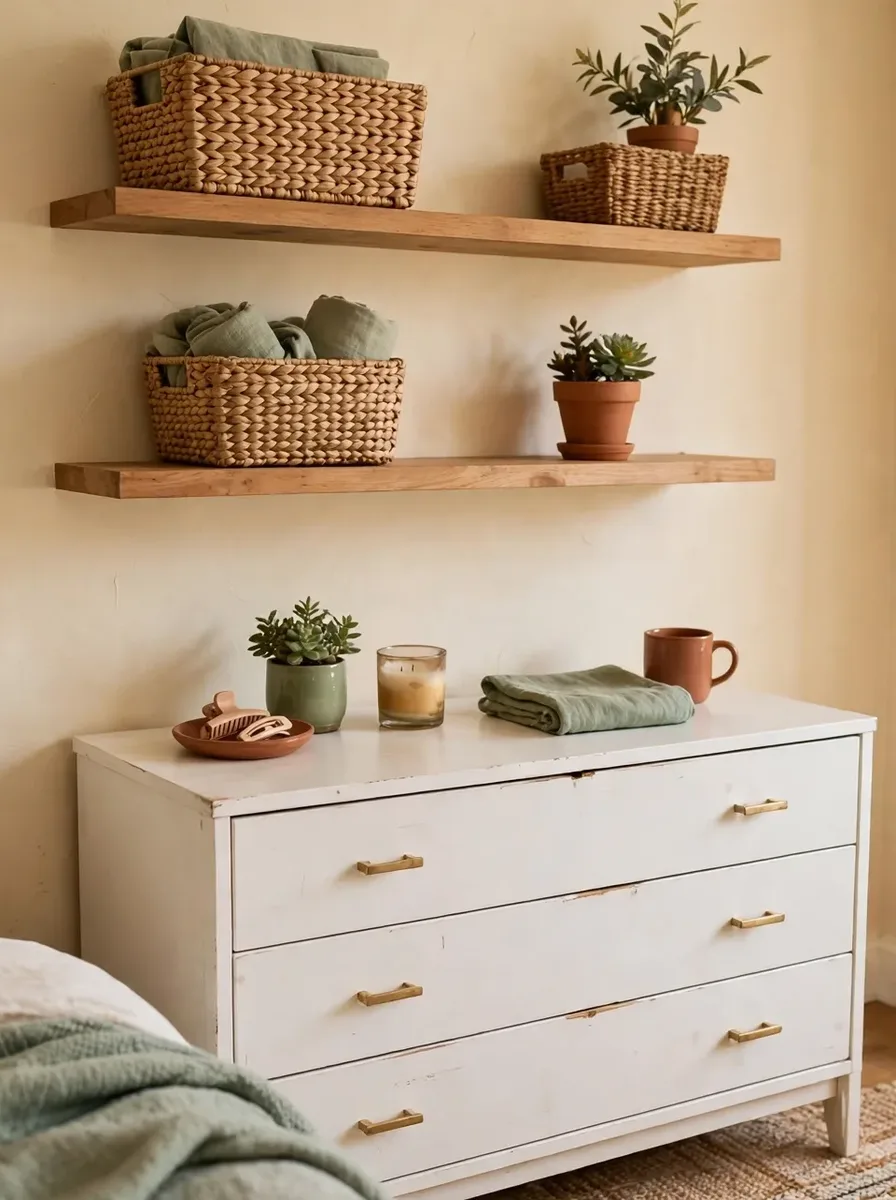
Above the dresser is the most underused wall in the room. No-drill options — adhesive shelves, picture-ledge style rails on removable strips, or a leaning shelf that rests against the wall — keep books, a watch box, and the morning routine off the dresser surface. Be honest about adhesive limits: most removable strips and adhesive shelves are rated by their makers at 5–15 lb (2–7 kg), and steam, textured paint, and time all reduce that. Load them at half the stated rating, keep breakables off them, and they are a reasonable renter risk. A leaning shelf costs more ($40–$80) but carries real weight with zero wall contact — the safer choice above anything you sit or sleep near.
Corners take the tall, thin things: a corner hamper, a narrow tower for shoes, the laundry basket moved out of the dress zone. Measure corners diagonally — a piece that fits a 14 in (36 cm) wall return can still block the door swing, which is the mistake that sends corner furniture back to the store.
High space — the shelf above the closet rod and the tops of wardrobes — is store-zone prime real estate for the least-used items: suitcases (store things inside them, too), spare duvets in vacuum bags, the fan in winter. If you need a step stool to reach it, it is store zone by definition; nothing daily belongs up there.
The discipline that makes the store zone work is labeling. Boxes you cannot identify become boxes you open, rummage, and leave open. A strip of painter’s tape and a marker — both removable, both renter-safe — beats a label maker you have to store somewhere.
One more store-zone spot hides in plain sight: the gaps. The 6–10 in (15–25 cm) between a dresser and the wall, or between the bed frame and the corner, fits a slim rolling cart or a standing file of flat items — gift wrap, a yoga mat, the folding tray table. Gap storage is unglamorous and genuinely useful, with one rule: whatever goes into a gap must come out without moving furniture, or the gap becomes a tomb. If you have to drag the dresser to reach it, store something there that you need exactly as often as you move the dresser — which is to say, almost never.
Required space: The wall above the dresser, the corners, the high space above the closet rod and the tops of wardrobes, and gaps of 6–10 in (15–25 cm) between a dresser and the wall or the bed frame and the corner.
Installation: Use adhesive shelves or picture-ledge style rails on removable strips, or a leaning shelf that rests against the wall. Label boxes with a strip of painter’s tape and a marker.
Approximate dimensions: Most removable strips and adhesive shelves are rated by their makers at 5–15 lb (2–7 kg); a leaning shelf costs $40–$80. No fixed shelf size is given in this guide — measure the wall above your dresser and each corner diagonally before buying.
Rental-friendly limits: Load adhesives at half the stated rating, keep breakables off them, and use them on smooth walls only. A leaning shelf carries real weight with zero wall contact — the safer choice above anything you sit or sleep near.
Pros: Vertical space and corners hold what you need monthly, not daily, without taking any floor, and the high space is prime real estate for suitcases, spare duvets in vacuum bags, and the fan in winter.
Cons: Gap storage becomes a tomb if furniture must move to reach it, and a corner piece that fits a 14 in (36 cm) wall return can still block the door swing.
Suitable products: Adhesive shelves, picture-ledge rails on removable strips, leaning shelf, labelled boxes, slim rolling cart for gaps.
The Work Zone: A Desk That Earns Its Footprint
Not every small bedroom needs a desk, and adding one “just in case” is how a 10 × 10 ft (3.0 × 3.0 m) room loses its dress zone. But if you work or study in the bedroom regularly, a dedicated corner beats the bed — for your back and for the sleep zone’s sanity.
Size it down honestly. A desk 36–47 in wide × 19–24 in deep (91–120 × 48–61 cm) fits a laptop, a notebook, and a lamp; anything larger is a dining table with ambitions. Wall-side placement matters more than the desk itself: put it against the wall you face least from the bed, so work is not the last thing you see at night. Where the desk meets the wall, go vertical — a desk organizer with tiers, a small pegboard on removable strips, or a shelf above at standing eye level — because desk depth is the scarcest measurement in the zone. Vertical organizers cost $12–$25 and return roughly a third of the surface.
If a desk genuinely does not fit, do not force the zone — borrow it. A C-shaped side table that slides over the bed, or a folding tray table that stores in a store-zone gap, gives you a work surface for laptop sessions and folds back to nothing. It is a compromise, not a workstation: no monitor, no long days, and the sleep zone gets its room back the moment you fold it away. Renters in studios and the smallest bedrooms often do better with this borrow-a-zone approach than with a permanent desk that shrinks every other zone to fit it.
The trade-offs deserve plain words. A desk chair needs about 30 in (76 cm) of pull-out space, which often means it lives in the walkway — a folding chair or a stool that tucks fully under the desk is the small-room answer. And a work zone in the bedroom blurs the room’s purpose; if the desk starts collecting dress-zone or store-zone items, that is zone bleed again, and the fix is a tray or box on the desk that defines what “work” is allowed to keep there. At the end of the workday, the zone should close like a shop: laptop shut, papers in the tray, chair tucked.
Required space: A desk footprint of roughly 36 × 20 in (91 × 51 cm) plus chair space, with about 30 in (76 cm) of pull-out space for the chair.
Installation: Put the desk against the wall you face least from the bed, go vertical where the desk meets the wall with a tiered organizer or pegboard on removable strips, and at the end of the workday close the zone like a shop — laptop shut, papers in the tray, chair tucked.
Approximate dimensions: A desk 36–47 in wide × 19–24 in deep (91–120 × 48–61 cm) fits a laptop, a notebook, and a lamp; vertical organizers cost $12–$25 and return roughly a third of the desk surface.
Rental-friendly limits: Freestanding desk with removable strips only — nothing screwed in. A folding chair or stool that tucks fully under the desk is the small-room answer for the chair.
Pros: A dedicated corner beats the bed for your back and for the sleep zone’s sanity, and a C-shaped side table or folding tray table gives a work surface that folds back to nothing.
Cons: Adding a desk “just in case” is how a 10 × 10 ft (3.0 × 3.0 m) room loses its dress zone, and a work zone in the bedroom blurs the room’s purpose if it starts collecting dress-zone or store-zone items.
Suitable products: Compact desk, tiered desk organizer, small pegboard on removable strips, folding chair or stool, C-shaped side table or folding tray table.
Zone by Zone: What Each Area Holds, Costs, and Risks
| Zone | Best storage moves | Typical cost | Deposit risk |
|---|---|---|---|
| Sleep | Flat under-bed bins, drawer nightstand, storage ottoman | $40–$110 | None — all freestanding |
| Dress | Second closet rod, garment rack, over-door hooks, slim hamper | $50–$120 | None if hooks fit the door |
| Work | Compact desk, vertical organizer, tuck-away chair | $60–$145 | None — keep strips off the wall list |
| Store | Adhesive or leaning shelves, labeled boxes up high | $25–$80 | Low — adhesives only, loaded lightly |
Read the table as a sequence, not a shopping list. The sleep and dress zones fix daily life; the store zone fixes the overflow; the work zone is optional. Prices are typical US retail ranges for the pieces named in each section, and every method here is one we would use in a deposit-sensitive rental — the same standard described on our how we test page, where weight ratings are treated as manufacturer claims to stay well under, not promises to lean on.
What Not to Buy for a Small Rental Bedroom
Some products are fine in houses and wrong in rentals. Skip these, however good the listing photos look:
- Wall-mounted shelving and floating shelves. They need anchors, and anchors are deposit money. Every one has a no-drill alternative in this guide.
- House-sized closet systems. Modular systems are drawn around walk-in closets. In a 24 in (61 cm) deep reach-in, their uprights and deep shelves usually waste more space than they create.
- Storage beds and heavy lift-up frames. Genuinely capacious — and a nightmare to move, expensive to replace, and often too tall once risers and a mattress stack up. Under-bed bins give you 80% of the benefit at 10% of the commitment.
- Oversized dressers. A 60 in (152 cm) dresser in a 10 ft (3.0 m) room eats the dress zone’s walkway and still holds less than the closet-plus-rack combination.
- Matching “organization sets.” Ten coordinated boxes in sizes chosen by a marketing team, not by your shelves. Measure your spaces, then buy the two or three containers that fit them.
- Anything you have not measured for. This is the real category. Most returned storage was not badly made — it was bought for a room that existed in the buyer’s head.
What Usually Goes Wrong
Buying before measuring. The walkway widths, rack depths, and clearances in this guide exist because “it looked smaller online” is the most common small-bedroom failure. Tape the footprint on the floor first; if you cannot walk past the tape, you cannot walk past the furniture.
Organizing the closet and stopping. The closet is one zone of four. Rooms where only the closet got fixed stay messy, because the mess was never only in the closet — it was on the nightstand, the chair, and the floor.
Letting the dress zone drift. The chair by the bed becomes a wardrobe, the rack becomes long-term storage, and one morning nothing has a home again. The zones hold only if each item has one zone it returns to; the five-minute evening reset — clothes to the dress zone, surfaces cleared, tomorrow’s outfit on a hook — is what maintains it.
Loading adhesives like screws. A removable strip rated at 10 lb (4.5 kg) is a marketing-department number measured on ideal paint. Half the rating, smooth walls only, nothing fragile — or use a leaning shelf and skip the gamble.
Storing daily items in the store zone. If you open a box every day, its contents are in the wrong zone. Swap it with something from the dress or sleep zone that you touch monthly.
Blocking the door swing or the closet doors. Bifold and sliding closet doors need their full travel; a rack or hamper in the way gets dragged aside daily and eventually just stays in the middle of the room.
From the Cozy Tiny Space shop
Start every bedroom project with the right measurements — this sheet is free
Room Measuring Cheat Sheet — a two-page checklist of exactly what to measure, including the delivery path most people forget · Free
Keeping It Working: The Five-Minute Reset
A zoned room maintains itself in about five minutes a day: clothes back to the dress zone, nightstand tray emptied of anything that is not nightly, desk tray holding all of work, floor clear. Once a season, re-audit the store zone — vacuum bags and high boxes quietly fill with things you no longer need, and in a small rental bedroom, space given back is worth more than space organized.
That is the whole system: four zones, free space claimed before furniture is bought, every method removable, and measurements before money. Start with the sleep and dress zones this weekend, live with them for a week, and let the room itself tell you whether it needs a work or store zone at all.