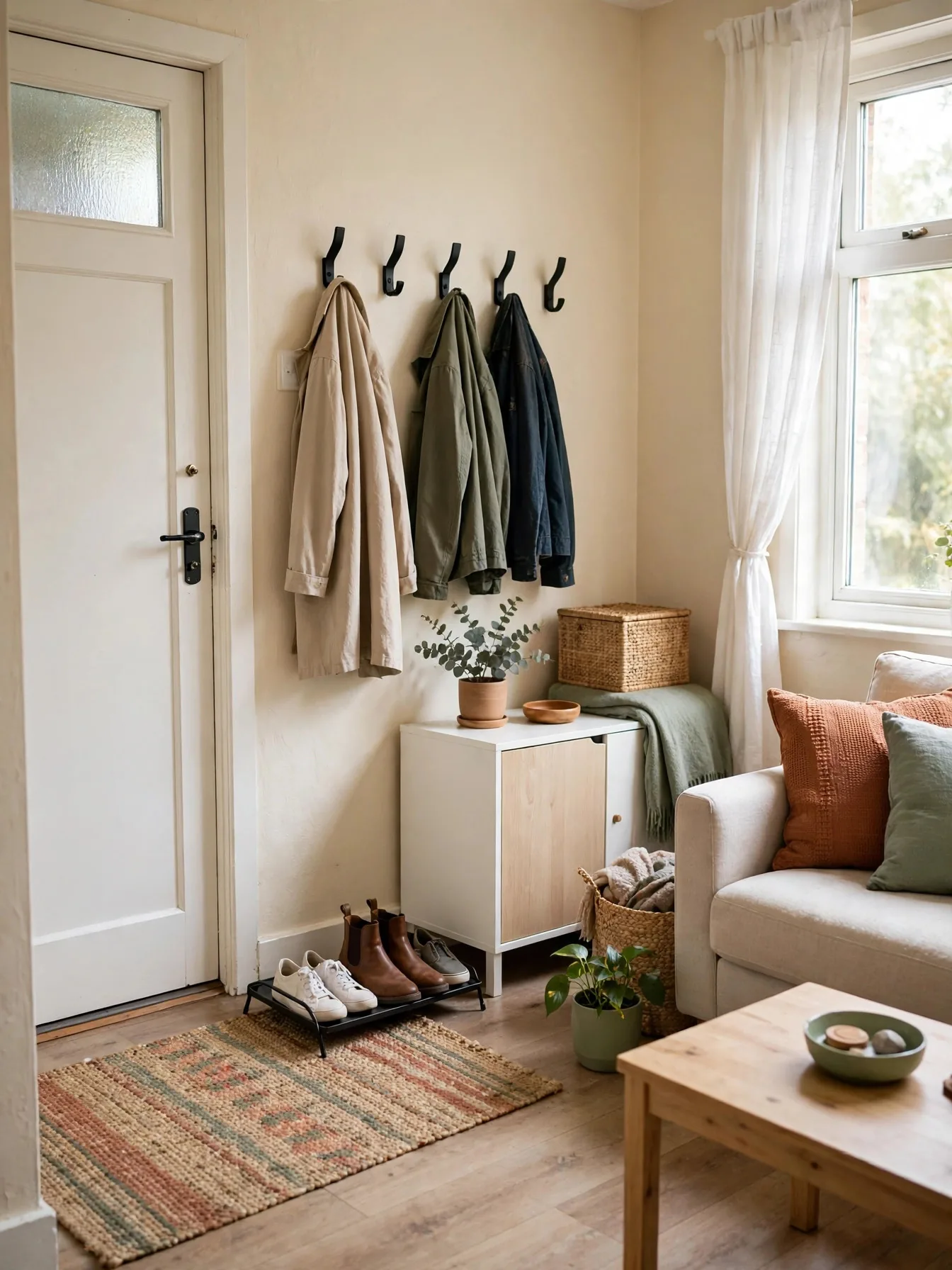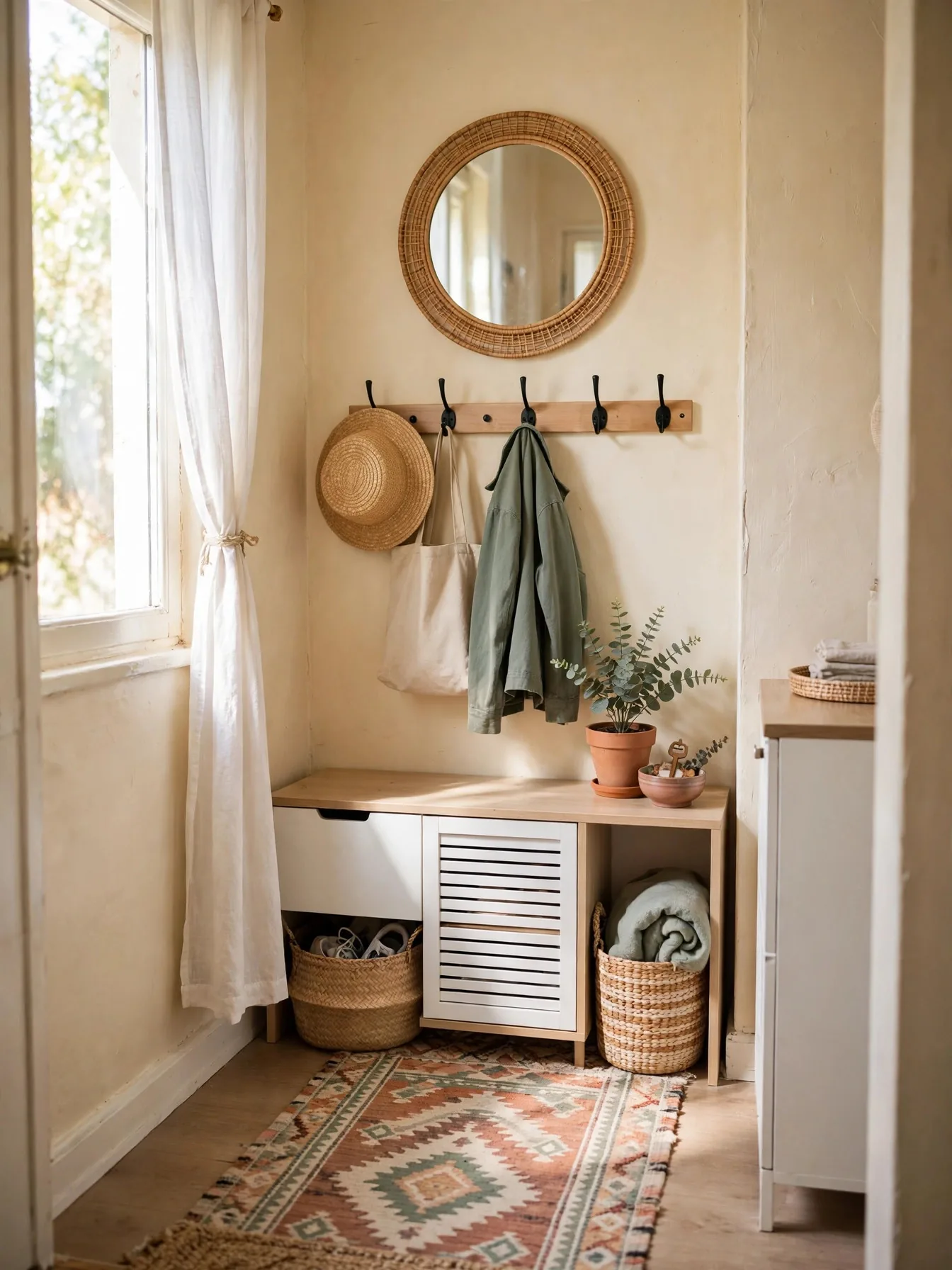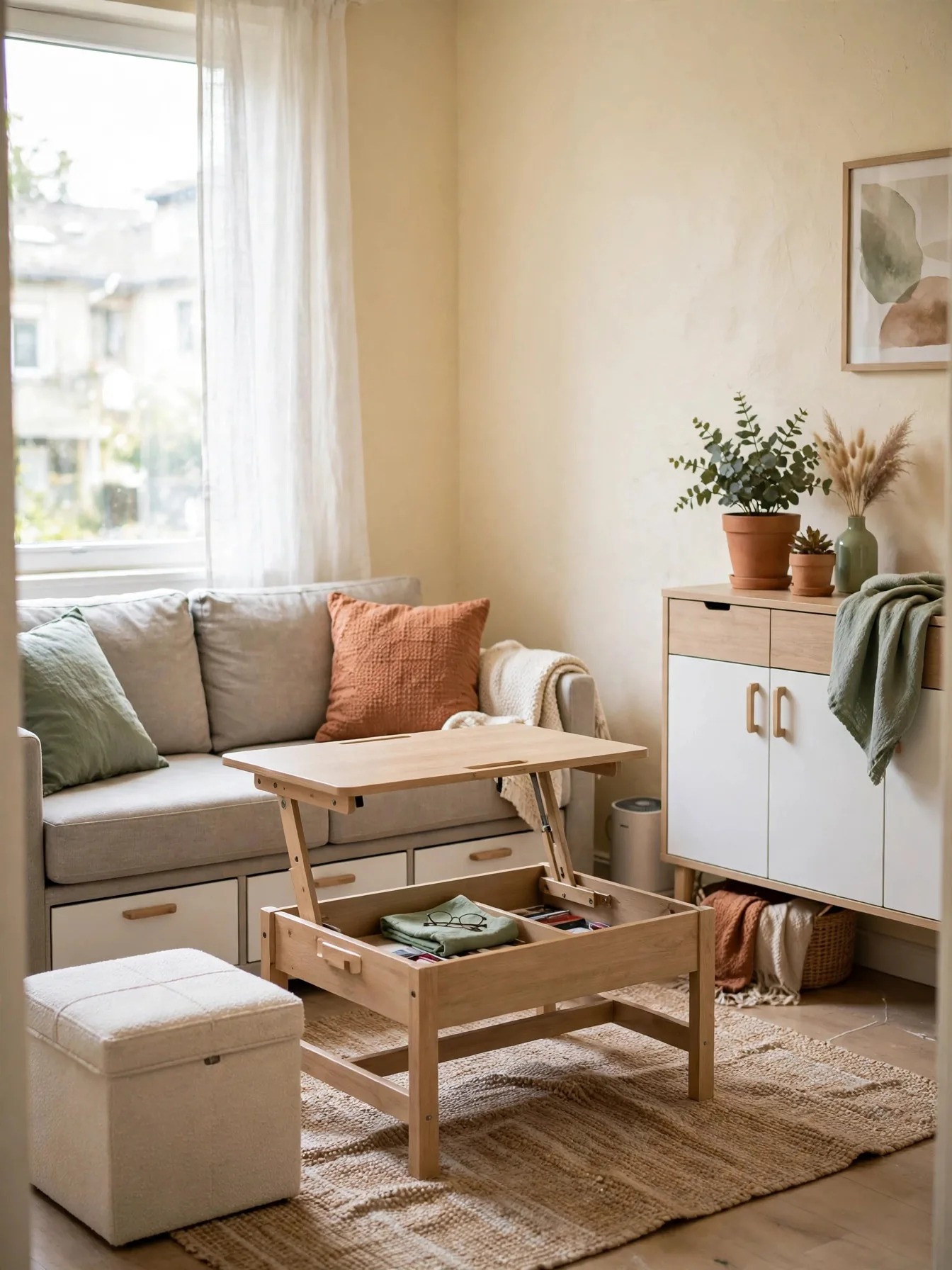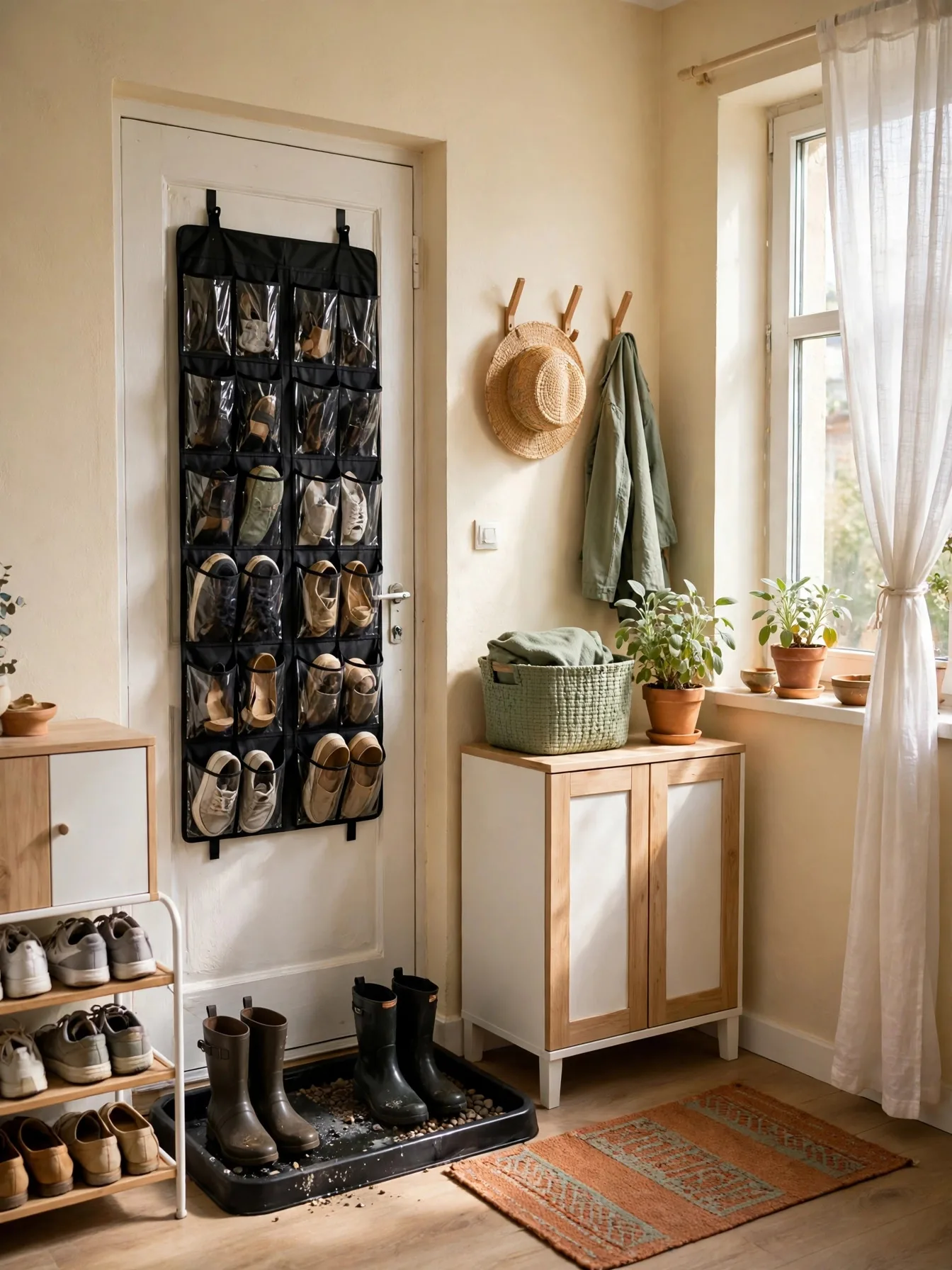
A rental living room with no built-ins is a blank box: four painted walls, no shelves, no cupboard, and nowhere for anything to go. The books stack on the floor, the blankets live permanently on the sofa, and the mail migrates across every flat surface. These living room storage ideas for a small rental with no built-ins start from one honest premise — when a room has no storage built into its walls, the storage has to be furniture-shaped. Every piece you bring in must earn its floor space twice: once as furniture, once as a container. Apartment Therapy’s storage workarounds for renters cover the same living-room problem.
That premise changes what you buy. Instead of a decorative coffee table, you buy one with a shelf or a lift top. Instead of an open TV stand, you buy a console with doors. And instead of scattering small organizers around the room, you audit the dead zones — the strip of floor behind the sofa, the corners nobody can use, the airspace under the coffee table, the wall behind the seating — and assign each one a single, properly sized piece. If the clutter starts at your front door rather than the sofa, work through our guide to rental apartment entryway storage ideas for small spaces first, and see our guide to multifunctional furniture for small rental living rooms for pieces that do three jobs at once.
Start With a Dead-Zone Audit, Not a Shopping Trip
Walk the room slowly and look for space that currently does nothing. In most small rental living rooms there are five dead zones: the 6–12 inches (15–30 cm) between the sofa back and the wall, the two corners flanking the sofa or the TV wall, the open volume under the coffee table, the stretch of wall above the sofa, and the floor space under and beside the TV stand. Measure each one — length, depth, and height — and write the numbers down before you look at a single product page. Storage furniture bought from a photo instead of a measurement is how renters end up with a bookcase that blocks a doorway.
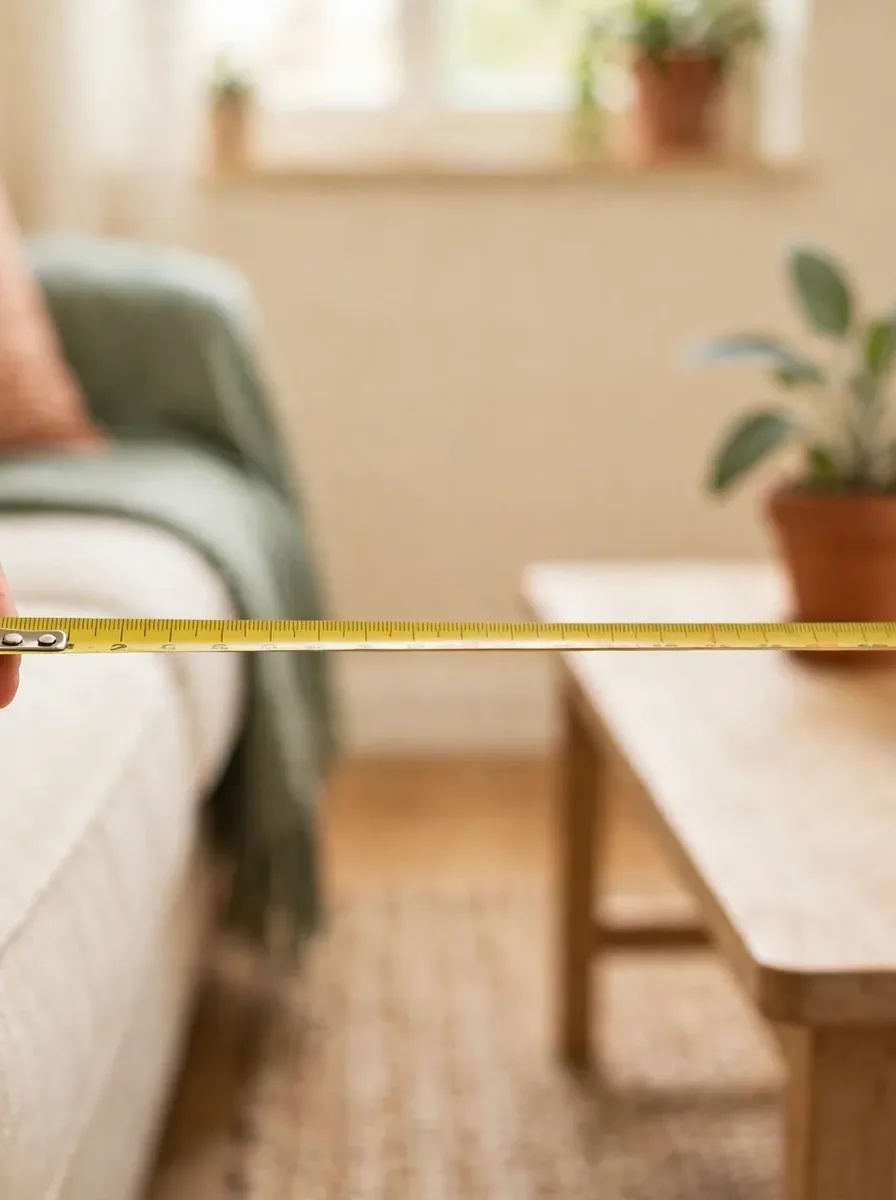
While you measure, note the constraints that will veto pieces later. Where are the heating vents, radiators, and baseboard heaters? Nothing upholstered or wooden should sit tight against a heat source, and blocking a vent with a console makes the room colder and the storage damp. Where do doors swing? A corner shelf that fits the corner but catches the door edge will annoy you daily. And where are the outlets? The behind-sofa console only becomes a charging station if there is an outlet within cord reach — otherwise it is a bookshelf with ambitions.
Finally, sort what actually needs storing into honest piles: daily items (remotes, chargers, the blanket in use), weekly items (board games, spare cushions, the good candles), and rare items (seasonal decor, gift wrap, the air mattress). Daily items get the easiest access — the ottoman, the coffee table shelf. Rare items get the awkward spots — the top of the bookcase, the back of the media console. Matching the pile to the zone is most of the system; the furniture is just the container.
Keep the audit in a note on your phone: zone measurements, pile sizes, and the veto list (vents, door swings, outlets). When a piece of furniture catches your eye in a store or a listing, you can check it against real numbers on the spot instead of guessing and hauling it home. This sounds like homework, but it takes twenty minutes once, and it is the difference between a room that gets steadily more organized and a room that accumulates almost-right furniture — the most expensive kind there is, because you pay for it twice: once at the till, and again in the floor space it wastes.
Behind and Above the Sofa: The Cheapest Square Footage in the Room
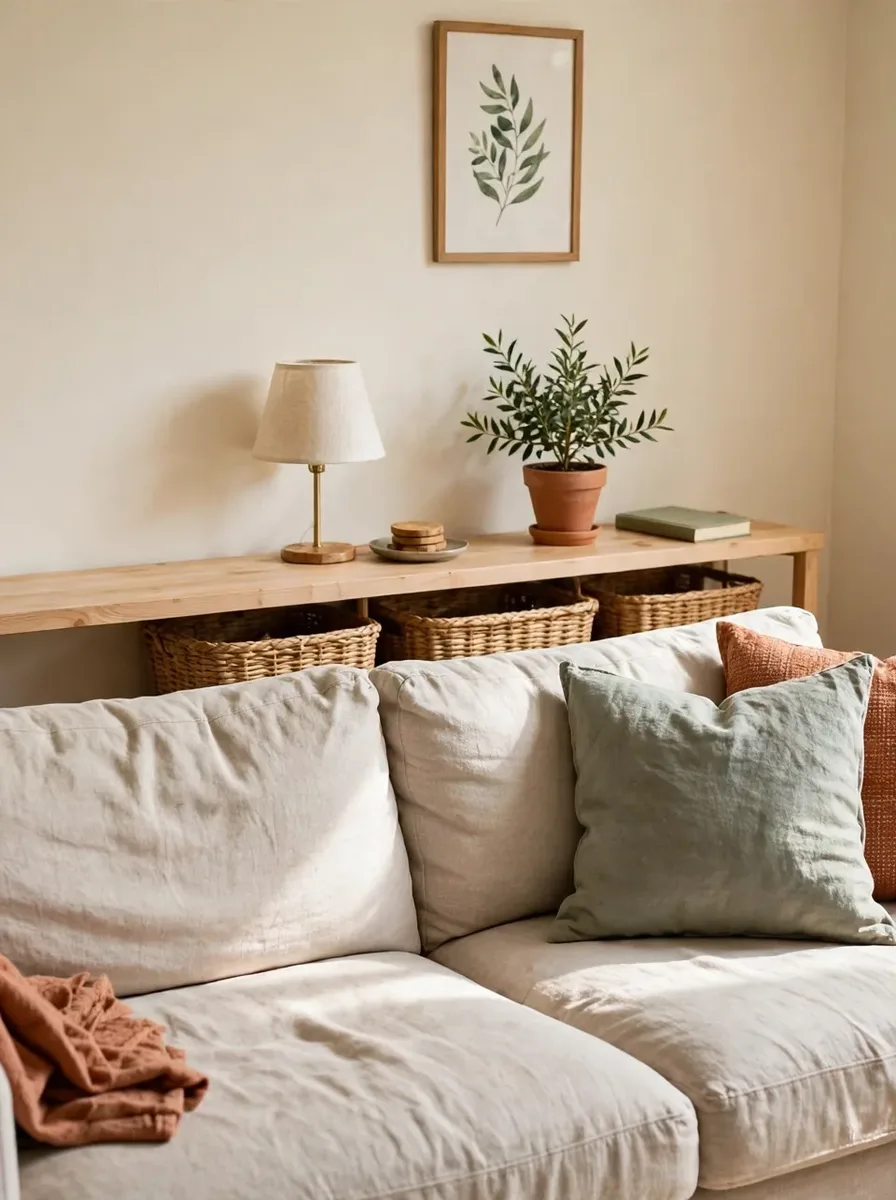
The strip of floor behind the sofa is the most underused storage real estate in a rental living room. Pull the sofa forward 6–12 inches (15–30 cm) and a slim console table — the kind sold as a sofa table, typically 8–12 inches (20–30 cm) deep, 48–60 inches (122–152 cm) long, and 30–33 inches (76–84 cm) tall, roughly level with the sofa back — drops into the gap. Expect to pay about $50–$130. The top surface holds a lamp (which frees the side table), a small tray for remotes and chargers, and the books in current rotation. Underneath, two low baskets hold blankets and games. The honest trade-off: you are spending room depth to buy storage. In a room where the sofa-to-TV distance is already tight, those 10 inches come straight out of your viewing distance and legroom, and the trade may not be worth it.
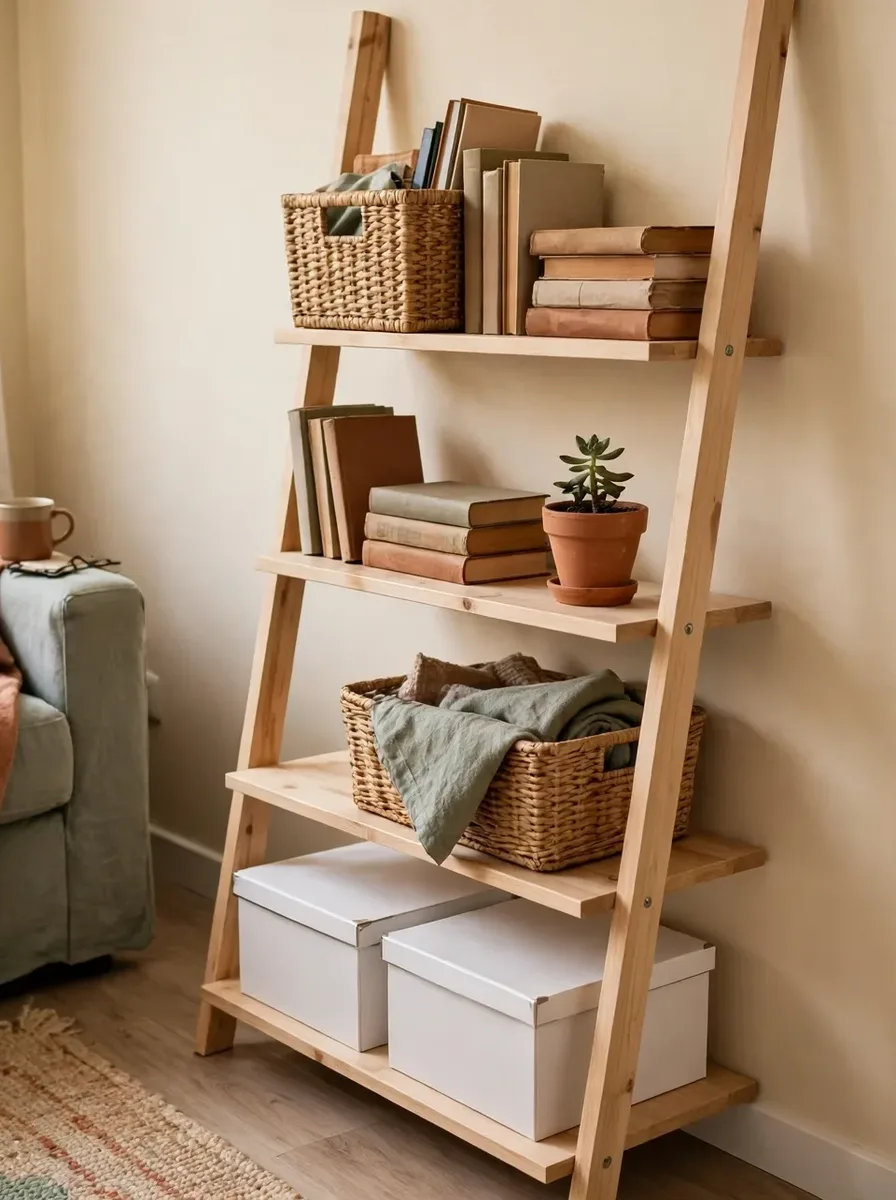
The wall above the sofa is the second half of this zone, and it needs an honest conversation. A leaning ladder shelf placed behind or beside the sofa uses the vertical space without any fixing at all: most are 16–24 inches (41–61 cm) wide, 60–72 inches (152–183 cm) tall, and 14–16 inches (36–41 cm) deep at the base, narrowing toward the top, for about $60–$150. The deep bottom shelves take baskets and books; the shallow top shelves take plants and decor. Because it leans, it must sit on a level floor against a flat wall, and the top shelves should never hold anything heavy — a leaning shelf is a display piece with storage benefits, not a bookcase.
A fixed floating shelf above the sofa is a different matter. It requires screws, which means written landlord permission in most leases — get it in writing, or skip it. Never store heavy or breakable items on any shelf mounted above seating, and keep the underside of anything above a sofa at least 24 inches (61 cm) above the seat cushion so a standing-up head clears it. Without permission, the renter-safe way to use that wall is a tall bookcase beside the sofa (covered below) and art hung on removable strips — decor, not storage.
Required space: The strip behind the sofa — pull it forward 6–12 in (15–30 cm) — for a console 8–12 in deep, plus the wall above or beside the sofa for a leaning ladder shelf.
Installation: Slide the console into the gap behind the sofa and set two low baskets underneath, and place the ladder shelf on a level floor against a flat wall, keeping its top shelves light.
Approximate dimensions: Consoles are typically 8–12 in deep × 48–60 in long × 30–33 in tall (20–30 × 122–152 × 76–84 cm), and ladder shelves 16–24 in wide × 60–72 in tall × 14–16 in deep at the base.
Rental-friendly limits: Both pieces are freestanding with no fixing at all. A fixed floating shelf above the sofa needs screws and written landlord permission, so skip it without that permission.
Pros: The console top holds a lamp, a tray and books in rotation while baskets underneath hold blankets and games, and the ladder shelf uses vertical space the room was wasting.
Cons: Those 10 inches behind the sofa come straight out of viewing distance and legroom, and a leaning shelf is a display piece with storage benefits, not a bookcase.
Suitable products: Slim sofa console tables, low baskets, and leaning ladder shelves.
The Middle of the Room: The Ottoman and the Coffee Table
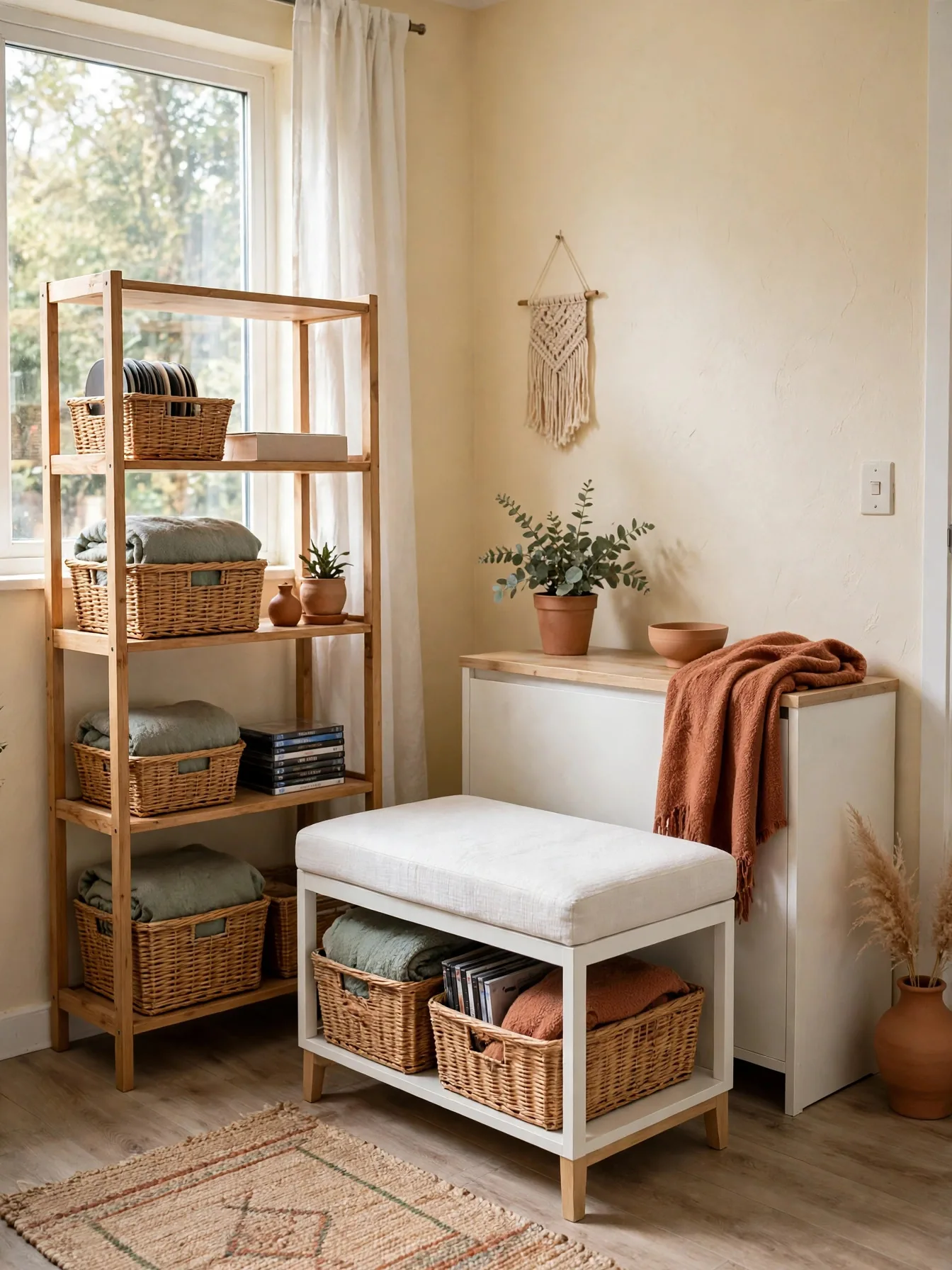
A storage ottoman is the hardest-working cheap piece in a rental living room. A cube ottoman runs 16–18 inches (41–46 cm) square; a bench ottoman runs 30–40 inches (76–102 cm) long; both stand 15–18 inches (38–46 cm) tall and hold roughly 2–3 cubic feet inside — two to three folded blankets, or the full remote/charger/board-game tangle. Prices run about $40–$120. Used as a coffee table with a tray on top, it replaces a whole piece of furniture; used as extra seating, check the lid’s stated weight rating — most sit-able lids are rated by the manufacturer for around 200–250 lb (91–113 kg), and that figure assumes an evenly spread load, not someone perching on an edge.

The ottoman’s weakness is that it becomes a junk drawer with a lid. Keep it to one category — blankets and evening clutter — and it stays useful. The moment it holds blankets, tax documents, and a toolbox, it holds nothing well.
The sofa’s flanks deserve the same treatment. A standard end table is a small tabletop on legs — mostly air. An end table with a drawer and a lower shelf, typically 14–18 inches (36–46 cm) wide and 22–26 inches (56–66 cm) tall for about $40–$90, holds the same lamp and drink on top while hiding chargers, coasters, and the current book below. A C-shaped side table that slides over the sofa arm is the zero-floor-space option: no storage inside, but it frees the end table spot for a basket of blankets instead. In a room this size, trading air for a drawer at both ends of the sofa quietly absorbs most of the daily clutter before it ever reaches the coffee table.
If you keep a real coffee table, its underside is a dead zone with a roof. A table with a lower shelf, typically 10–12 inches (25–30 cm) of clearance above the floor, takes two woven baskets of about 12 × 12 × 8 inches (30 × 30 × 20 cm) each — one for blankets, one for games or magazines. Baskets cost about $10–$25 each. A lift-top coffee table (about $100–$250) hides a shallow compartment sized for remotes, coasters, and a laptop, and the rising top doubles as a work-from-sofa desk. The trade-off with both: anything stored at floor level collects dust faster, so give the under-table zone to washable or wipeable things, not paperwork.
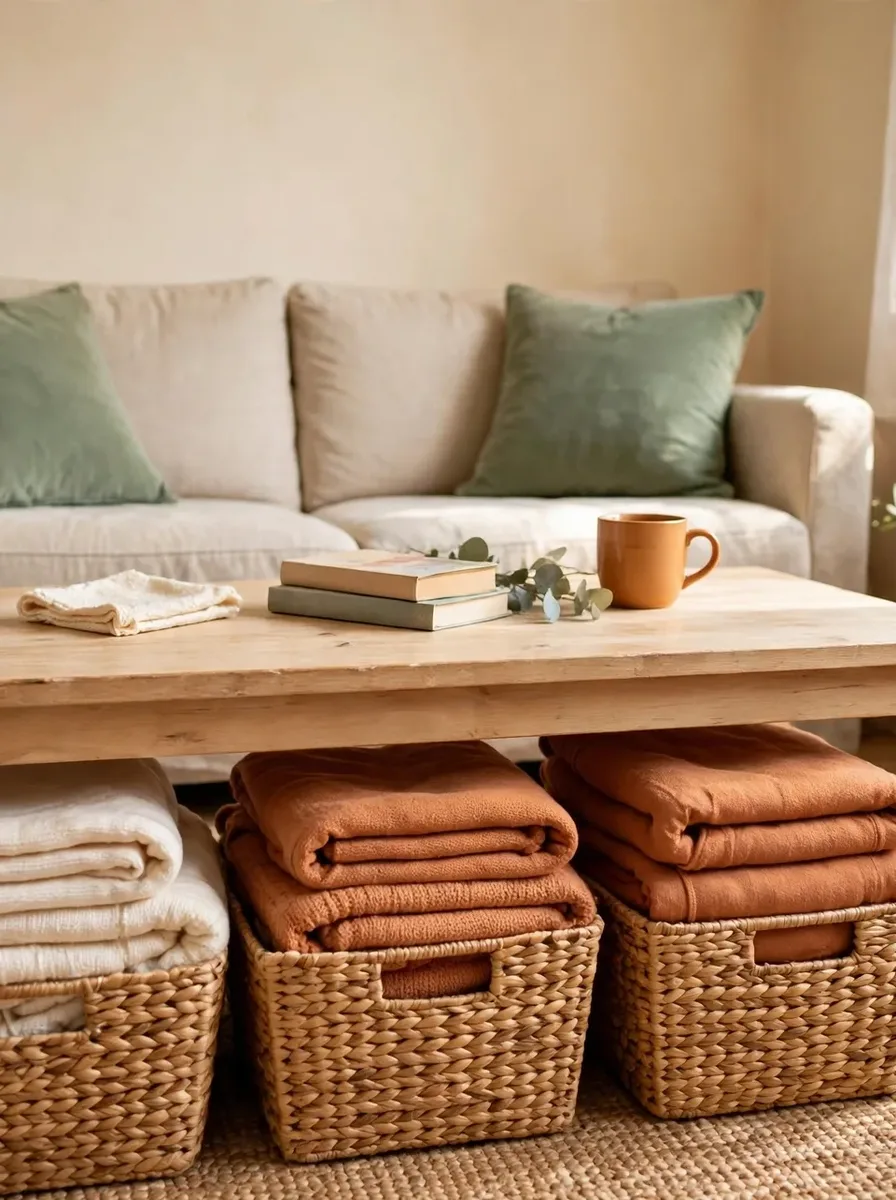
Required space: The middle of the room — a cube ottoman 16–18 in square or a bench 30–40 in long, and the 10–12 in of clearance under a coffee table for two baskets.
Installation: Use the ottoman as a coffee table with a tray on top, set baskets of about 12 × 12 × 8 in under the coffee table’s lower shelf, and keep the ottoman to one category so it does not become a junk drawer with a lid.
Approximate dimensions: Cube ottomans run 16–18 in (41–46 cm) square and bench ottomans 30–40 in (76–102 cm) long, both 15–18 in tall, holding roughly 2–3 cubic feet inside. Under-table baskets are about 12 × 12 × 8 in (30 × 30 × 20 cm).
Rental-friendly limits: Every piece here is freestanding furniture with nothing fixed to the walls, and each can leave with you on move-out day.
Pros: An ottoman replaces a whole piece of furniture as a coffee table or extra seating, and a lift-top table hides a shallow compartment and doubles as a work-from-sofa desk.
Cons: An ottoman becomes a junk drawer with a lid the moment it holds more than one category, and anything stored at floor level collects dust faster.
Suitable products: Storage ottomans, end tables with a drawer and lower shelf, C-shaped side tables, and lift-top coffee tables.
Corners and Short Walls: Bookcases and Corner Shelves
Corners are where small rooms hide their spare capacity. A corner shelf unit — triangular or quarter-round shelves on a frame, usually 12–16 inches (30–41 cm) of radius and 48–65 inches (122–165 cm) tall, about $40–$110 — turns the dead angle behind an armchair into display and basket storage. Be realistic about capacity: corner shelves hold less than their photos suggest, because each triangular shelf loses its back point to the wall angle. They suit plants, paperbacks, and small baskets, not bulk storage.
For real capacity on a short wall, a tall narrow bookcase beats a wide low one in most small rooms: 24–31 inches (61–79 cm) wide, about 12 inches (30 cm) deep, and 60–72 inches (152–183 cm) tall, for about $60–$160. Five shelves of that width hold a serious amount — books on two, fabric bins on two, display on one. The non-negotiable with any tall piece is tipping: load the heaviest items on the bottom two shelves, keep the top shelf light, and push the unit flush to the wall. Manufacturers supply anti-tip straps meant to be screwed into a stud; if your lease forbids screws, an adhesive anti-tip strap is better than nothing but is not equivalent — it is a supplement to sensible loading, not a substitute for it, and in a home with climbing toddlers the honest answer is a low, wide unit instead.
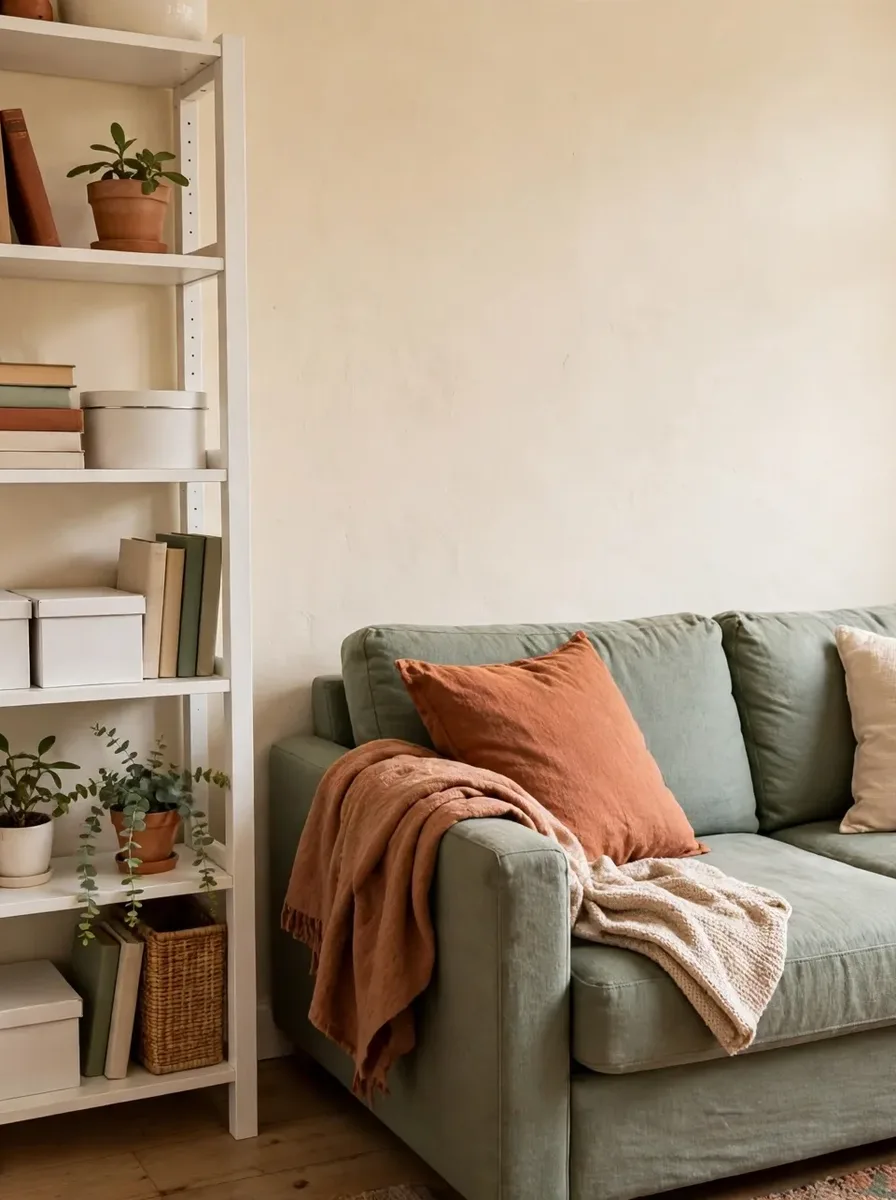
Place tall pieces on the same wall where possible. One wall of vertical storage reads as a deliberate library wall; tall pieces scattered on three walls make the room feel like it is closing in.
Required space: A corner with 12–16 in (30–41 cm) of radius for a corner unit, or a short wall about 24–31 in (61–79 cm) wide for a tall narrow bookcase.
Installation: Push the bookcase flush to the wall, load the heaviest items on the bottom two shelves and keep the top shelf light, and keep tall pieces on the same wall so they read as one library wall.
Approximate dimensions: Corner units are usually 12–16 in of radius and 48–65 in tall (30–41 × 122–165 cm). Tall narrow bookcases are 24–31 in wide, about 12 in deep and 60–72 in tall (61–79 × 30 × 152–183 cm).
Rental-friendly limits: No screws are needed for the freestanding pieces, but an adhesive anti-tip strap is a supplement to sensible loading, not a substitute for a screwed strap — in a home with climbing toddlers the honest answer is a low, wide unit instead.
Pros: Five shelves of a narrow bookcase hold a serious amount — books on two, fabric bins on two, display on one — and a corner unit turns a dead angle into display and basket storage.
Cons: Corner shelves hold less than their photos suggest because each triangular shelf loses its back point, and a tall top-heavy bookcase is a tip hazard.
Suitable products: Corner shelf units and tall narrow bookcases with fabric bins.
Under the TV: The Case for a Closed Media Console
The TV wall is usually the biggest storage opportunity in the room, and the most common mistake is an open stand that displays every cable, console, and router you own. A low media console with doors or drawers — typically 48–60 inches (122–152 cm) wide, 15–18 inches (38–46 cm) deep, and 20–24 inches (51–61 cm) tall, about $120–$300 — hides all of it in one footprint. Check the interior shelf height against your tallest device before buying, and choose a unit with an open back or cable cut-outs: game consoles and streaming boxes need airflow, and a sealed cabinet with the door shut will cook them slowly.
If a $120–$300 console is out of reach this year, the budget stand-in is a cube organizer laid on its long side under the TV: two rows of cubes, fabric bins in half of them, devices in the open half where they can breathe. A 4 × 2 cube unit is about 48 inches (122 cm) wide and 30 inches (76 cm) tall and costs roughly $50–$90. It is less elegant than a console — the bins read as “organizer” rather than “furniture” — and the open cubes still show their contents, but as a one-season bridge it holds nearly as much, and the bins transfer straight into a bookcase later. What does not work as a stand-in is a folding camp table or a bare TV stand with a curtain rod of stuff beneath it: if the storage looks temporary, the room feels temporary, and in a rental you live with that feeling every day.
Inside, assign one side to devices and one side to the living-room overflow that has no other home: spare batteries, the candle stash, board games too big for the ottoman. A small cable-management box (about $15–$25) inside or behind the console tames the power strip. Keep the top surface disciplined — TV, one plant or speaker pair, nothing else — because a clear console top is what makes the whole room look stored rather than stacked. Our full living room and entryway storage hub collects the companion guides for the rest of this category, including what to do when shoes pile up by the door — see small apartment shoe storage without drilling for that specific fix.
Required space: The TV wall, for a console 48–60 in (122–152 cm) wide and 15–18 in (38–46 cm) deep, or a 4 × 2 cube unit laid on its long side at about 48 in wide.
Installation: Check the interior shelf height against your tallest device before buying, choose a unit with an open back or cable cut-outs, and assign one side to devices and one side to living-room overflow.
Approximate dimensions: Consoles are typically 48–60 in wide × 15–18 in deep × 20–24 in tall (122–152 × 38–46 × 51–61 cm), and a 4 × 2 cube unit is about 48 in wide and 30 in tall.
Rental-friendly limits: The console is freestanding with nothing fixed to the wall, and it leaves with you at move-out.
Pros: One footprint hides every cable, console and router, and a cube unit holds nearly as much as a one-season bridge with bins that transfer straight into a bookcase later.
Cons: A sealed cabinet with the door shut will cook game consoles slowly, and open cubes still show their contents.
Suitable products: Low closed media consoles, cube organizers with fabric bins, and cable-management boxes.
Layout Rules: Walkways, Sight Lines, and Light
Storage furniture fails when it ignores how the room is used. Three numbers govern a small living room layout. Main walkways — door to sofa, sofa to kitchen — need at least 30 inches (76 cm), and 36 inches (91 cm) is noticeably more comfortable; a bookcase that narrows a walkway below 30 inches will be bumped daily and resented weekly. The sofa-to-coffee-table gap should be 14–18 inches (36–46 cm): closer than 14 and knees collide; farther than 18 and you cannot reach your drink without standing. And tall storage (over about 48 inches / 122 cm) belongs against walls, never floating mid-room where it blocks light and sight lines.
Sight lines matter as much as square inches. From the sofa, you should be able to see over everything except the designated tall wall. Low pieces — consoles, ottomans, benches — under the window line keep daylight moving through the room, which is what makes a small rental feel bigger than its floor plan. Closed storage helps here too: a room where every stored thing is behind a door or under a lid reads as calm, while the same volume on open shelves reads as clutter, even when it is tidy clutter.
The Zones, Side by Side
| Zone | Best piece | Typical size | Approx. cost | Watch out for |
|---|---|---|---|---|
| Behind the sofa | Slim console table + baskets | 48–60 in long, 8–12 in deep (122–152 × 20–30 cm) | $50–$130 + baskets | Eats viewing distance; check vents and outlets |
| Above/beside sofa | Leaning ladder shelf | 16–24 in wide, 60–72 in tall (41–61 × 152–183 cm) | $60–$150 | Top shelves are shallow; display weight only |
| Middle of room | Storage ottoman | 16–18 in cube or 30–40 in bench (41–46 / 76–102 cm) | $40–$120 | Becomes a junk drawer without a single category |
| Under coffee table | Baskets on a lower shelf | ~12 × 12 × 8 in each (30 × 30 × 20 cm) | $10–$25 each | Floor-level dust; washable items only |
| Corners | Corner shelf unit | 12–16 in radius, 48–65 in tall (30–41 × 122–165 cm) | $40–$110 | Holds less than it looks; light items |
| Short wall | Tall narrow bookcase | 24–31 in wide, 60–72 in tall (61–79 × 152–183 cm) | $60–$160 | Tip risk — load the bottom, keep top light |
| TV wall | Closed media console | 48–60 in wide, 20–24 in tall (122–152 × 51–61 cm) | $120–$300 | Devices need airflow; check shelf heights |
An Honest Word on Walls, Adhesive, and Permission
Because this site’s whole method is renter-safe storage, the wall question deserves a straight answer — the same standard we describe on our how we test page. Adhesive strips and hooks carry manufacturer ratings (large picture strips are commonly rated by their makers at up to about 16 lb / 7.2 kg per set) that assume a clean, smooth, fully cured painted surface and a full 24-hour cure before loading. Painted rental drywall is often none of those things: matte and flat paints bond weakly, textured walls reduce contact, and steam or heat softens adhesive. The typical failure is not the strip letting go — it is the strip taking a coin-sized patch of paint with it, and paint damage is exactly what deposits get charged for. Our rule: adhesive for light decor and cable clips only, never for a shelf holding real weight.
If your lease allows small nail holes or your landlord agrees in writing to a screwed shelf or anti-tip anchor, that permission is worth more than any adhesive product — a single stud anchor outperforms every strip on the market. Ask; the worst answer is no, and “no” still leaves you every freestanding option in this guide.
Traps to Avoid
Buying storage before auditing. A beautiful bookcase that does not fit the one free wall is a return label waiting to happen. Measure the zones first; shop second.
Five small pieces instead of two big ones. Small organizers scattered around a small room multiply visual noise and hold less in total than one console and one bookcase. Consolidate.
Open storage for ugly things. Open shelves are for objects you enjoy looking at. Chargers, paperwork, and game boxes go behind doors and lids, or the room never looks tidy no matter how organized it is.
Blocking heat and air. Consoles tight against radiators, baskets over floor vents, media cabinets with no airflow — each one trades storage for a colder room, a fire risk, or a dead console.
Ignoring the tip risk. A tall, top-heavy bookcase in a rental is a hazard, not a hack. Heavy low, light high, flush to the wall — and if kids climb, go low and wide instead.
Storing daily items in the hardest place. The blanket you use every night does not belong on the top shelf of the bookcase. Match access to frequency and the system survives; fight it and the piles come back within a week.
From the Cozy Tiny Space shop
Planning a living room layout? Do it on paper first
Small-Space Furniture Layout Kit — scale grids, furniture cut-outs, and worked sample layouts for small living rooms · $9
Putting It Together on Three Budgets
Starter (about $40–$100): one storage ottoman and two coffee-table baskets. This clears the sofa, the remotes, and the floor pile — the three things that make the room look messy.
Middle (about $150–$220): add a behind-sofa console with baskets, or a ladder shelf if the room cannot spare the depth. Now the books, chargers, and games have homes too.
Full system (about $280–$300): add the closed media console, or swap the ladder shelf for a tall narrow bookcase if your clutter is mostly books and bins. At this point the room holds roughly a small closet’s worth of belongings, every bit of it freestanding, and every piece can leave with you on move-out day — which, in a rental, is the whole point.