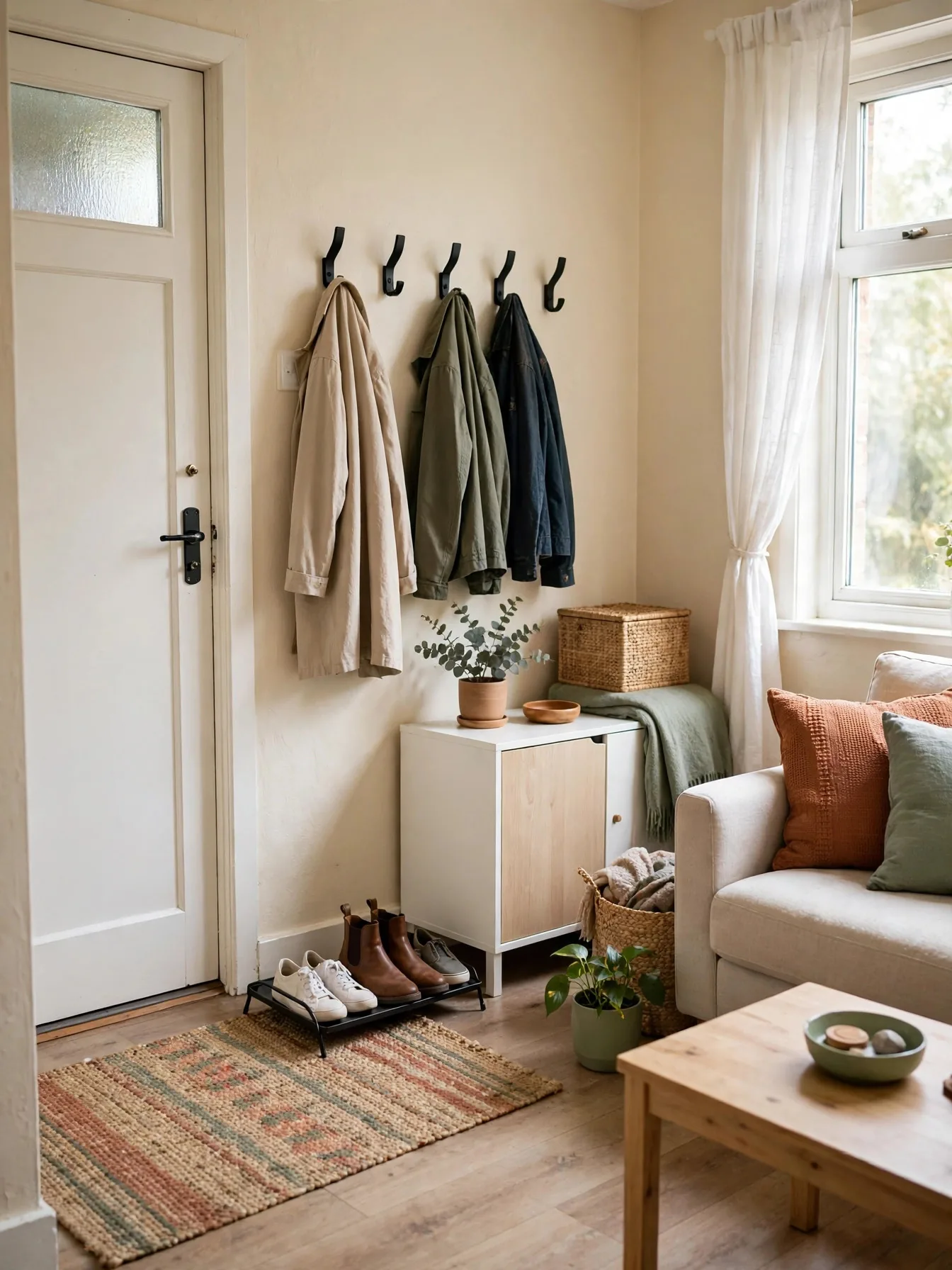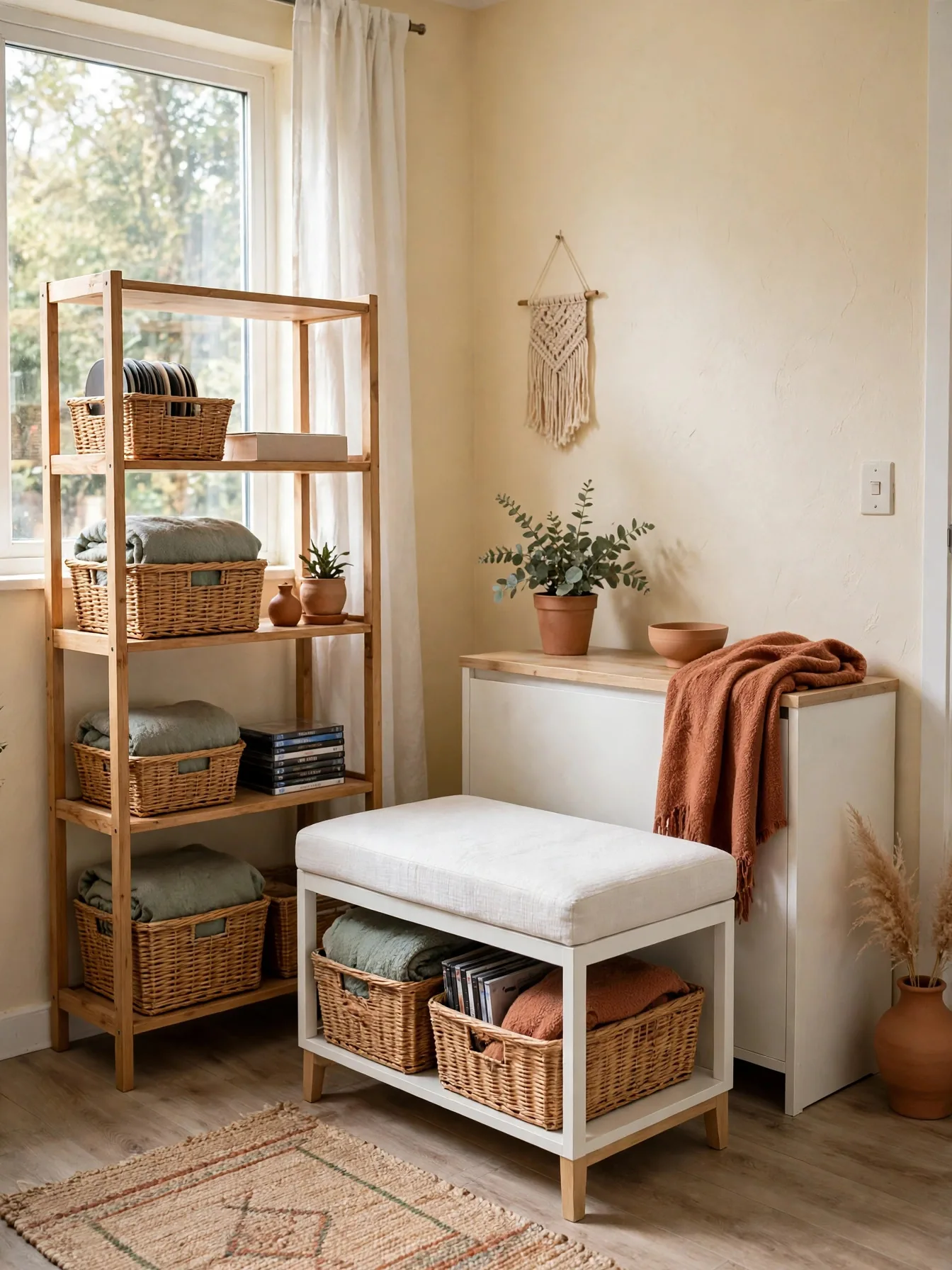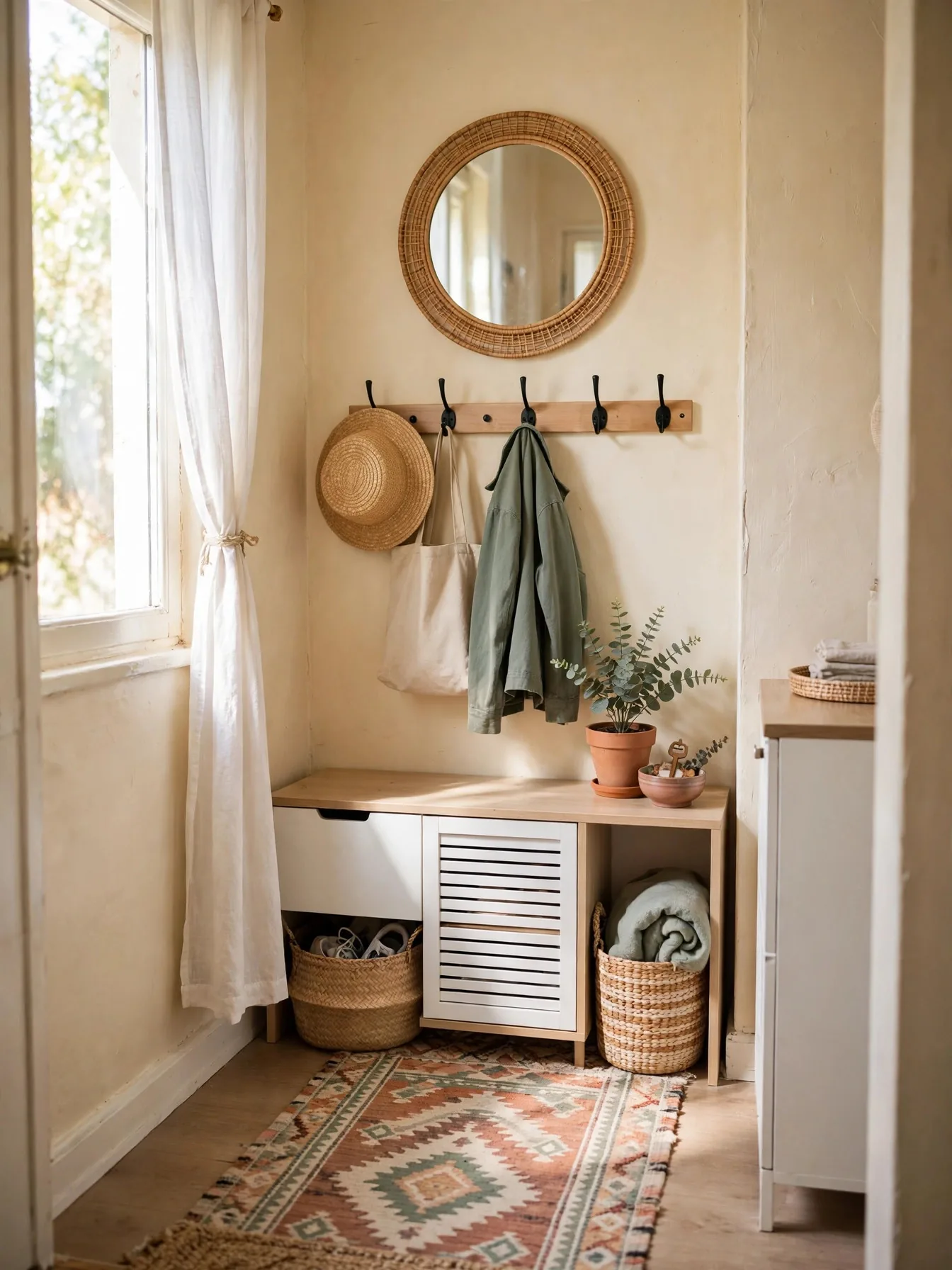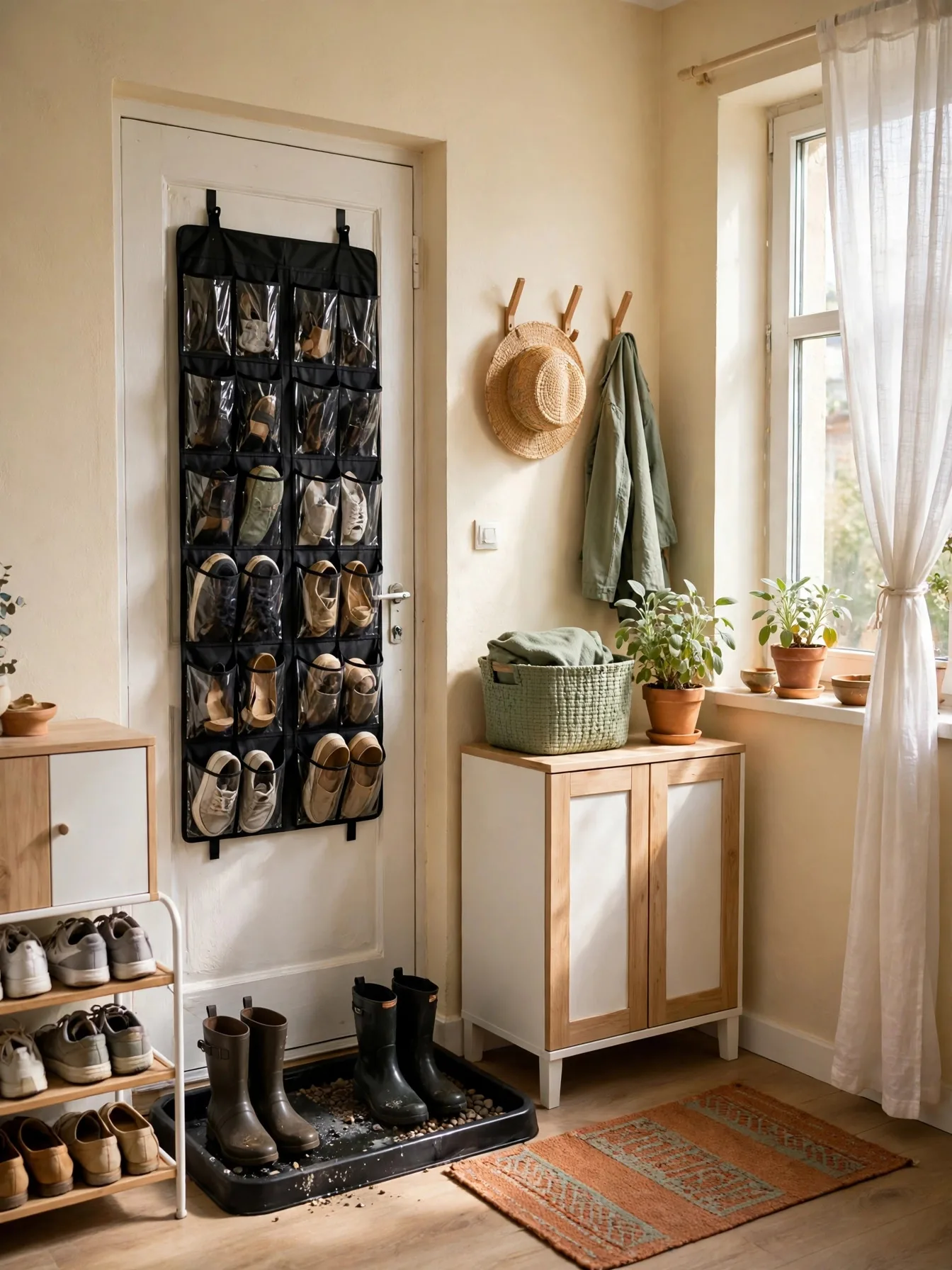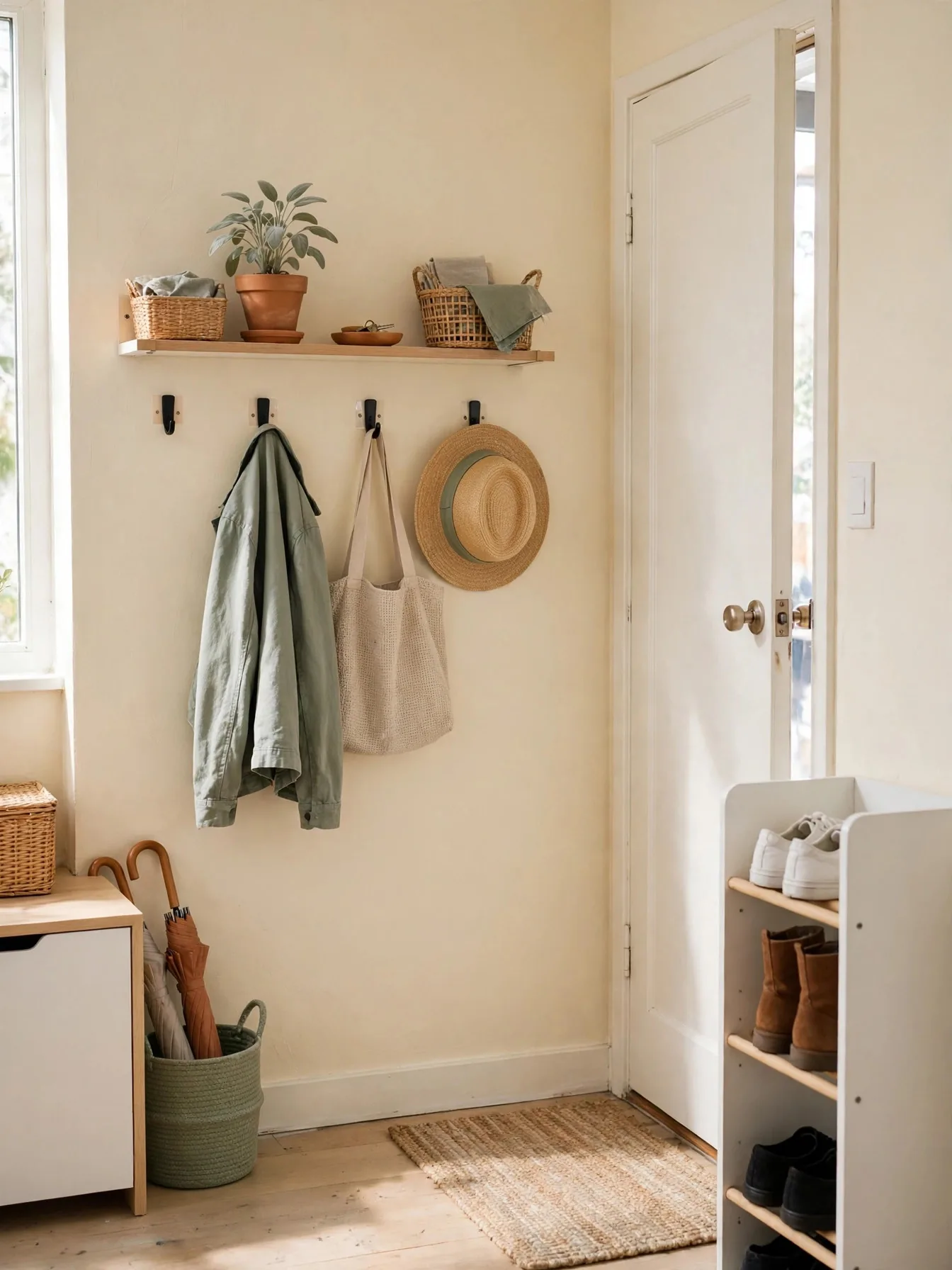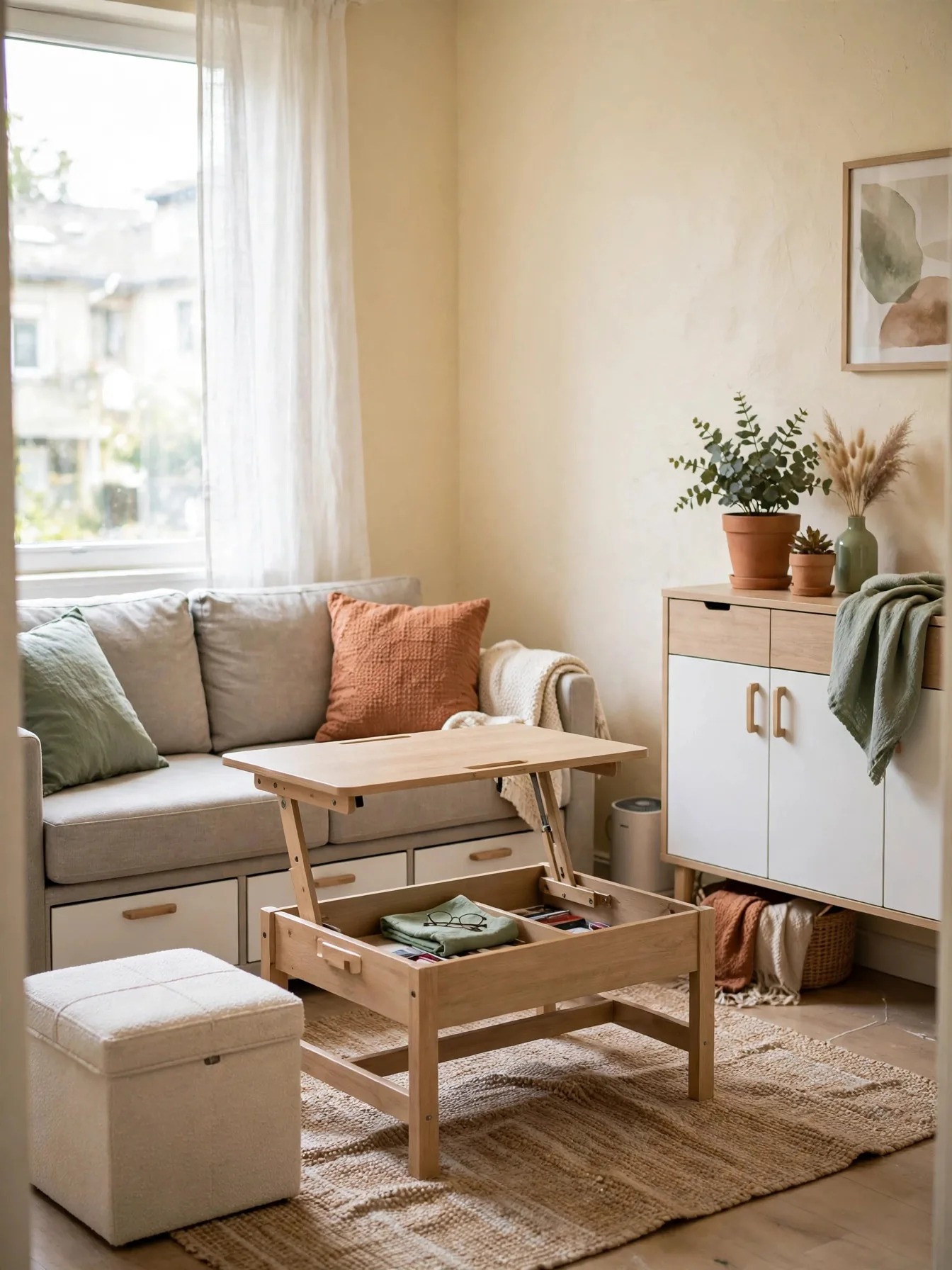
In a small rental living room, floor space is the one thing you cannot buy more of. The room has to be a lounge in the evening, an office at nine in the morning, a dining room when friends visit, and a guest room twice a year — all inside the same 120 or so square feet. That is why multifunctional furniture is the core strategy for a small living room rental: not more furniture, but fewer pieces that each do two or three jobs honestly. For more double-duty pieces, browse IKEA’s small-space living range.
This guide judges every piece the same way — by how many real jobs it does per square foot of floor it takes, and by whether it obeys rental rules. Everything here is freestanding: nothing is bolted, anchored, or screwed to a wall, nothing needs landlord approval, and everything can leave through the front door on move-out day. If you are still deciding how the room should store things in the first place, start with our guide to living room storage ideas for small rentals with no built-ins, then come back here for the pieces that do the heavy lifting.
The Two-Job Rule: Judge Every Piece by Jobs Per Square Foot
Before any individual piece, you need a way to judge. Ours is simple: count the jobs a piece genuinely does, then divide by the floor space it occupies. A storage ottoman that works as a footrest, a seat, a tray table, and a blanket box is doing four jobs in about 2.2 square feet (0.2 m²). A decorative side table does one job in the same space. In a big house that difference is trivia. In a small rental it is the whole game.
Two honest limits on the rule. First, a job only counts if you will use it weekly — a dining table that seats six sounds like a job, but if you eat on the sofa five nights a week, it is a 12-square-foot ornament. Second, the score is a guide, not a verdict: a sofa bed scores terribly on jobs per square foot, yet it can still be the right buy because it replaces an entire guest room. We score everything in the comparison table further down, and we explain how we test and judge storage furniture if you want the full method.
One more piece of honest maths: measure the footprint in working mode, not storage mode. A drop-leaf table is 3 square feet closed and 10 square feet open; a sofa bed is a sofa until the evening it becomes 17 square feet of bed. The closed number tells you what the piece costs on an ordinary day. The open number tells you whether the room still functions on the day you actually use the second job. A piece only passes the two-job rule if both numbers fit your life — the room has to work with the bed out, the leaves up, and the lift-top raised, not just with everything folded away.
Then there are the rental rules, which override everything:
- No wall fixing. Every piece in this guide stands on the floor. If a “space-saving” product needs anchors, screws, or adhesive strips rated for permanent loads, it is not rental furniture — it is a deposit risk.
- Protect the floor. Fit felt pads under every leg and foot before the piece takes weight. Hard feet on laminate or hardwood will scratch, and scratches come out of deposits. Pads cost a few dollars; refinishing does not.
- Pass the move-out test. Measure your front door (most are 30–32 inches / 76–81 cm wide), any hallway turn, and any stairwell before you buy — not when the delivery driver is standing there. Then check the weight. A piece one person can carry (under about 50 lb / 23 kg) is a different commitment from a 180 lb (82 kg) sofa bed that needs two people and a free Saturday.
- Leave walking room. Keep at least 30 inches (76 cm) of clear path between major pieces, and never let an open sofa bed or a pulled-out table block the route to the door or the kitchen.
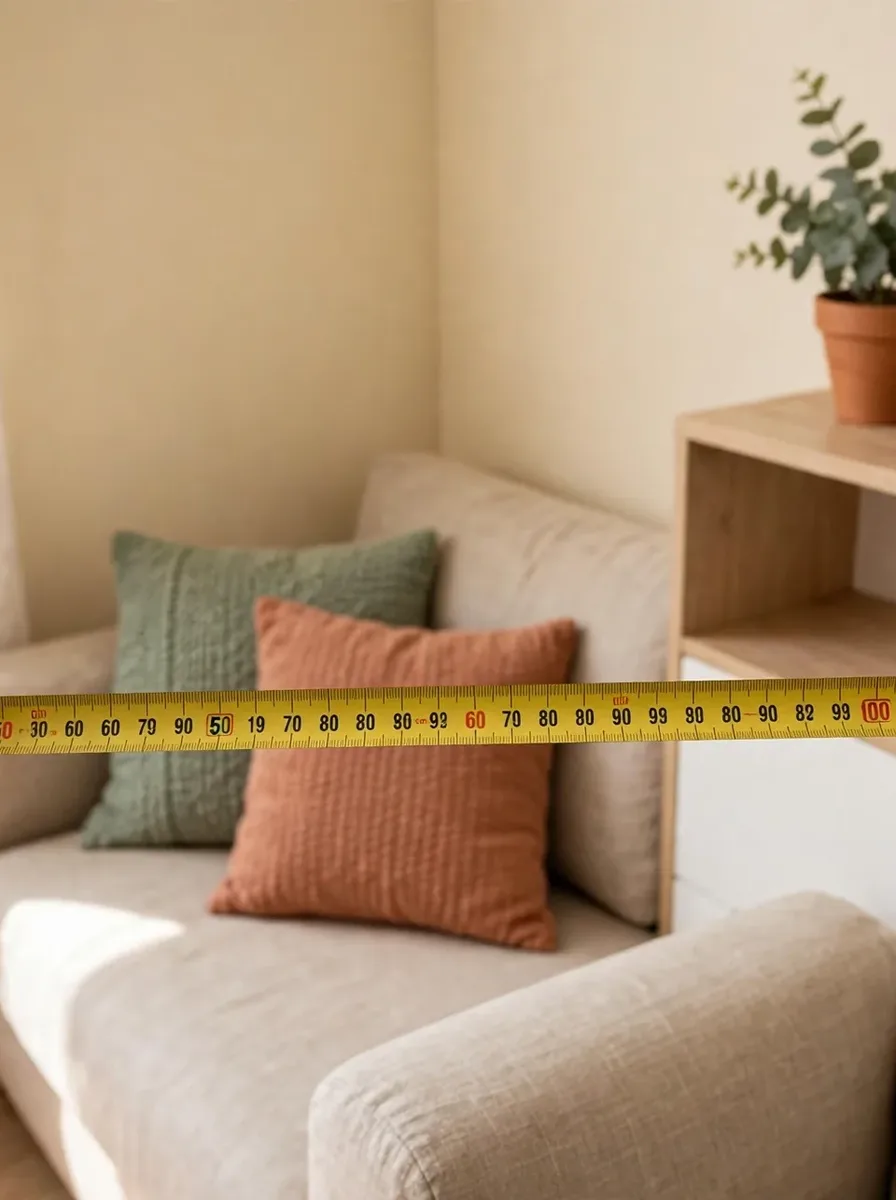
Measure the corner, tape the footprint on the floor with painter’s tape, and live with the tape for a day. It is the cheapest mistake you will ever avoid.
Sit + Store: Storage Ottomans and Storage Benches
The sit-and-store pair is where multifunctional furniture earns its reputation, because seating is the one thing every living room already has — the trick is making it hollow.
The storage ottoman
A typical cube ottoman is 16–18 inches (41–46 cm) square and 15–18 inches (38–46 cm) tall, with roughly 2–3 cubic feet (57–85 litres) of storage inside — enough for two or three throw blankets, a games stack, or every charger and remote you own. Bench styles run 30–48 inches (76–122 cm) long if you have the wall space. Prices are gentle: about $40–$120 for most fabric and faux-leather models.
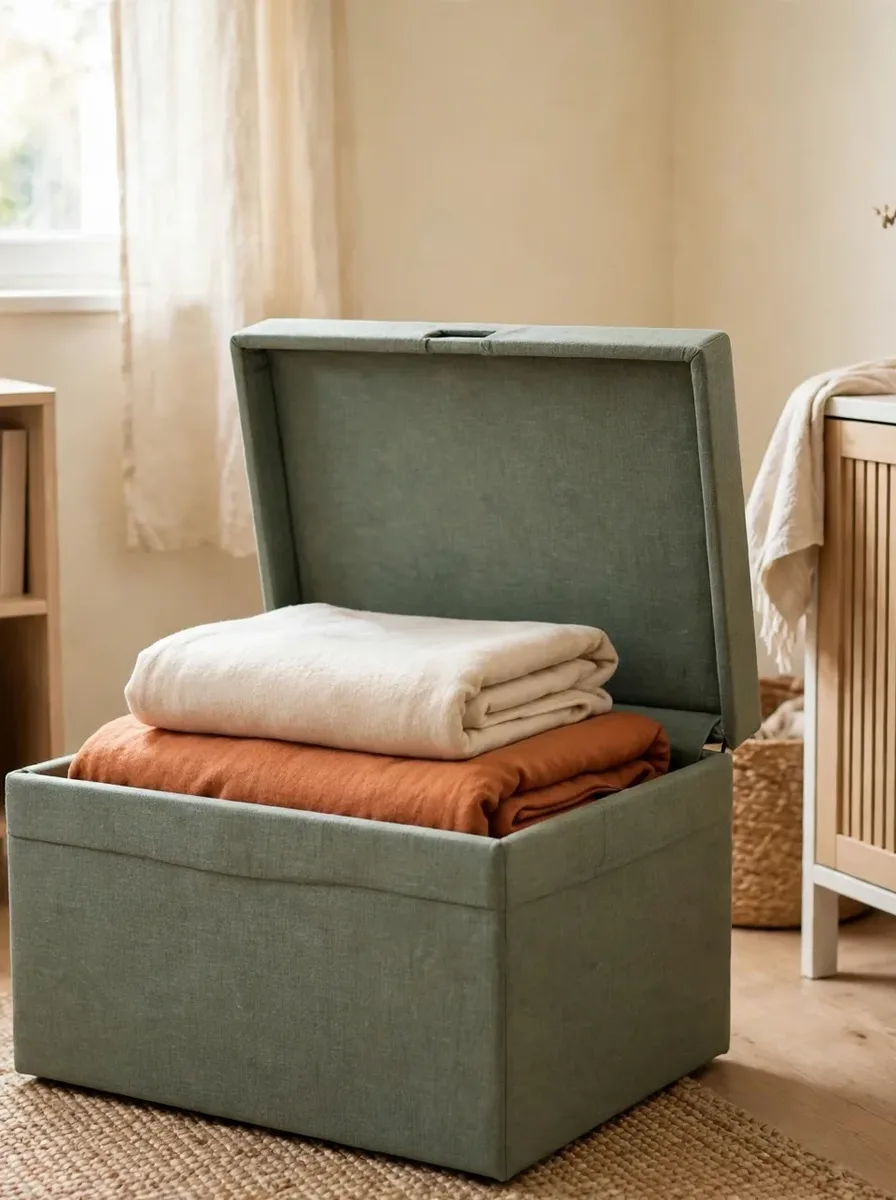
Read the lid before you buy. A firm, flat lid is a seat and a tray table; a soft, tufted lid is a footrest only, because a mug will tip on it. Manufacturers typically rate a firm ottoman lid for a seated adult — often in the 200–250 lb (91–113 kg) range on the package — but that is the maker’s rating for a new product on a flat floor, so treat it as a ceiling, not a target. The honest trade-offs: the interior is one open box, so small items migrate to the bottom and digging means emptying; and fabric lids show wear exactly where heels land. Keep the ottoman for bulky, grab-and-go things and it will stay useful for years.
The storage bench
A storage bench — 36–48 inches (91–122 cm) long, 14–16 inches (36–41 cm) deep, about 18 inches (46 cm) high — does three jobs: seating for two, a lidded box for shoes or blankets, and a surface that can hold a tray or a stack of books. Expect $80–$200. Put it along the wall a sofa cannot use, or at the boundary between an open-plan living area and the entry, where it doubles as the place shoes come off — the same logic as entryway decor that adds storage, applied inside the room.
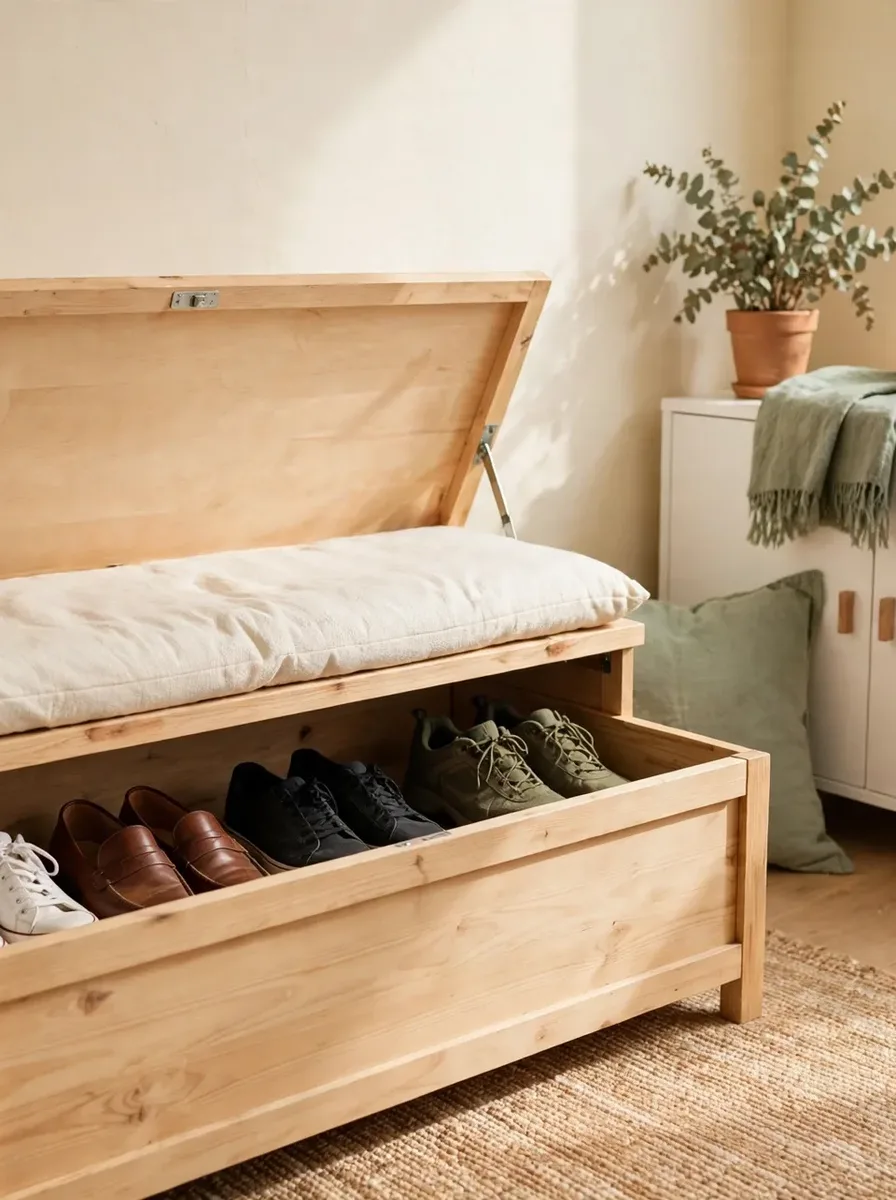
The trade-off is comfort: most benches have a shallower seat and a straighter back (or no back) than a real chair, so they suit perching, shoe-tying, and overflow seating better than a three-hour film. Buy one for storage and short sits, not as your main seat.
Required space: About 2.2 square feet (0.2 m²) for a cube ottoman, or a wall run 36–48 in (91–122 cm) long for a storage bench.
Installation: No assembly beyond taking the ottoman out of the box. Place the bench along a wall the sofa cannot use or at the boundary between living area and entry.
Approximate dimensions: Cube ottomans are 16–18 in square and 15–18 in tall with roughly 2–3 cubic feet inside. Benches are 36–48 in long, 14–16 in deep and about 18 in high.
Rental-friendly limits: Both pieces stand on the floor with no wall fixing, anchors or landlord approval, and each leaves through the front door on move-out day.
Pros: An ottoman does four jobs — footrest, seat, tray table and blanket box — in about 2.2 square feet, and a bench seats two while its lidded box holds shoes or blankets.
Cons: The interior is one open box, so small items migrate to the bottom and digging means emptying, and most benches suit perching and short sits rather than a three-hour film.
Suitable products: Storage ottomans with firm flat lids and storage benches.
Work + Eat: Lift-Top Tables, C-Tables, and Drop-Leaf Tables
The second job pair is the one modern rentals demand most: a surface that is a coffee table at seven in the evening and a desk or dining table the rest of the day.
The lift-top coffee table
A lift-top table is typically 36–48 inches (91–122 cm) long and 18–24 inches (46–61 cm) deep. The top rises about 6–10 inches (15–25 cm) and pulls toward the sofa, landing at roughly dining height so you can work or eat without hunching over a low table. Under the top sits a hidden compartment — usually enough for a laptop, notebooks, and remotes — and many models add a lower shelf. Prices run about $120–$300.
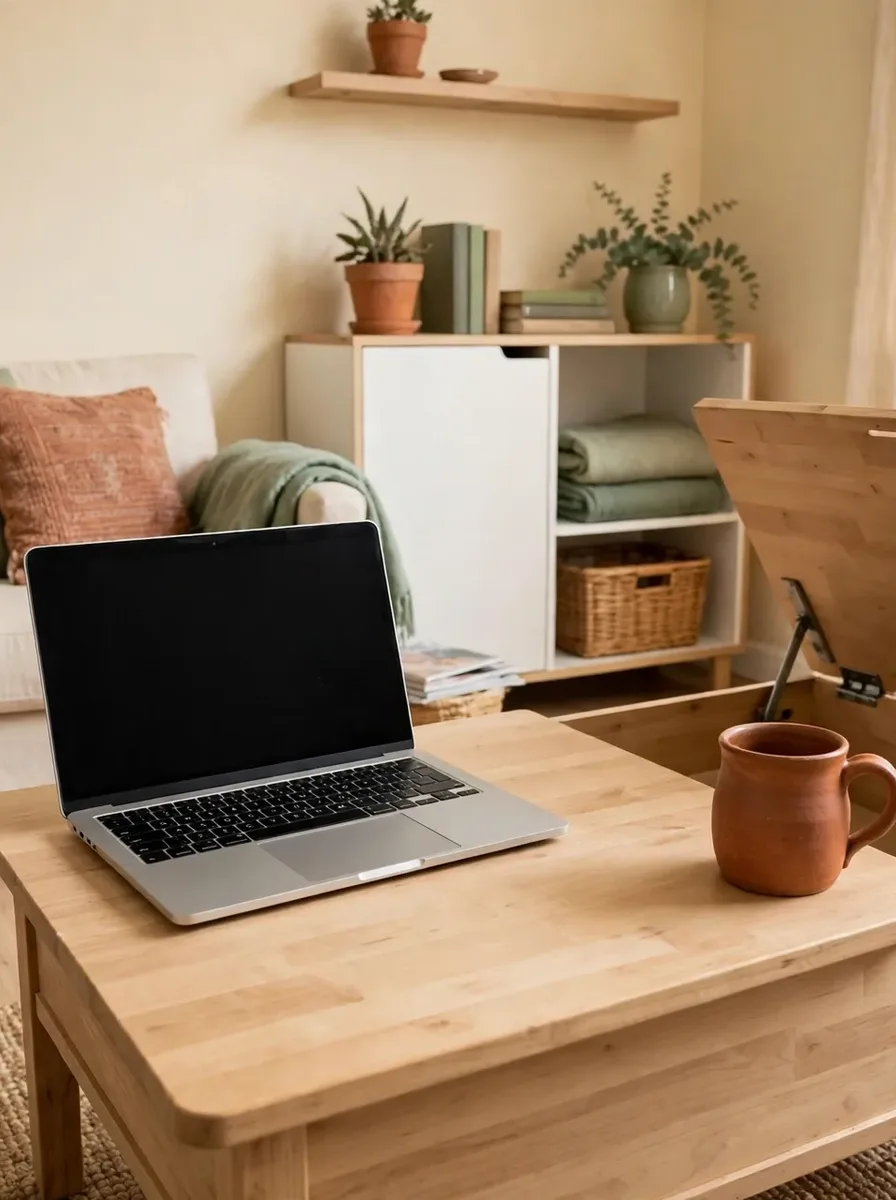
The trade-offs are mechanical. The lifting frame makes these tables heavy for their size — 60–90 lb (27–41 kg) is common — and the raised top is rated by the manufacturer for light loads only: a laptop and a plate, not a pile of textbooks or a leaning elbow. Keep heavy things in the compartment, not on the raised surface, and check the hinge action in person if you can; a top that racks side-to-side when raised will annoy you every single day.
The C-table
A C-table is a small top — about 12×18 inches (30×46 cm) up to 16×24 inches (41×61 cm) — on a frame shaped like the letter C, so the base slides under the sofa and the top floats over your lap or the sofa arm. It is a side table, a laptop stand, and a snack surface in about 1.3 square feet (0.12 m²), for $30–$90. The one measurement that matters: the top sits 24–28 inches (61–71 cm) high, so confirm it clears your sofa arm, and confirm the base fits under your sofa frame — some sofas sit too low for the base to slide in.
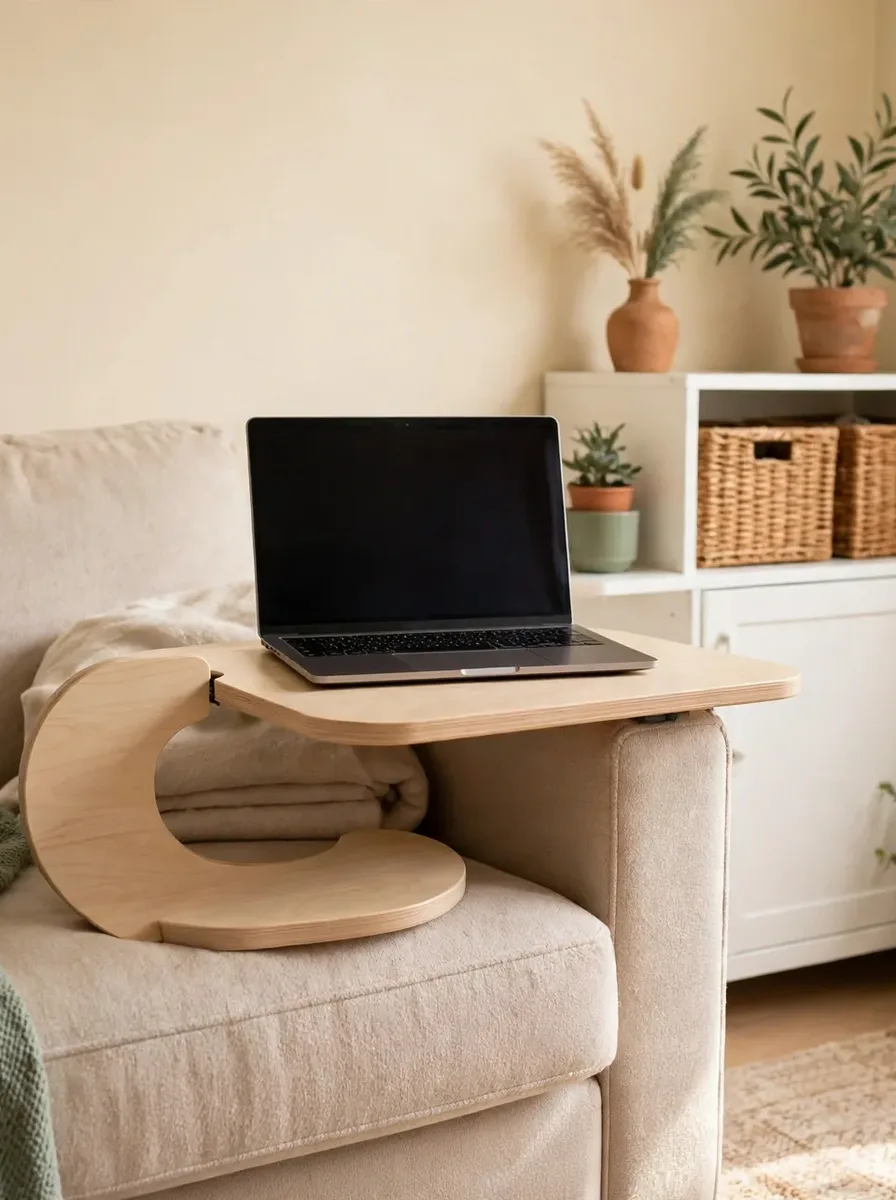
The honest warning: the cantilever design that makes a C-table useful also makes cheap ones wobble, and we cover that properly in the failures section below. Buy the version with a wide, heavy base plate, and load the top near the upright, not at the far edge.
The drop-leaf table
A drop-leaf (or gateleg) table lives against the wall at 12–20 inches (30–51 cm) deep — a console, a plant stand, a landing strip — and opens to 36–48 inches (91–122 cm) across to seat four for dinner or hold a full work-from-home setup. Expect $100–$300. It is the only dining table most small rentals can honestly own, because the other six days of the week it is barely there.
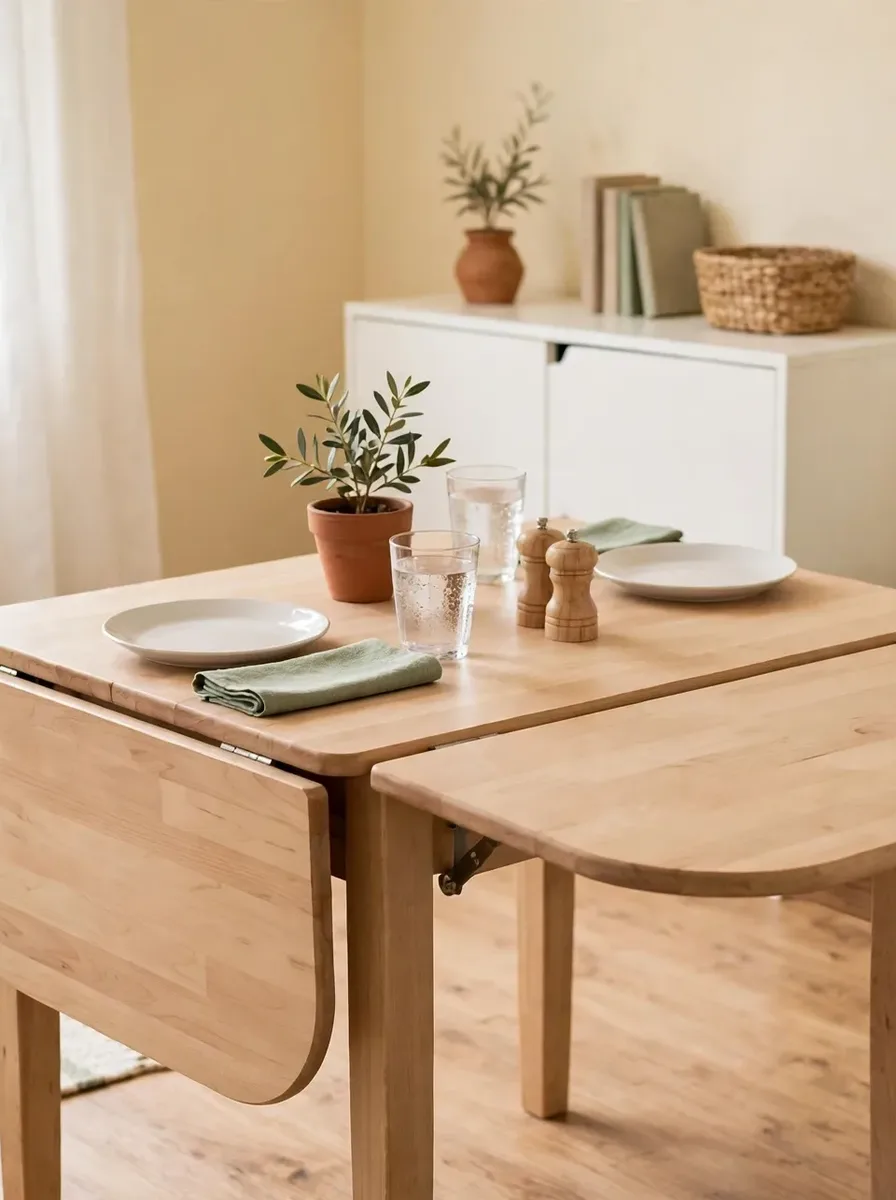
Trade-offs: you need somewhere for the dining chairs to live (folding chairs in a closet or behind a door are the usual answer), and leaves that are opened daily wear their hinges faster than leaves opened monthly. If you host dinners twice a year, a folding card table stored flat may honestly beat it.
Required space: A lift-top table 36–48 in long by 18–24 in deep, a C-table in about 1.3 square feet beside the sofa, or a drop-leaf table at 12–20 in deep against the wall when closed.
Installation: Slide the C-table base under the sofa and confirm the top clears the sofa arm, pull the lift-top toward the sofa to dining height, and open the drop-leaf table to 36–48 in across only when dining or working.
Approximate dimensions: Lift-top tables are typically 36–48 in long × 18–24 in deep with the top rising about 6–10 in. C-table tops run about 12 × 18 in up to 16 × 24 in at 24–28 in high. Drop-leaf tables open to 36–48 in across.
Rental-friendly limits: All three pieces are freestanding with no wall fixing, and each can leave through the front door — but check the front door width first, since most doors are 30–32 in wide.
Pros: A lift-top hides a compartment and becomes a desk, a C-table is a side table, laptop stand and snack surface in about 1.3 square feet, and a drop-leaf is the only dining table most small rentals can honestly own.
Cons: Lift-top tables are heavy at 60–90 lb and the raised top takes light loads only, cheap C-tables wobble, and drop-leaf hinges wear faster when opened daily.
Suitable products: Lift-top coffee tables, C-tables with wide heavy base plates, and drop-leaf or gateleg tables.
Sleep + Sit: Sofa Beds, Judged Honestly
The sofa bed is the biggest multifunctional promise and the easiest to get wrong, so it gets its own section. The maths first: a sofa 35 inches (89 cm) deep with a pull-out mechanism needs a total of about 85–95 inches (216–241 cm) of clear floor from wall to the foot of the open bed. Mattresses are typically twin 39 inches (99 cm), full 54 inches (137 cm), or queen 60 inches (152 cm) wide. Tape that rectangle on your floor before you fall in love with any model — if the open bed blocks the bathroom route, the piece fails, whatever its price.
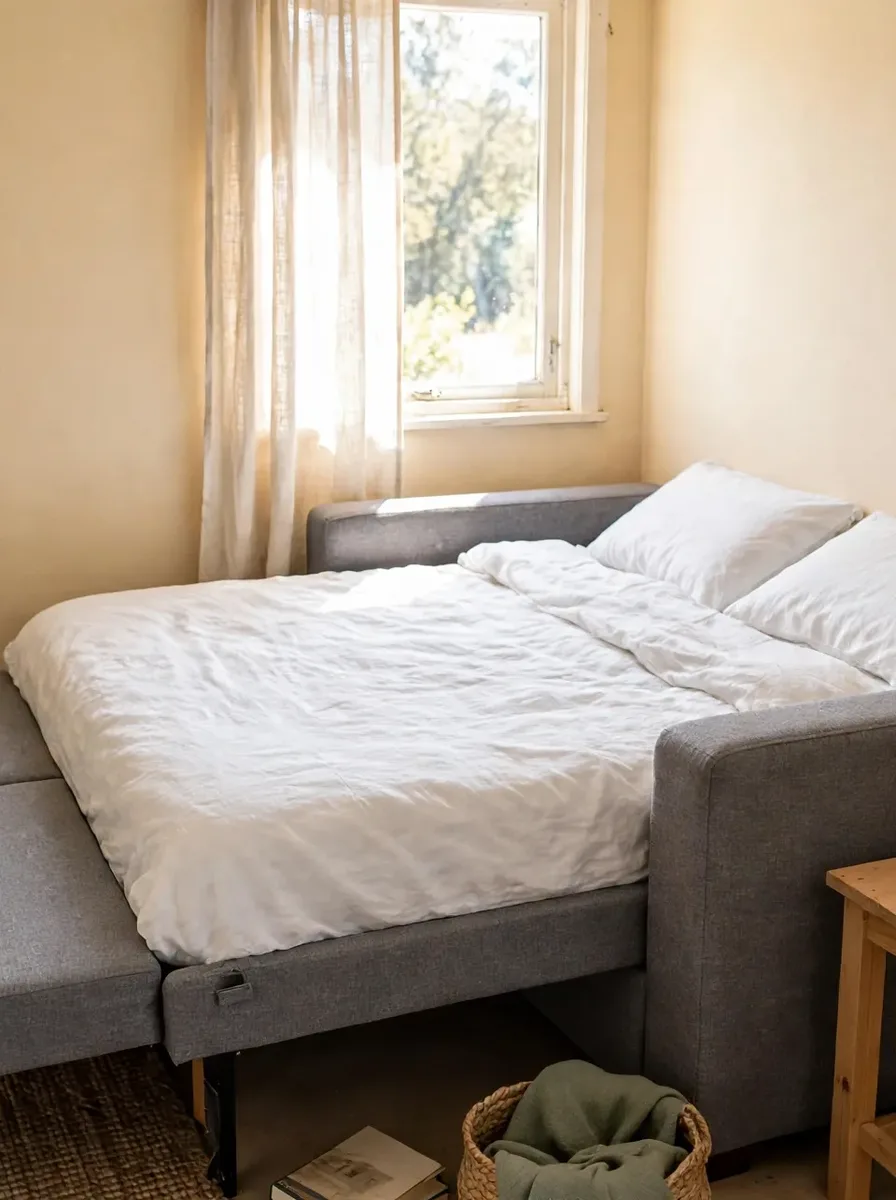
Price tells the truth here. Below roughly $300, sofa beds usually pair a thin mattress — around 3–4 inches (8–10 cm) — with a frame your guest will feel through it. The $400–$600 band is where mattresses get to 4.5–5 inches (11–13 cm) and frames stop flexing. And the rental cost nobody mentions: a sofa bed is typically the heaviest item in the room at 120–200 lb (54–91 kg). It will be the hardest thing you move out, and possibly the hardest thing to get in. If your building has a tight stair turn, measure it twice or choose a futon-style sleeper that arrives in lighter sections.
The balanced verdict: a sofa bed earns its place if guests stay over several times a year and there is no spare room. For once-a-year guests, a good air mattress plus your ordinary sofa does the same job for a tenth of the price and none of the weight.
Required space: About 85–95 in (216–241 cm) of clear floor from the wall to the foot of the open bed, taped out on the floor before buying.
Installation: Tape that rectangle on your floor first and confirm the open bed does not block the bathroom route, then measure the stair turn twice before delivery.
Approximate dimensions: Mattresses are typically twin 39 in, full 54 in or queen 60 in wide, on a sofa about 35 in (89 cm) deep. Mattresses run around 3–4 in thick below $300 and 4.5–5 in in the $400–$600 band.
Rental-friendly limits: A sofa bed is freestanding with no wall fixing, but at 120–200 lb it is typically the heaviest item in the room and the hardest thing to move out.
Pros: It replaces an entire guest room, and in the $400–$600 band the mattress reaches 4.5–5 in and the frame stops flexing.
Cons: Below roughly $300 the thin mattress pairs with a frame your guest will feel through it, and the open bed can block the route to the bathroom if the rectangle was never taped out.
Suitable products: Mid-range sofa beds and futon-style sleepers that arrive in lighter sections.
Flex Space: Nesting Tables That Appear When Needed
Nesting tables are the quiet overachievers of this category. A set of three — the largest usually 18–22 inches (46–56 cm) across — stacks into a footprint of about 2.3 square feet (0.21 m²) and separates into a side table, a plant stand, a drinks table for a guest, and a step-free surface wherever the evening needs one. Sets run about $50–$150 in wood, metal, or mixed materials.
The trade-off is scale: three small tops never equal one big one, and the smallest table in a set is often genuinely tiny. But for rentals, the ability to redeploy surfaces — and to make them vanish again — is worth more than one more fixed table. Choose a set whose tables slide smoothly and whose feet have pads, and they will be the most-used pieces you own after the sofa itself.
The same flex logic applies to seating. A pair of folding stools or a single folding chair — the decent wooden or padded kind, roughly $25–$60 each — stores in a 4-inch (10 cm) slot beside a bookcase or behind a door, and turns a two-person room into a four-person room for the length of a dinner. They score absurdly well on jobs per square foot precisely because their stored footprint is nearly zero. What they are not is everyday seating: no folding stool survives a daily eight-hour work session comfortably, and pretending otherwise is how renters end up buying the same chair three times. Flex pieces are for peaks — guests, game nights, one extra surface — and judged that way, they are the best value in this entire guide.
Required space: About 2.3 square feet (0.21 m²) nested for a set of three tables, or a 4 in (10 cm) slot beside a bookcase or behind a door for folding stools.
Installation: Stack the set into its nested footprint when not in use and separate the tables wherever the evening needs one, and store folding stools flat in the slot until guests arrive.
Approximate dimensions: The largest nesting table is usually 18–22 in (46–56 cm) across, and folding stools store in a slot about 4 in (10 cm) wide.
Rental-friendly limits: Everything here is freestanding with no wall fixing, and the pieces vanish back into their stored footprint when the guests leave.
Pros: Nesting tables redeploy as a side table, plant stand or drinks table and make themselves vanish again, and folding stools turn a two-person room into a four-person room for a dinner.
Cons: Three small tops never equal one big one and the smallest table is often genuinely tiny, and no folding stool survives a daily eight-hour work session comfortably.
Suitable products: Nesting table sets and folding stools or folding chairs.
The Scorecard: Every Piece Compared
Here is the whole category on one table, using the two-job rule. Footprints are the floor area of typical models; “jobs” counts only functions a normal household uses weekly.
| Piece | Jobs it really does | Footprint | Jobs per sq ft | Typical price | Rental watch-out |
|---|---|---|---|---|---|
| C-table | Side table, laptop/snack surface (2) | ~1.3 sq ft (0.12 m²) | ~1.5 | $30–$90 | Wobble; must clear the sofa arm |
| Storage ottoman | Footrest, seat, tray table, storage (4) | ~2.2 sq ft (0.2 m²) | ~1.8 | $40–$120 | Soft lids can’t hold a tray; digging to the bottom |
| Nesting tables (3) | Side tables ×3, serving surfaces (2–3) | ~2.3 sq ft (0.21 m²) nested | ~1.1 | $50–$150 | Small tops; smallest table is tiny |
| Drop-leaf table | Console, desk, dining for 4 (3) | ~3.3 sq ft (0.31 m²) closed | ~0.9 | $100–$300 | Chairs need a home; hinge wear |
| Storage bench | Seat for 2, storage, shoe station (3) | ~4.2 sq ft (0.39 m²) | ~0.7 | $80–$200 | Shallow seat — not for long sits |
| Lift-top coffee table | Coffee table, desk/dining, storage (3) | ~5.3 sq ft (0.49 m²) | ~0.6 | $120–$300 | Heavy; raised top takes light loads only |
| Sofa bed | Sofa, guest bed (2) | ~17 sq ft (1.6 m²) | ~0.1 | $300–$600+ | Heaviest move-out piece; open length blocks routes |
Read the last row carefully: the sofa bed’s score is the worst on the table and it can still be the right purchase, because it replaces a room, not a piece of furniture. Use the score to compare like with like — ottoman against side table, lift-top against plain coffee table — and use the rental rules from the top of this guide for everything else. More storage-first layouts live in our living room and entryway storage hub.
Multifunctional Failures: Pieces That Do Two Jobs Badly
Multifunctional furniture has a failure mode built into the idea: every added mechanism is a compromise and a moving part. These are the ones that most often disappoint, so you can spot them in a listing photo.
The bargain sofa bed. A very cheap sofa bed usually means a thin mattress over a frame with a crossbar exactly where a sleeper’s back lands. If guests regularly stay more than a night or two, either budget for the mid-range or plan on a mattress topper — and know that “sleeps two” on the label often means two people who are on excellent terms, on a mattress nearer 54 inches (137 cm) than 60.
The wobbly C-table. The physics are unforgiving: a top cantilevered out from one upright will flex unless the base is wide and heavy. Thin tube frames with small feet are the tell. Load any C-table near its upright, never at the far edge, and if a listing shows the base hidden in every photo, assume the base is the problem.
The soft-lid ottoman sold as a coffee table. If the lid is deeply tufted or pillow-soft, it is a footrest. Sellers photograph trays on them; your mug will still tip. A coffee-table ottoman needs a firm, flat, preferably reversible tray lid.
Storage drawers under sofas that jam. Low drawers and deep-pile rugs do not mix, and drawer runners are the first thing cut on cheap storage sofas. If you want under-sofa storage, a lidded ottoman or a bench does the same job with no mechanism at all.
The five-in-one novelty piece. Convertible chair-ladder-shelf-ironing-board contraptions exist, and each function is the worst version of itself. A fair rule of thumb: the more transformations a listing advertises, the fewer of them you will use by month two. Two jobs done well beat five done badly — that is the entire argument of this guide.
The Mistakes We See Again and Again
- Buying before measuring the door. The piece fits the room perfectly and never gets into it. Door width, hallway turns, and stairwell corners first, always.
- Counting fantasy jobs. Scoring a piece for a job you will never do — the daily desk, the weekly dinner party — inflates every bad purchase. Count last month’s real life, not next month’s intentions.
- Ignoring move-out weight. Rentals end. A 180 lb (82 kg) piece that took a delivery crew to install will take friends, a dolly, and a deposit-risking scrape down the stairs to remove.
- Blocking the routes. An open sofa bed across the bathroom path, a bench narrowing the doorway below 30 inches (76 cm) — if a piece only works when the room stops working, it does not work.
- Forgetting the floor. No felt pads, one dragged ottoman, and the deposit conversation writes itself. Pads under everything, before it takes weight.
- Choosing open storage everywhere. Open compartments display your clutter at eye level. In a small room, closed storage is what makes double-duty furniture look calm instead of chaotic.
From the Cozy Tiny Space shop
Before you buy a two-job piece, check it fits — on paper, at true scale
Small-Space Furniture Layout Kit — scale grid sheets and furniture cut-outs that let you test a layout before you lift or buy anything · $9
Where the Money Goes First
If the budget is one piece, make it the storage ottoman: roughly $40–$120, four jobs, zero assembly, and it will move with you for a decade. Around $150–$250 total, add the piece your life is missing — a C-table if you work from the sofa, nesting tables if you host. The lift-top coffee table is the mid-budget upgrade that replaces a desk outright. And the sofa bed is the one deliberate splurge: buy it once, in the mid-range, measured twice — or skip it entirely and keep the money.
Every piece in this guide was chosen to be carried out of a rental as easily as it was carried in. That, more than any single mechanism, is what makes furniture genuinely multifunctional for a renter: it does two jobs in this apartment, and then it does them again in the next one.