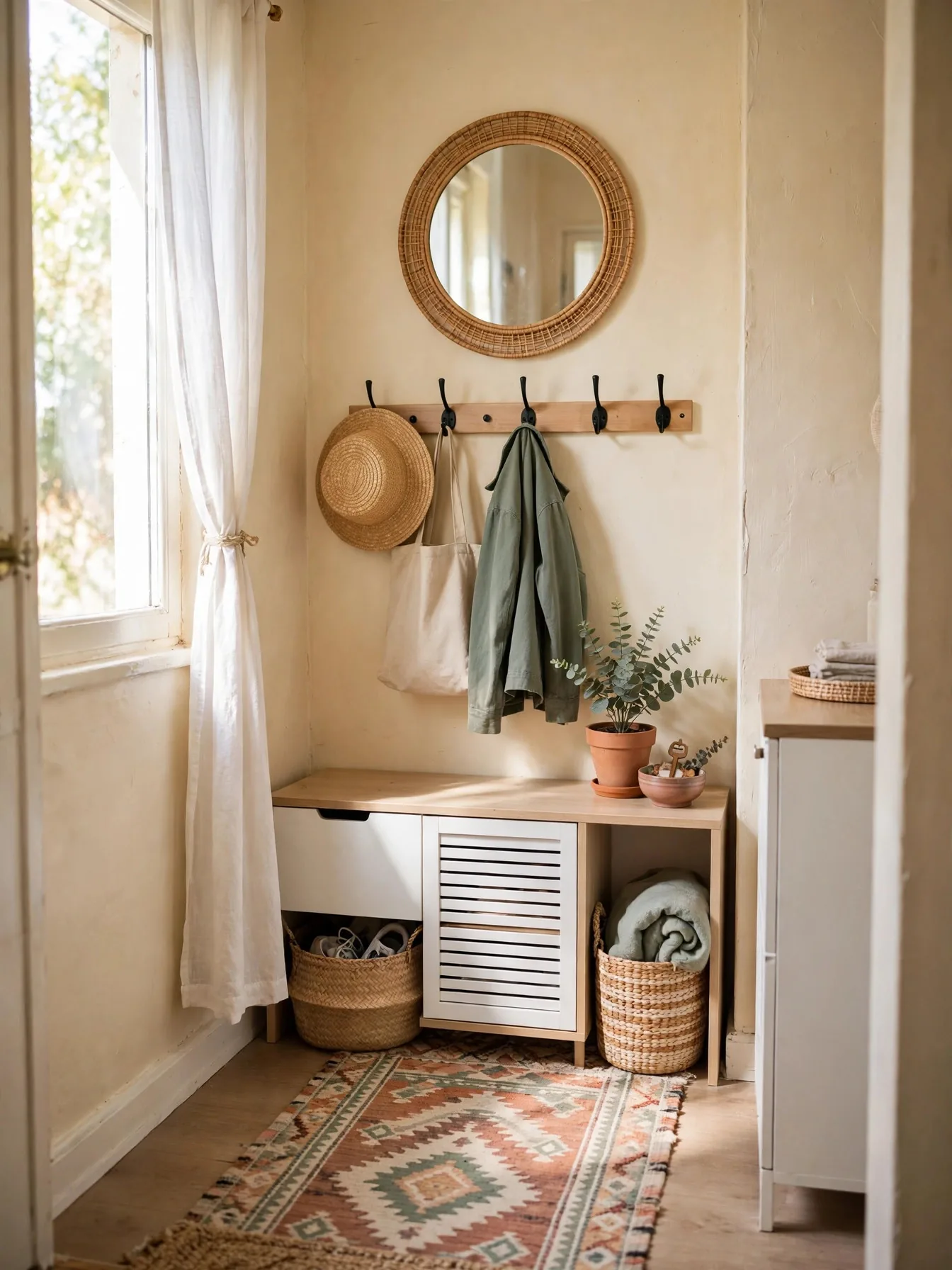
A small entryway gives you maybe six square feet to work with, and it has to absorb coats, keys, shoes, mail, and the dog leash — while also being the first thing you and your guests see. That is why small entryway decor with storage is not a compromise in a rental; it is the only approach that fits. Every piece has to earn its place twice: once for how it looks, once for what it holds. Apartment Therapy’s small-entryway ideas show more decor-first entries.
This guide treats decor as the storage plan, not decoration added afterward. If you want the full storage-first layout first, start with our pillar guide to rental apartment entryway storage ideas for small spaces, then come back here to make that layout look deliberate. Everything below is damage-free: no drilling, no anchors, nothing to be charged for at move-out.
The Rule: Every Piece Works Twice
Before any individual piece, it helps to have a test. For every item you are considering, ask two questions. What does it hold? And what does it add to the room visually? A mirror that holds nothing still passes if it doubles the light — but a framed print, a vase, and a decorative bowl on the same console all fail the first question, and in six square feet that failure is the difference between an entryway and a pile.
The practical version: storage you can see should look like decor, and decor you can see should hide or hold storage. Open shoe racks, plastic bins, and bare utility hooks all store things, but they read as equipment; the same functions in wood, woven fibre, and brass-toned metal read as furnishing. The pieces below are the standard entryway storage items, each in the version that also does the decorating.
One honest note before the pieces: none of this adds space. It makes the same footprint feel calmer because daily clutter gets assigned, good-looking places to land. If your problem is sheer volume — twelve pairs of shoes, four coats per person — decor will not fix that; a purge will. Decor-storage handles the daily layer.
The Mirror That Holds Your Keys
A mirror is the hardest-working decor piece in any small entryway. It bounces light from the nearest window or lamp, it makes a 3-foot-wide (91 cm) entry feel wider, and it gives you the last-check moment before you leave. The storage version adds a shallow shelf or a short hook rail along the bottom edge, and that ledge is where keys, sunglasses, and a wallet land instead of migrating to the kitchen counter.
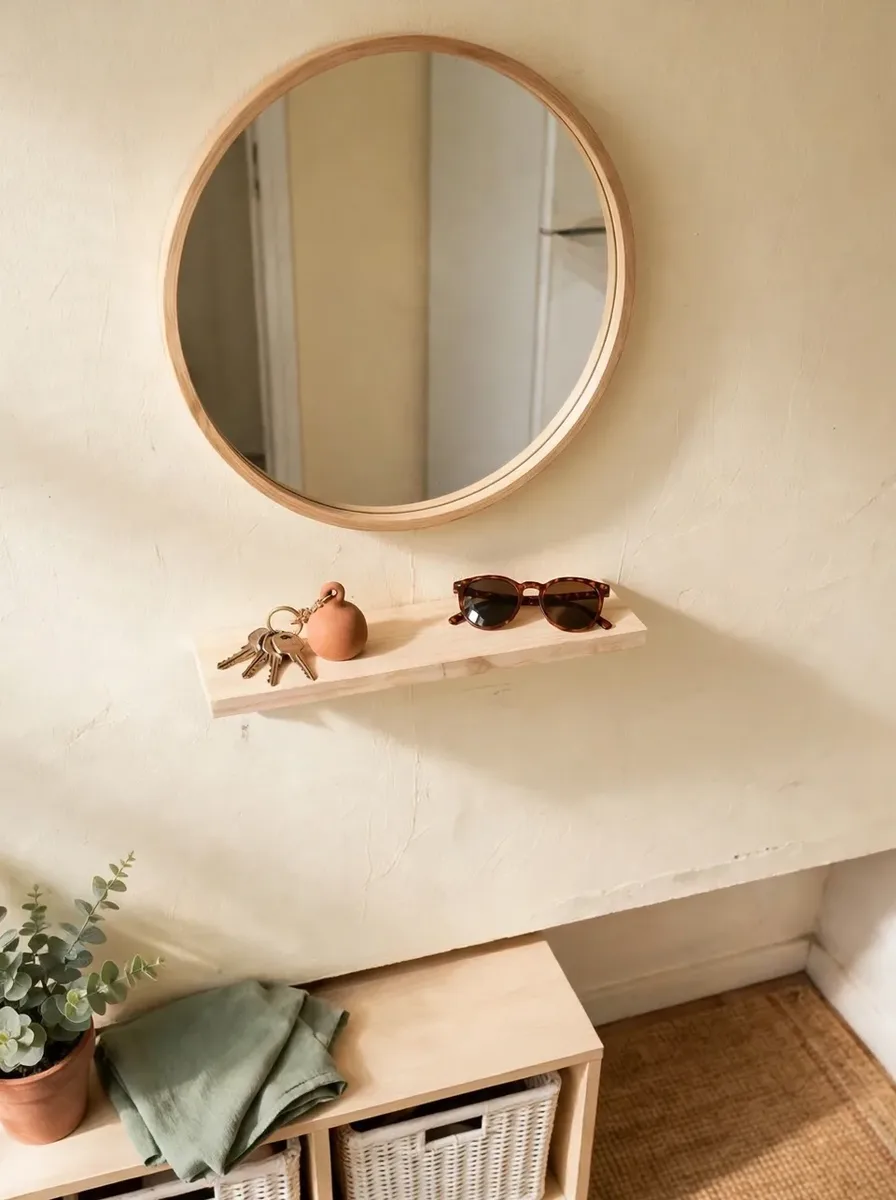
Sizes that work: a round or arched mirror 20–24 inches (51–61 cm) wide is the sweet spot for a narrow entry — big enough to reflect real light, small enough for adhesive mounting to be a sane option. The shelf underneath should be 4–5 inches (10–13 cm) deep: deep enough for keys and a phone, shallow enough that it never becomes a dumping ledge. Hang the mirror so its centre sits at about 57–60 inches (145–152 cm) from the floor, with the shelf roughly at waist height, 36–40 inches (91–102 cm).
Expect to pay $25–$60 for a mirror with an integrated shelf or rail. One trade-off: a mirror reflects whatever faces it — opposite a tidy console it doubles the styled effect, opposite a shoe pile it doubles that instead. Check the reflection from the doorway before fixing a position, and expect to wipe it often; entryway mirrors collect fingerprints fast.
Mounting honesty lives in its own section below, but the short version for mirrors specifically: lean a heavy mirror, hang a light one, and never hang glass over a walkway on adhesive alone.
Required space: A narrow entry wall, with the mirror’s centre at about 57–60 inches (145–152 cm) from the floor and the shelf roughly at waist height, 36–40 inches (91–102 cm).
Installation: Hang a light mirror on adhesive strips, and lean a heavy mirror against the wall or rest it on a shelf instead of relying on adhesive alone; add a shallow shelf or a short hook rail along the mirror’s bottom edge for keys, sunglasses, and a wallet.
Approximate dimensions: A round or arched mirror 20–24 inches (51–61 cm) wide is the sweet spot for a narrow entry, and the shelf underneath should be 4–5 inches (10–13 cm) deep.
Rental-friendly limits: Lean a heavy mirror, hang a light one, and never hang glass over a walkway on adhesive alone; mirrors over about 10 lb (4.5 kg) should lean against the wall or rest on a shelf instead of relying on adhesive.
Pros: A mirror bounces light from the nearest window or lamp, makes a 3-foot-wide (91 cm) entry feel wider, gives the last-check moment before leaving, and its ledge keeps keys, sunglasses, and a wallet from migrating to the kitchen counter.
Cons: A mirror reflects whatever faces it, so opposite a shoe pile it doubles that instead, and entryway mirrors collect fingerprints fast, so expect to wipe it often.
Suitable products: A round or arched mirror with an integrated shelf or hook rail.
Hooks as Wall Art
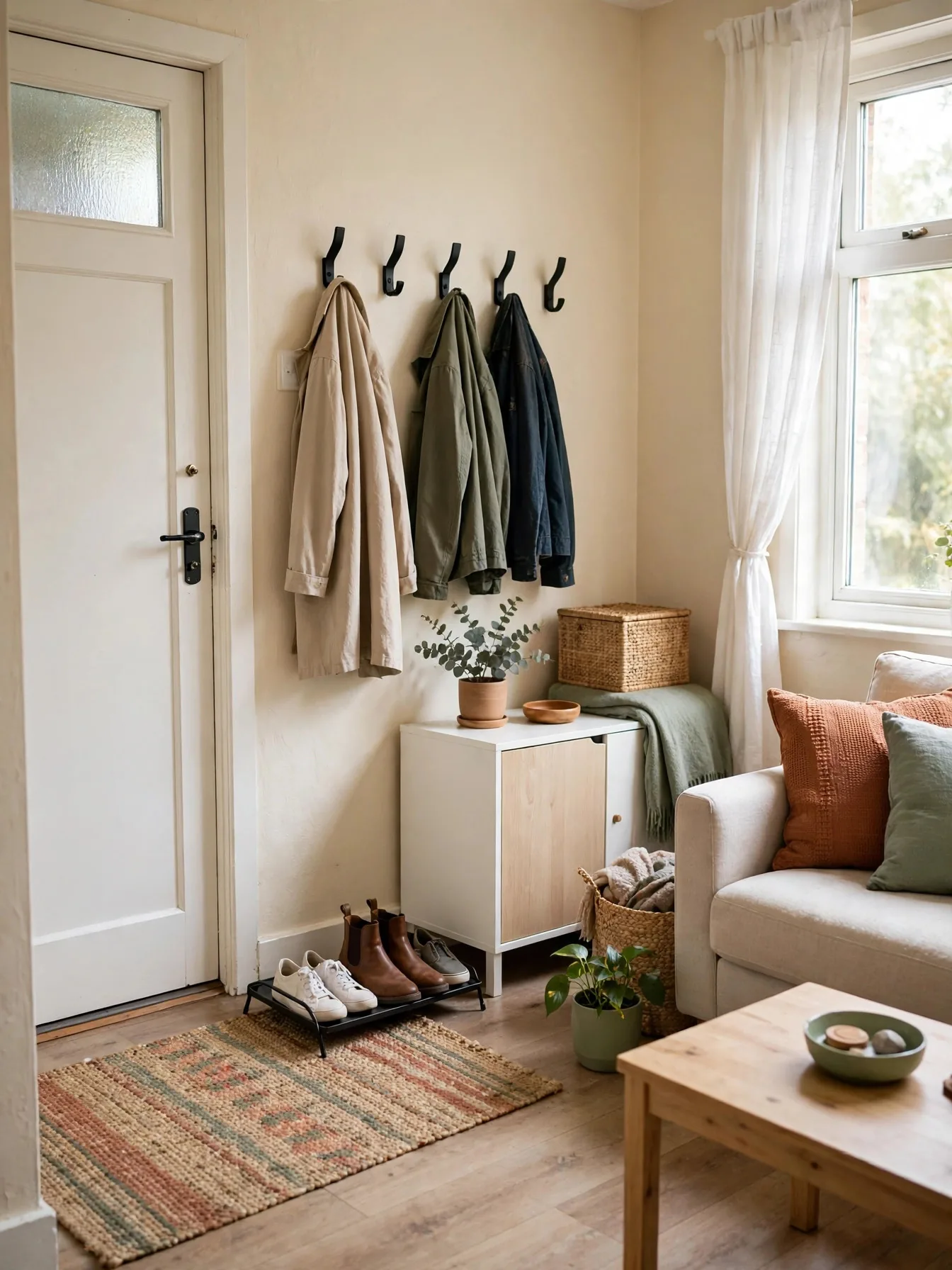
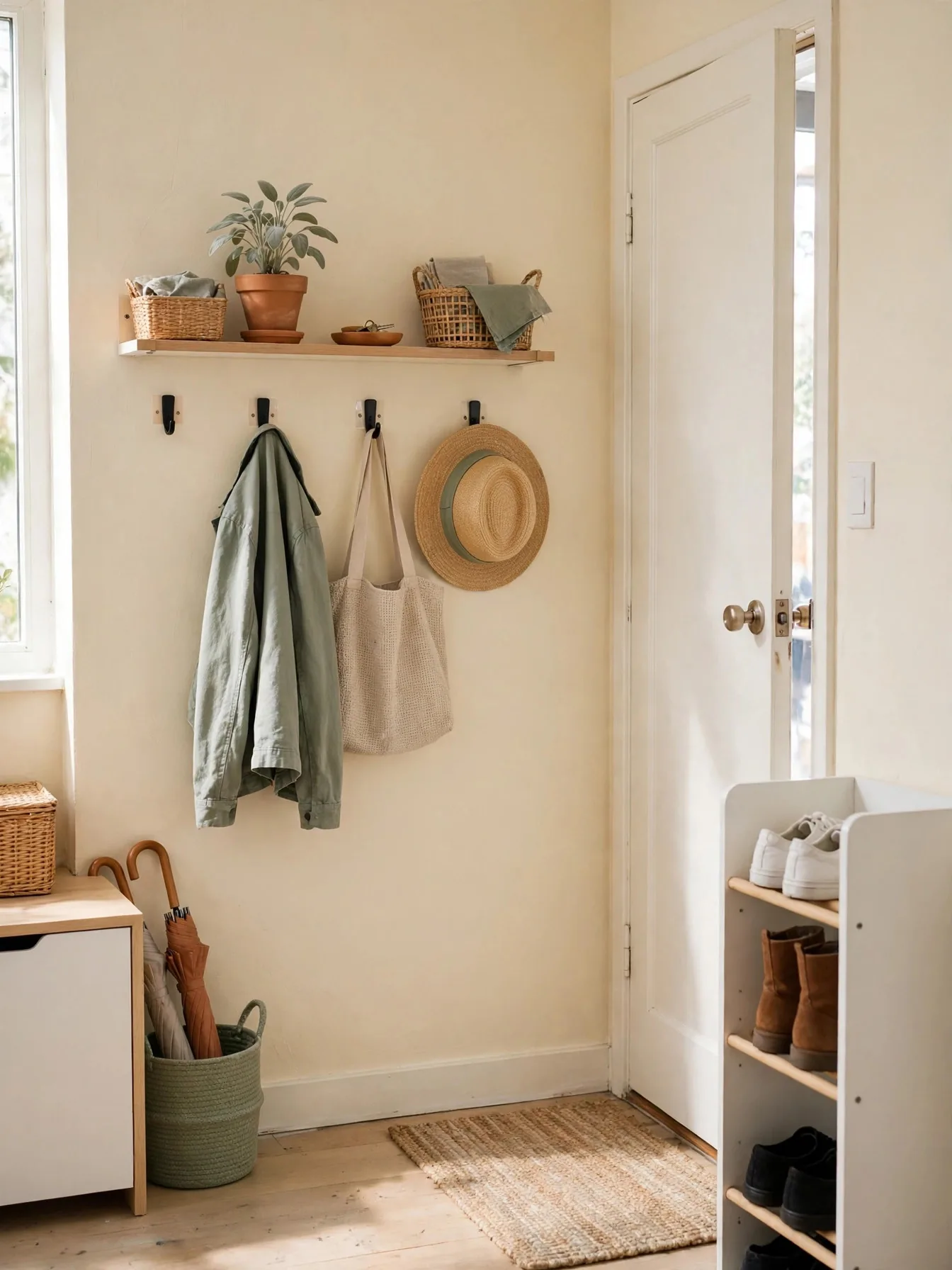
Hooks are where entryway storage usually turns ugly — a row of mismatched plastic stick-ons reads as hardware, not decor. The fix is to treat the hook row as a design element: matching hooks in one finish (matte black, brushed brass, or natural wood pegs), mounted in a straight, evenly spaced line or on a wooden rail, so the row looks like a wall feature even when empty.
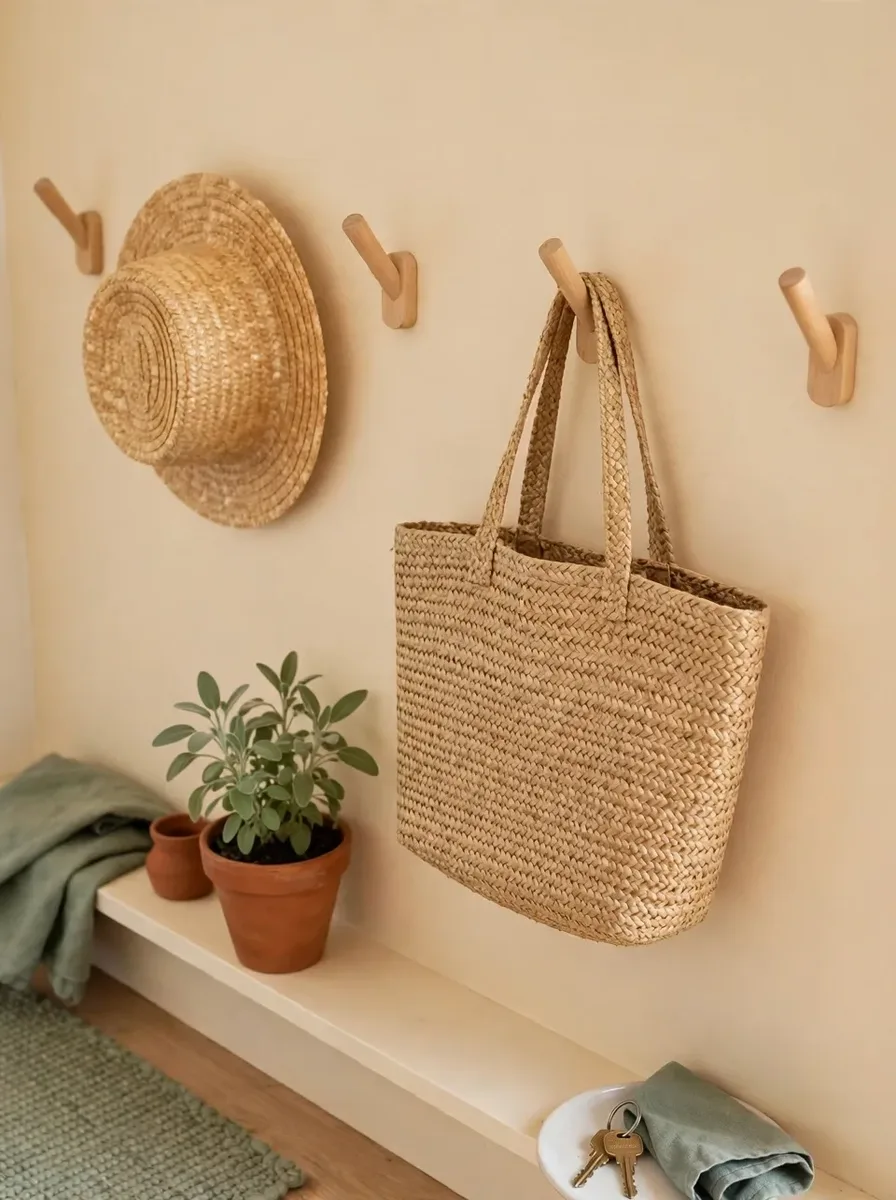
Practical numbers: space hooks 6–8 inches (15–20 cm) apart so coats do not bunch into one mass, and mount the main row at 66–68 inches (168–173 cm) for adults — high enough that coats clear a bench or shoe rack below. A second, lower row at 48 inches (122 cm) works for kids and for the dog leash and tote bags. Four to five hooks is the realistic count for a small entry; more than that and the wall becomes a coat swamp no matter how pretty the hooks are.
Adhesive hooks carry package ratings of roughly 3–5 lb (1.4–2.3 kg) per hook for the common large sizes. A winter coat with full pockets can reach that on its own, which is why the working rule in this guide is to load adhesive hooks to about half their package rating and give the heaviest coat the end hook, where the mount is stiffest. A wooden rail with hooks spreads load across several adhesive pads and looks better than individual hooks; expect $15–$35 for a rail and $10–$25 for a set of individual decorative hooks.
The styling detail that makes hooks read as art: hang one attractive thing on them permanently. A woven tote, a good-looking hat, or a scarf in your palette stays on its hook even when you are home, so the row never looks bare or purely functional.
Required space: One wall, with the main hook row at 66–68 inches (168–173 cm) for adults and a second, lower row at 48 inches (122 cm) for kids and for the dog leash and tote bags.
Installation: Mount matching hooks in one finish in a straight, evenly spaced line or on a wooden rail, spaced 6–8 inches (15–20 cm) apart so coats do not bunch into one mass, and load adhesive hooks to about half their package rating, giving the heaviest coat the end hook.
Approximate dimensions: Hooks are spaced 6–8 inches (15–20 cm) apart, the main row sits at 66–68 inches (168–173 cm), the lower row at 48 inches (122 cm), and four to five hooks is the realistic count for a small entry.
Rental-friendly limits: Adhesive hooks carry package ratings of roughly 3–5 lb (1.4–2.3 kg) per hook for the common large sizes, and a winter coat with full pockets can reach that on its own, so the working rule is about half the package rating; a wooden rail spreads load across several adhesive pads.
Pros: A row of matching hooks in one finish looks like a wall feature even when empty, and a rail looks better than individual hooks while spreading the load.
Cons: A row of mismatched plastic stick-ons reads as hardware, not decor, and more than four or five hooks turns the wall into a coat swamp no matter how pretty the hooks are.
Suitable products: Matching decorative hooks in matte black, brushed brass, or natural wood pegs, a wooden hook rail, and a woven tote, hat, or scarf kept permanently on one hook.
The Bench: Seating, Shoe Storage, and a Landing Strip
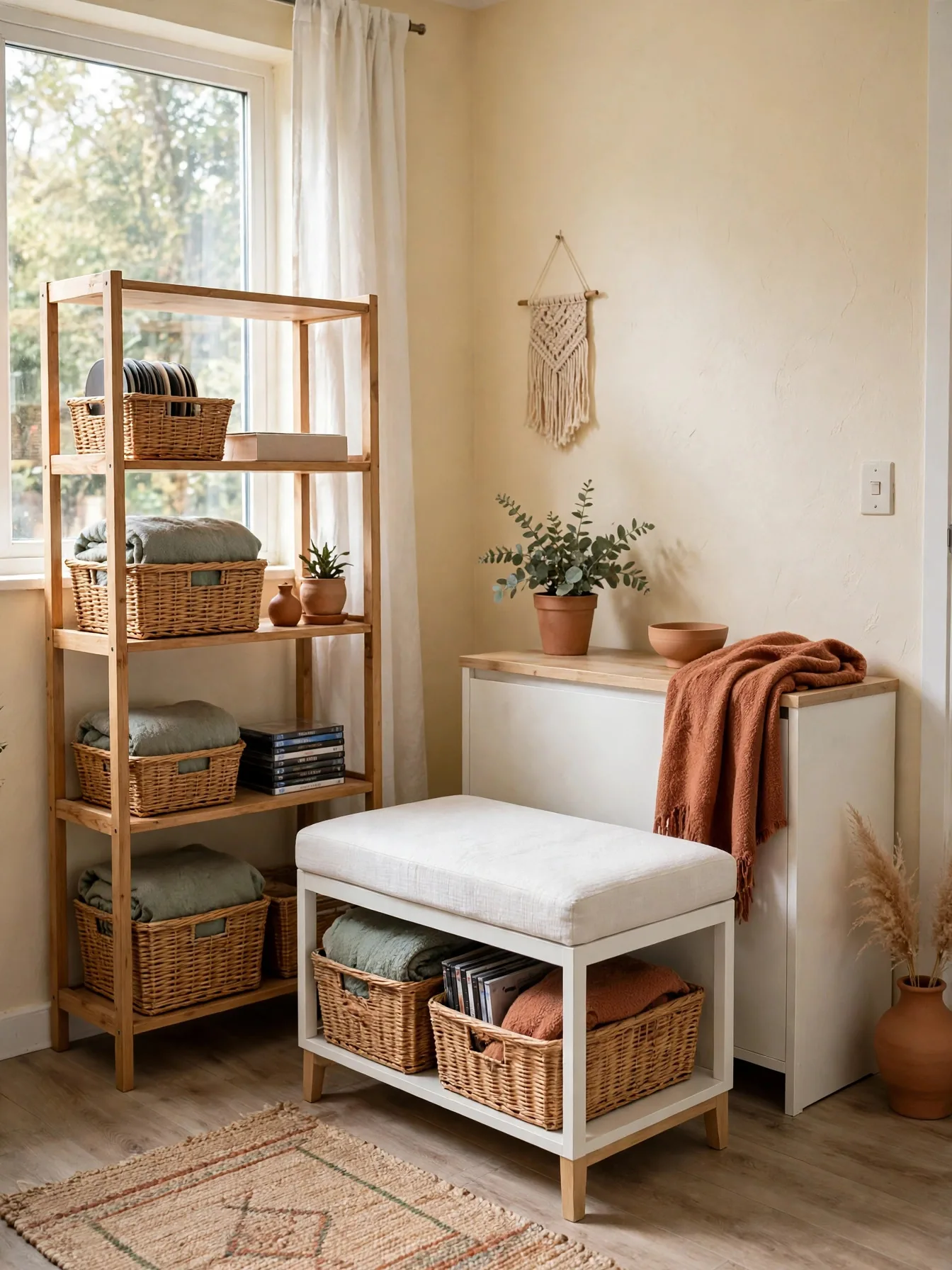
If you have the floor space for one piece of furniture, make it a bench. It is seating for putting on shoes, a landing surface for bags, and — with baskets or a low shelf underneath — the shoe storage that keeps pairs off the floor. Visually, it is also the piece that most makes an entryway look furnished rather than equipped.
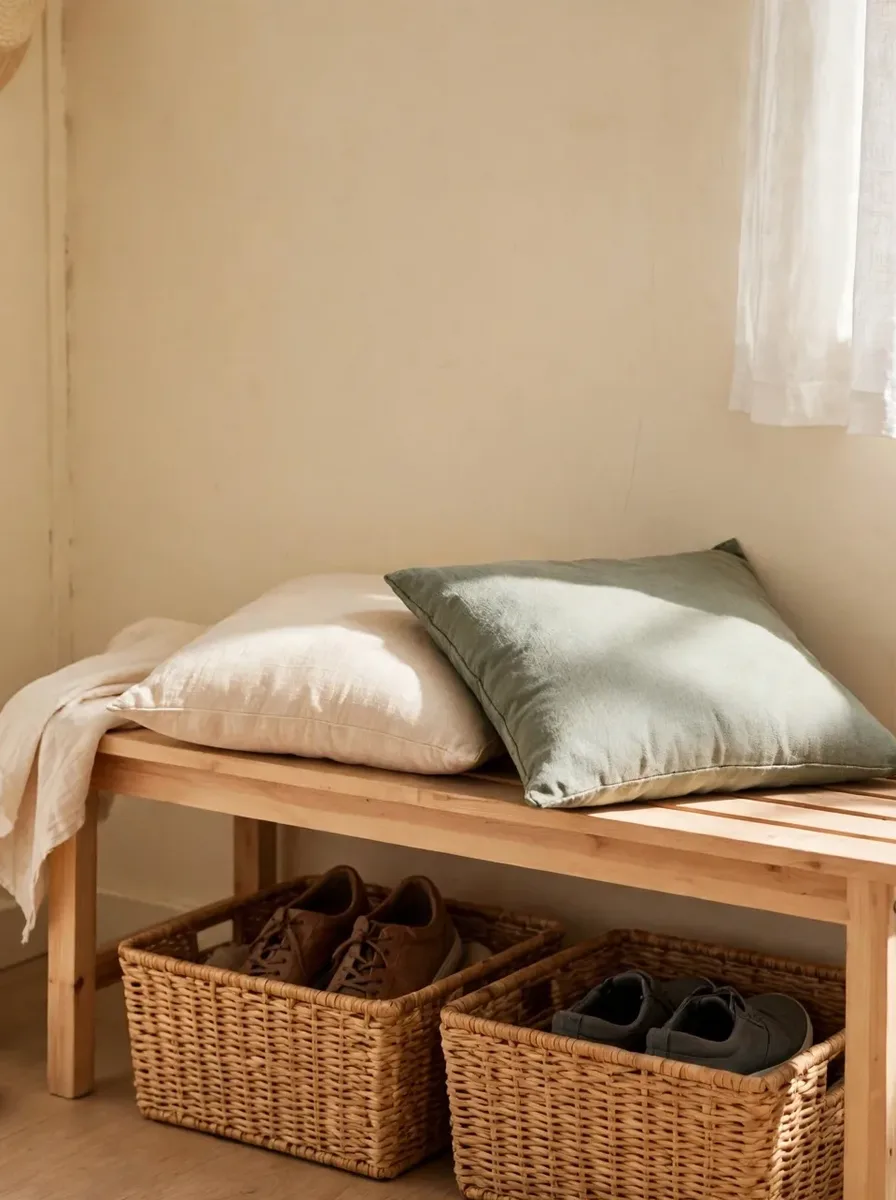
Size it carefully, because this is the piece people most often buy too big. Look for 32–40 inches (81–102 cm) long, 12–14 inches (30–36 cm) deep, and a seat height of 17–19 inches (43–48 cm) — standard chair height. Before buying, tape the footprint on the floor: the bench must sit completely outside the door’s swing arc, and you want about 24 inches (61 cm) of clear walkway left in front of it. Underneath, the clearance is usually 8–10 inches (20–25 cm), which fits low baskets or a tray with two pairs of shoes per person — not a full shoe collection. For a household’s whole shoe rotation, pair the bench with the systems in our guide to small apartment shoe storage without drilling.
Prices run $45–$90 for a simple wooden or upholstered bench. The honest trade-offs: a bench eats the floor space a slim console would leave open, cushions in an entryway get grubby fast (choose a washable cover or wipeable fabric), and a bench placed opposite the door becomes a bag magnet unless the baskets underneath are the designated bag overflow.
Required space: A taped footprint on the floor that sits completely outside the door’s swing arc, with about 24 inches (61 cm) of clear walkway left in front of it and 8–10 inches (20–25 cm) of clearance underneath.
Installation: Tape the footprint on the floor before buying, check that the bench sits outside the door’s swing arc and leaves the walkway clear, and place low baskets or a tray with two pairs of shoes per person underneath.
Approximate dimensions: Look for 32–40 inches (81–102 cm) long, 12–14 inches (30–36 cm) deep, and a seat height of 17–19 inches (43–48 cm); the clearance underneath is usually 8–10 inches (20–25 cm).
Rental-friendly limits: The bench is freestanding, so nothing is fixed to the wall or floor; it must sit completely outside the door’s swing arc, or the door will clip it every time it opens.
Pros: It is seating for putting on shoes, a landing surface for bags, and — with baskets or a low shelf underneath — the shoe storage that keeps pairs off the floor, and it is the piece that most makes an entryway look furnished rather than equipped.
Cons: A bench eats the floor space a slim console would leave open, cushions in an entryway get grubby fast, and a bench placed opposite the door becomes a bag magnet unless the baskets underneath are the designated bag overflow.
Suitable products: A simple wooden or upholstered bench and low baskets or a tray for underneath.
Baskets and Boxes: Texture That Swallows Clutter
Baskets are the cheapest way to make storage look like styling. Woven seagrass, cotton rope, or water hyacinth adds the texture and warmth that a small, hard-surfaced entryway usually lacks, and a basket’s whole job is to make its contents invisible. Gloves, scarves, umbrellas, pet supplies, the charger cable tangle — all of it disappears behind weave.
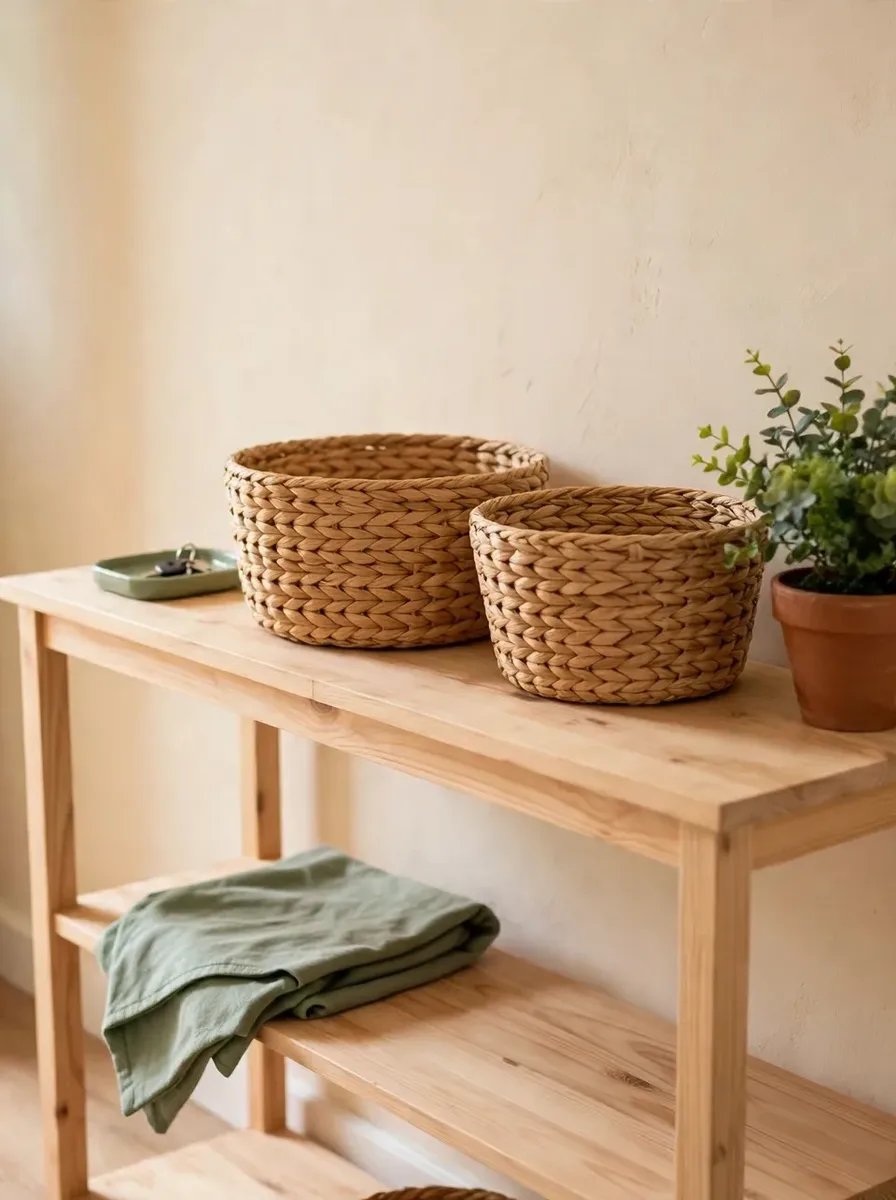
Two decisions matter more than the basket itself. First, lids at eye level, open weave below it. A lidded basket reads as furniture; an open basket at eye level reads as a bin of stuff. Put lidded baskets on consoles and shelves, and save open baskets for under the bench, where you mostly see their sides. Second, size to the contents: baskets for gloves and small items run about 12 × 10 × 8 inches (30 × 25 × 20 cm); for scarves, hats, and pet gear, 15 × 12 × 10 inches (38 × 30 × 25 cm). Measure the shelf or under-bench opening first and buy baskets about 1 inch (2.5 cm) smaller on each side so they slide without scraping.
Expect $10–$25 per basket. The failure mode is well known: an unlabeled, unassigned basket becomes a junk drawer within a month. Give each basket one category and, in a shared household, one owner. If a basket’s category cannot be named in two words, it is too big or too vague.
Required space: Consoles and shelves for lidded baskets at eye level, and under the bench for open baskets, where you mostly see their sides.
Installation: Measure the shelf or under-bench opening first and buy baskets about 1 inch (2.5 cm) smaller on each side so they slide without scraping; give each basket one category and, in a shared household, one owner.
Approximate dimensions: Baskets for gloves and small items run about 12 × 10 × 8 inches (30 × 25 × 20 cm), and for scarves, hats, and pet gear, 15 × 12 × 10 inches (38 × 30 × 25 cm).
Rental-friendly limits: Baskets simply sit on surfaces, so nothing is fixed or drilled; put lidded baskets on consoles and shelves, and save open baskets for under the bench.
Pros: Baskets are the cheapest way to make storage look like styling, adding the texture and warmth a small, hard-surfaced entryway usually lacks, while a basket’s whole job is to make its contents invisible.
Cons: An unlabeled, unassigned basket becomes a junk drawer within a month, and an open basket at eye level reads as a bin of stuff, so lids belong at eye level and open weave below the waist.
Suitable products: Woven seagrass, cotton rope, or water hyacinth baskets, with lids for eye-level use.
Art Above, Storage Below: The Gallery Strip
The wall space above a hook rail or console is usually wasted or filled with one lonely print. A better arrangement is a gallery strip: a tight row or pair of framed prints above a narrow shelf, with hooks or a small rail beneath the shelf. The art does the decorating at eye level; the shelf holds mail, sunglasses, and a small plant; the hooks take the daily carry. From the doorway it reads as a composed wall, not as storage with pictures over it.
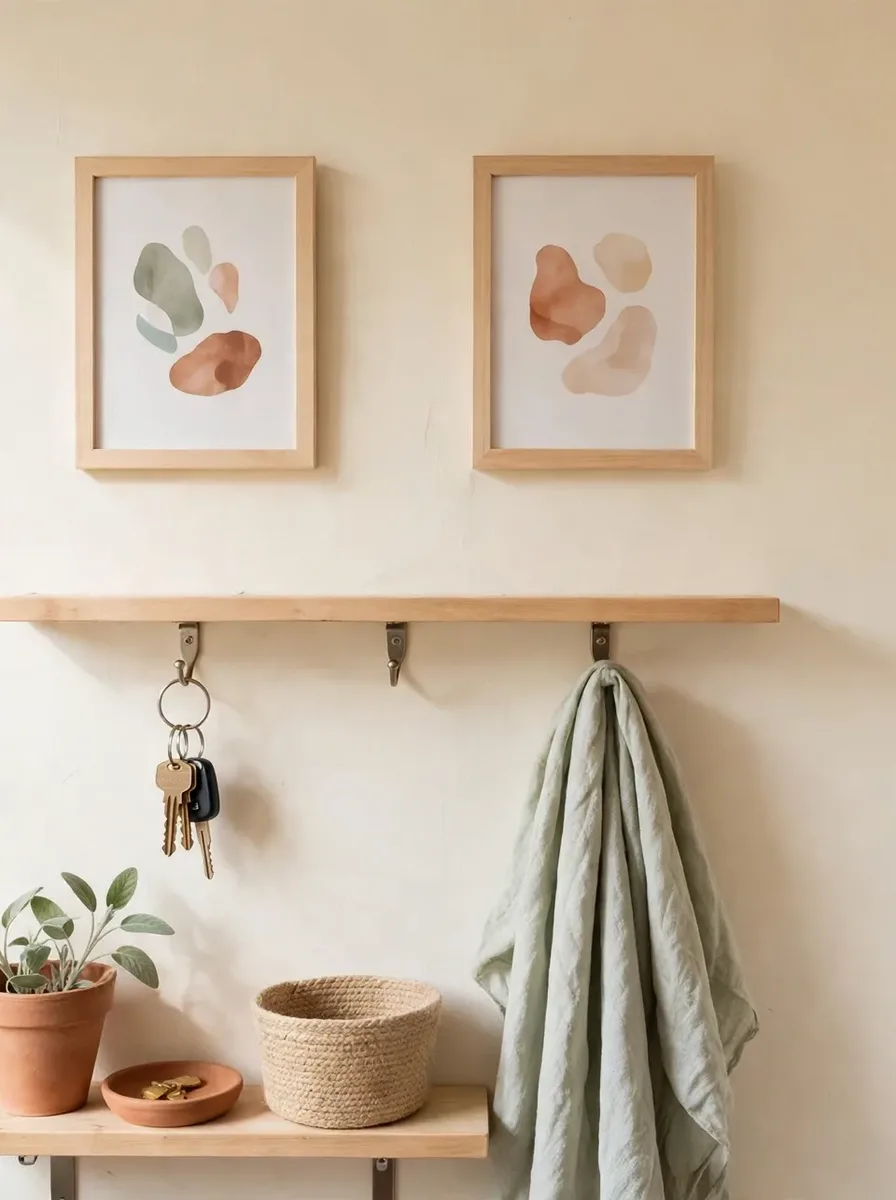
Keep the strip disciplined: two or three frames, 8 × 10 inches (20 × 25 cm) or 11 × 14 inches (28 × 36 cm), in matching frames, with 2–3 inches (5–8 cm) between them. The shelf below should be 24–36 inches (61–91 cm) long and no more than 4–5 inches (10–13 cm) deep. Lightweight frames are genuinely fine on large picture-hanging strips — a framed 11 × 14 print typically weighs 2–4 lb (0.9–1.8 kg) — but the shelf and anything on it should be treated like the mirror: light loads only, or rest the shelf on a console instead of the wall.
Frames run $8–$20 each; prints are often free if you use your own photos. The trade-off is visual noise — a gallery strip is the easiest piece to overdo. If the mirror is already on that wall, skip the strip: one focal wall per entryway is the ceiling.
Required space: The wall above a hook rail or console, with two or three frames and a narrow shelf below, and hooks or a small rail beneath the shelf.
Installation: Hang two or three frames in matching frames with 2–3 inches (5–8 cm) between them, put a narrow shelf below for mail, sunglasses, and a small plant, and add hooks or a small rail beneath the shelf for the daily carry; lightweight frames are fine on large picture-hanging strips, but the shelf and anything on it should be treated as light loads only, or the shelf should rest on a console instead of the wall.
Approximate dimensions: Frames are 8 × 10 inches (20 × 25 cm) or 11 × 14 inches (28 × 36 cm), the shelf below is 24–36 inches (61–91 cm) long and no more than 4–5 inches (10–13 cm) deep, and a framed 11 × 14 print typically weighs 2–4 lb (0.9–1.8 kg).
Rental-friendly limits: Lightweight frames are genuinely fine on large picture-hanging strips, but the shelf carries light loads only; if the mirror is already on that wall, skip the strip, since one focal wall per entryway is the ceiling.
Pros: The art does the decorating at eye level, the shelf holds mail, sunglasses, and a small plant, and the hooks take the daily carry, so from the doorway it reads as a composed wall, not storage with pictures over it.
Cons: A gallery strip is the easiest piece to overdo, and its trade-off is visual noise.
Suitable products: Matching frames, prints or your own photos, a narrow shelf, and hooks or a small rail.
The Runner: A Zone You Can See
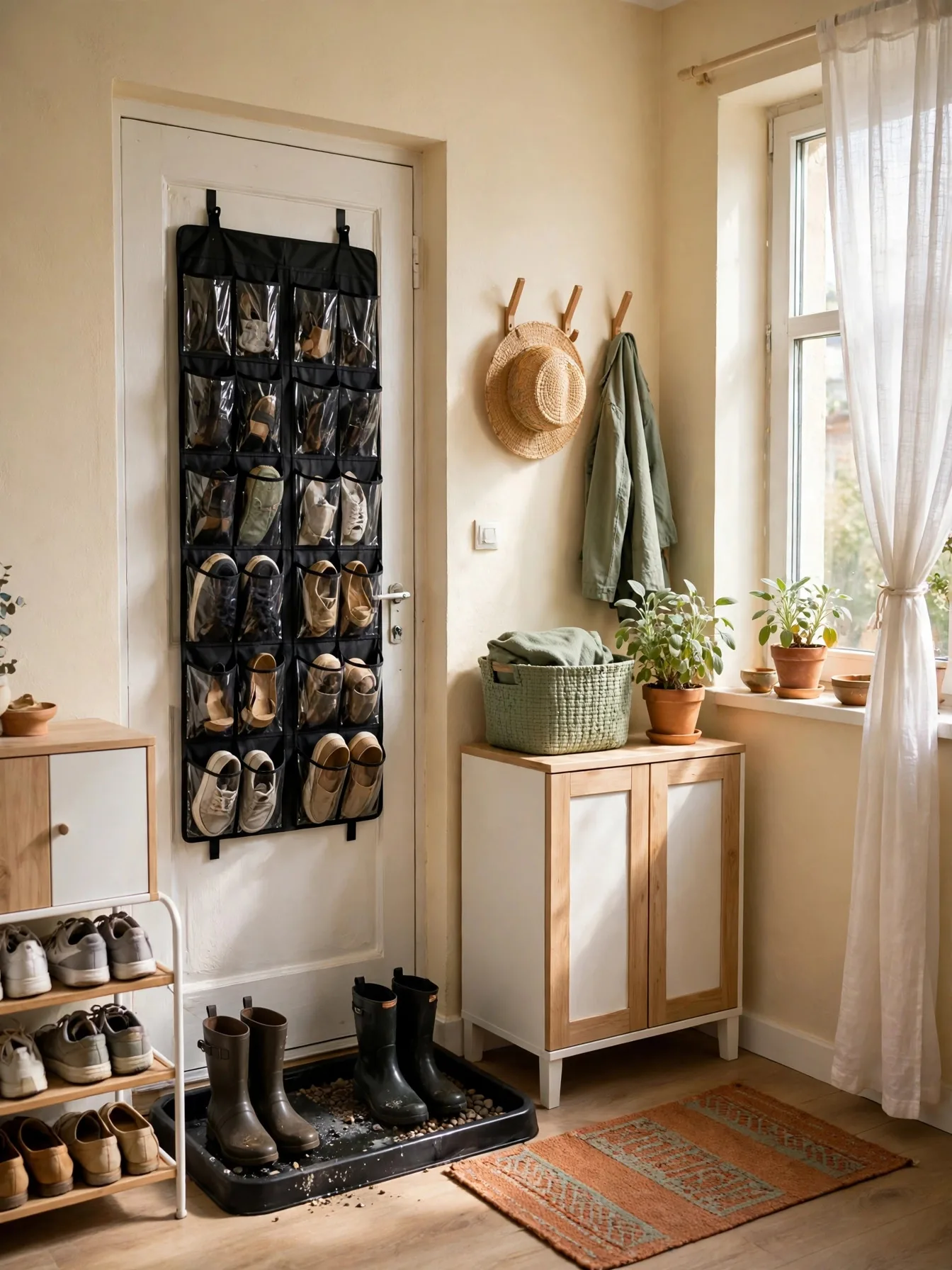
A runner rug is decor that does three storage-adjacent jobs: it defines the entryway as a separate zone (crucial when the door opens straight into the living room), it catches the grit and water that would otherwise track indoors, and it quietly tells everyone where shoes come off — which is what makes the shoe storage actually get used.
Standard runner sizes are 2 × 6 ft (61 × 183 cm) and 2.5 × 7 ft (76 × 213 cm); leave 3–6 inches (8–15 cm) of floor visible on each side so the rug reads as a placed piece, not a carpet remnant. The measurement that decides whether a rug works at all is door clearance: measure the gap under your closed door, and choose rug plus pad at least 1/4 inch (6 mm) thinner than that gap. Most apartment doors clear a low-pile runner under 0.4 inches (1 cm) total thickness; a thick pad under a medium-pile rug is the classic combination that ends with the door scraping every time it opens.
Choose washable, low-pile, and patterned enough to hide entryway dirt between washes. Expect $20–$45. The honest downside: a runner is the highest-traffic textile in the home and will look tired before anything else you buy — budget for it as a consumable, not a forever piece. If your door opens directly into the living room, the runner plus a console is the zone; our guide to creating a drop zone in a small rental with no entryway covers that layout in full.
Required space: The entryway floor, with 3–6 inches (8–15 cm) of floor visible on each side so the rug reads as a placed piece, not a carpet remnant.
Installation: Measure the gap under your closed door first, and choose a rug plus pad at least 1/4 inch (6 mm) thinner than that gap; most apartment doors clear a low-pile runner under 0.4 inches (1 cm) total thickness.
Approximate dimensions: Standard runner sizes are 2 × 6 ft (61 × 183 cm) and 2.5 × 7 ft (76 × 213 cm), with 3–6 inches (8–15 cm) of floor visible on each side.
Rental-friendly limits: The runner needs no fixing — it lies on the floor with a rug pad — but a thick pad under a medium-pile rug is the classic combination that ends with the door scraping every time it opens.
Pros: A runner defines the entryway as a separate zone, catches the grit and water that would otherwise track indoors, and quietly tells everyone where shoes come off, which is what makes the shoe storage actually get used.
Cons: A runner is the highest-traffic textile in the home and will look tired before anything else you buy, so budget for it as a consumable, not a forever piece.
Suitable products: A washable, low-pile, patterned runner and a rug pad.
Light and the Lidded Box: The Console Finish
Two small pieces finish a console so it looks styled instead of used as a shelf. The first is light: a small lamp, 12–15 inches (30–38 cm) tall, with a warm bulb. Entryways are often windowless, and a lamp at entry height turns a functional corner into a welcoming one — and gives practical light for finding keys in the evening. With no outlet nearby, a rechargeable LED lamp does the same job with no cord to hide.
The second is a lidded box, roughly 10 × 7 × 4 inches (25 × 18 × 10 cm), for the ugly essentials: spare keys, a tape measure, batteries, the building’s fob paperwork. A closed box on a styled console reads as a decor object; the same items loose read as clutter. This is the cheapest styling upgrade in the guide — boxes run $8–$15 — because visual calm is mostly about how many small objects the eye has to process.
Add a small tray beside the box for the true daily items — the keys and wallet that are in your hand when you walk in. Tray, box, lamp: that trio is the complete console formula, and it is also the whole surface. Anything beyond it is the start of the pile.
Required space: The console surface, finished with three pieces — a lamp, a lidded box, and a small tray — and nothing beyond that trio.
Installation: Place a small lamp on the console, put a lidded box beside it for the ugly essentials, and add a small tray beside the box for the true daily items, the keys and wallet that are in your hand when you walk in; with no outlet nearby, a rechargeable LED lamp does the same job with no cord to hide.
Approximate dimensions: A small lamp 12–15 inches (30–38 cm) tall, and a lidded box roughly 10 × 7 × 4 inches (25 × 18 × 10 cm).
Rental-friendly limits: The lamp, box, and tray simply sit on the console, so nothing is fixed or drilled, and a rechargeable LED lamp needs no outlet or cord.
Pros: A lamp at entry height turns a functional corner into a welcoming one and gives practical light for finding keys in the evening, while a closed box on a styled console reads as a decor object.
Cons: Without the box and tray, the same small items loose on the console read as clutter, and anything beyond the tray, box, and lamp trio is the start of the pile.
Suitable products: A small lamp with a warm bulb or a rechargeable LED lamp, a lidded box, and a small tray.
Every Piece at a Glance
| Piece | Storage job | Typical size | Typical price | Mounting |
|---|---|---|---|---|
| Mirror with shelf | Keys, sunglasses, wallet on the ledge | 20–24 in (51–61 cm) wide; shelf 4–5 in (10–13 cm) deep | $25–$60 | Adhesive strips if light; lean if heavy |
| Decorative hook row or rail | Coats, hats, bags, leash | 4–5 hooks, 6–8 in (15–20 cm) apart | $10–$35 | Adhesive pads or rail on strips |
| Bench with baskets | Shoes, gloves, scarves; seating | 32–40 × 12–14 in (81–102 × 30–36 cm) | $45–$90 | Freestanding |
| Lidded baskets and boxes | Hidden clutter, pet gear, paperwork | 10–15 in (25–38 cm) wide | $8–$25 each | Sit on surfaces |
| Gallery strip with shelf | Mail, small items; hooks below | Shelf 24–36 in (61–91 cm) long | $25–$55 total | Strips for frames; light shelf loads |
| Runner rug | Defines the zone; shoe-off cue | 2 × 6 ft (61 × 183 cm) | $20–$45 | Rug pad, no fixing |
| Lamp and tray | Daily items corralled; evening light | Lamp 12–15 in (30–38 cm) tall | $15–$30 | Sit on console |
Hanging Without Holes: What Adhesive Can and Cannot Honestly Do
Every wall-mounted piece in this guide hangs on adhesive, so the honest version of how adhesive works matters more than any single product pick. We check manufacturer ratings against real rental walls before recommending a load — the method is on our how we test page — and the gap between the two is consistent.
Package ratings for picture-hanging strips and adhesive hooks are measured by manufacturers on clean, smooth, fully cured painted surfaces, with the full cure time (usually 24 hours) observed before loading. Real rental walls are often textured, repainted many times, or freshly painted before you moved in. On paint less than about 30 days old, adhesive can bond to the paint film more strongly than the paint is bonded to the wall — removal then takes paint with it. On orange-peel or heavier textures, the pad contacts only the high points and holds a fraction of its rating.
Working rules that account for all of that: plan loads at about half the package rating on smooth, older paint; less on textured paint; nothing adhesive on wallpaper, brick, or fresh paint. Clean the spot with rubbing alcohol, press for the full time the package states, and wait the full cure time before hanging anything — loading a strip after an hour is the most common reason “adhesive doesn’t work.” And keep the standing rule from the mirror section: glass, and anything heavy enough to hurt if it falls, does not hang over a walkway on adhesive alone. Lean it, shelf it, or choose a lighter piece — a leaning mirror looks every bit as styled as a hung one.
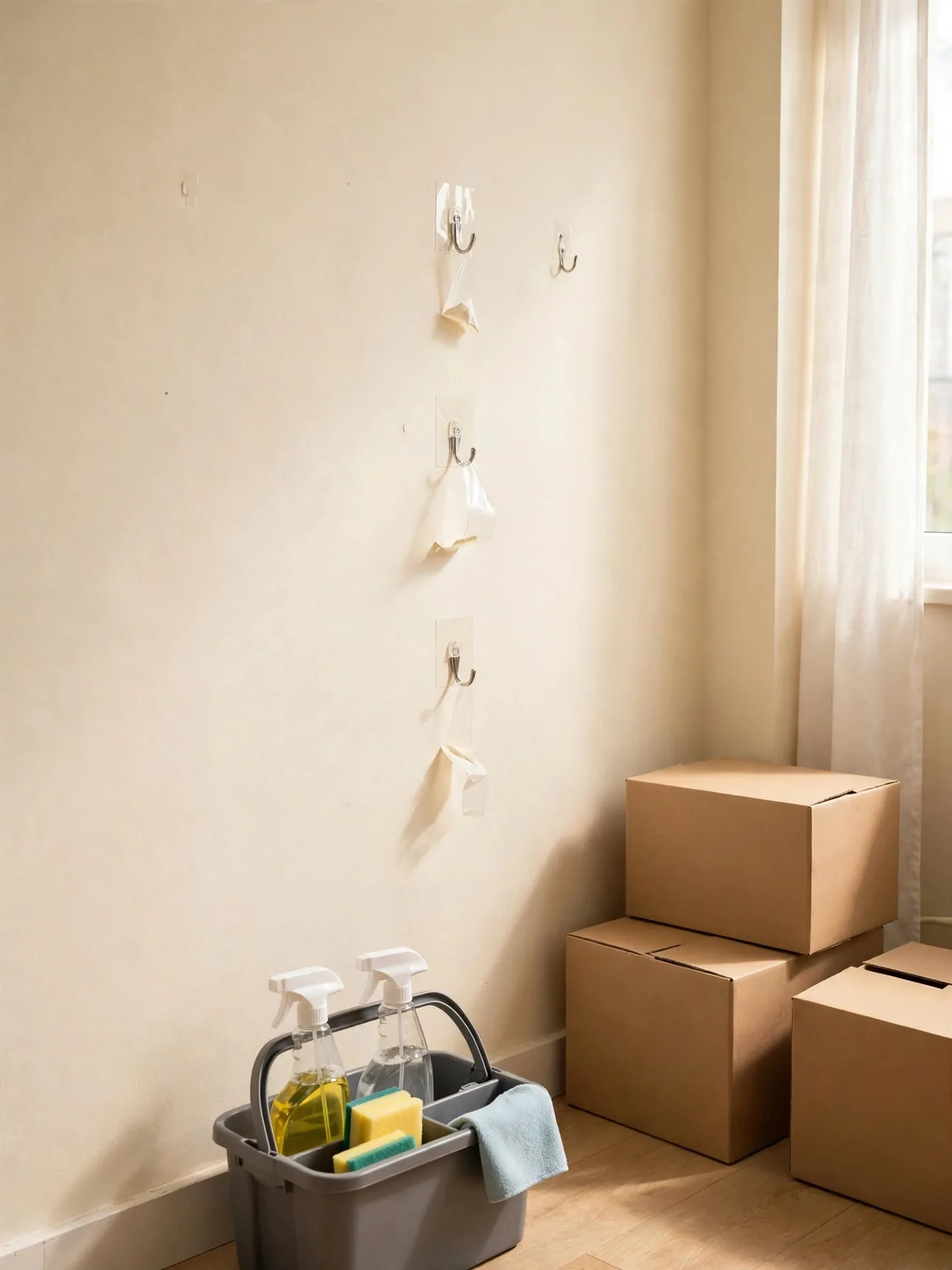
Removal, done right, is why this is all renter-safe: pull strips straight down, slowly, parallel to the wall — never out toward you — and the paint stays intact. Method-by-method limits live in the living room and entryway storage hub.
Styling Rules That Keep It Looking Like Decor
The difference between “entryway with storage” and “storage that happens to be in the entryway” is a handful of styling disciplines:
One palette, repeated. Pick two or three materials — say, light wood, black metal, and woven fibre — and make every piece one of them. A brass hook rail, a chrome mirror frame, and a white plastic basket each look fine alone; together they look accumulated. Repetition is what makes separate purchases read as a set.
Odd numbers, grouped tight. Style in threes: tray, box, lamp on the console; three frames in the gallery strip; three hooks in use with one good-looking item left hanging. Groups read as arrangements; even, spread-out rows read as inventory.
A third of every surface stays empty. This is the rule that does the most work and costs nothing. A console with a tray and a box on it looks styled; the same console covered edge to edge looks like a shelf in a stockroom. Empty space is a design material — in a six-square-foot entryway, the main one.
One focal point per wall. The mirror is the focal point of its wall; the gallery strip is the focal point of its wall. Two focal points on one small wall compete and both lose. If the mirror wall and the gallery wall are the same wall, choose one.
Mind the sightline from the door. Stand in the open doorway: the first thing you see is what the entryway “is.” Aim that sightline at the mirror or the art, with the shoe storage and coat mass at the edges of vision, low and to the sides. Storage you notice second is storage that looks like decor.
Closed beats open at eye level. Below waist height, open baskets and visible shoes are fine — the eye reads them as ground-level utility. At eye level, lids, doors, and frames. This single gradient, open at the bottom and closed at the top, is most of what separates a styled entry from a storage corner.
Three Budgets: $30, $80, and $150
About $30 — the hooks-and-corrals version. A set of matching decorative adhesive hooks ($12–$20), a tray for keys ($5–$8), and one lidded basket ($10). This handles the daily clutter and already looks intentional if the hooks match and the tray is the only thing on the surface.
About $80 — add the mirror and the zone. Everything above, plus a mirror with a shelf ($30–$40 bought carefully) and a washable runner ($20–$25). This is the version where guests start saying the entryway looks nice, because the mirror and rug do the visual work while the hooks do the storage work.
About $150 — the full setup. Everything above, plus a bench with two low baskets ($50–$60 on sale or second-hand) and a small lamp ($15). The entryway is now furnished, not equipped: seating, light, mirror, closed storage, and a defined zone, all removable in an afternoon at move-out.
Slip-Ups That Waste Space
Hanging the mirror on adhesive over the walkway. The most consequential mistake on this list. A falling picture frame is an annoyance; falling glass where people walk barefoot is an injury. Lean heavy mirrors, always.
Buying the bench before measuring the door swing. A bench that the door clips every time it opens will be hated daily and moved within a month. Tape the footprint, swing the door, then buy.
Too many small pieces. Six little decor objects store almost nothing and create visual noise that makes the entryway feel smaller. Two or three larger, closed, matching pieces beat a dozen small open ones on both storage and looks.
Hooks at the wrong height. Too high (above 72 in / 183 cm) and shorter household members drape coats over the bench instead; too low and coats drag on the shoe rack. Measure against the tallest coat and the shortest adult, not against the picture in the listing.
Open baskets at eye level. The contents become the decor. Lids at eye level, open weave below the waist — see the styling rules.
A rug the door cannot clear. Measure the gap, pad included, before ordering — a scraped runner bunches and gets forgotten.
Decorating before assigning the storage. The pieces in this guide work because each has a job. Buying the pretty version of a piece you do not need — a second mirror, a decorative bowl — spends the entryway’s scarcest resource: not money, but surface.
The Short Version
Small entryway decor with storage is a selection problem, not a shopping problem. Choose pieces that hold something, mount them honestly within what adhesive can actually do on a real rental wall, and style them with a tight palette and a third of every surface left empty. Do that, and six square feet at the front door stops being the apartment’s dumping ground and becomes the room that makes the rest of the home feel organised.